

Texas SEO Guide: How to Choose the Right SEO Services in 2026
For Texas business owners, finding the right SEO partner is one of the most important and most confusing decisions. There are literally hundreds of agencies operating across Dallas, Houston, Austin, San Antonio and other cities across Texas, and this can make the world of Texas SEO hard to navigate. This Texas SEO guide aims to give business owners the clarity and information they need to navigate the space with confidence.
Over 3.2 million small businesses in Texas compete in an intensely competitive economic landscape. Whether you operate a legal firm in Austin, a restaurant in San Antonio, or an online business shipping products across the country from Dallas, a strong online presence is essential for your business success. But research indicates that nearly 75% of users never click through to the second page of Google search results, making it a necessity rather than an option.
In this Texas SEO Guide, we’ll explain the various types of services available, how to approach an agency, what to expect to pay and what you should expect in terms of results. By the end of this guide, you’ll have a clear idea of what to look out for and what to avoid when choosing SEO services in Texas.
This Guide was written by Webxtalk, a global digital marketing agency that helped businesses across Texas and elsewhere to secure high search rankings, attract qualified leads, and establish a long-lasting and valuable digital presence.
What is SEO for Texas Businesses?
Search engine optimization (SEO) refers to the process of increasing organic search results visibility in search engines. For Texas businesses, this means showing up in search results when someone searches for what you offer – whether they are sitting at their desk in Sugar Land or looking for some recommendations on Siri while driving through Fort Worth.
The Texas Digital Landscape
The rich economic landscape of Texas makes the SEO market uniquely competitive. This is one of the five most competitive digital markets in the U.S., with some of the nation’s largest metro areas like Houston (the 4th largest city in the U.S.), Dallas-Fort Worth (one of the fastest-growing metro areas in the country), and Austin (a global tech hub), all in the Lone Star State, which means millions of local searches happens every day.
Here are some Texas facts for businesses:
- Texas has more than 30 million people with high smartphone adoption and mobile search usage far beyond the national average.
- Over 46% of Google searches contain local intent – meaning the searcher is searching for local services.
- Near me” searches have increased more than 500% in recent years and Texas metro areas are among the highest users of these searches in the country.
- Voice searches via devices such as Siri, Alexa, Google Assistant are becoming more widespread, especially when it comes to finding restaurants, maps, and other services.
AI Search Will Revolutionise in 2026
In addition to Traditional Google search, a new category of AI-driven search engines – such as Google’s AI Overviews, ChatGPT Search, and Perplexity – is changing the way Texas businesses are found. These tools synthesize information from various sources and sometimes provide answers without a user having to click through to a site. When Texas businesses hire an SEO agency in 2026, they should ask how the agency plans to optimize for AI-driven search results.
Types of SEO Services: What Texas Agencies offer
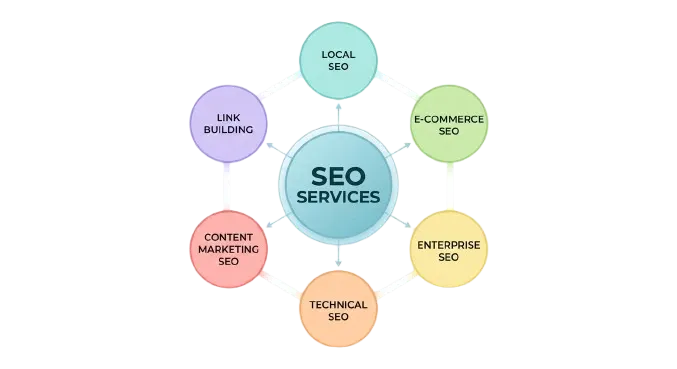
There are various types of SEO Services in Texas. Agencies in Texas specialise in a variety of services, and it’s important to know which category is relevant to your company before you start to compare agencies. Here’s a breakdown of the services you can expect.
Local SEO
Local SEO in texas focuses on improving visibility for local search terms, including map pack listings, “near me” search results, and prominent placements in Google Business Profiles. It’s the most prevalent type of SEO for businesses in Texas with a fixed location or service territory.
Who needs it: Restaurants, attorneys, medical professionals, plumbers, beauty parlors, contractors – anyone who can benefit from attracting customers in a specific town or region.
What you can expect: Higher rankings on Google Maps, more inquiries, and more walk-in customers in 3-6 months with consistent effort.
Cost: $500 – $2,500/month based on competition.
E-commerce SEO
E-commerce SEO is a subset of SEO for e-commerce sites, focusing on optimizing product listings, category organization, JSON-LD markup for product data, and generating “buyer intent” traffic.
Who needs it: Online Texas retailers, brands with their own dedicated websites, and traditional retailers moving into e-commerce.
What you can expect: Improved product rankings, more buyer-intent traffic, and increased online sales over time.
Cost: $1,500 – $5,000+/month, depending on products and platform.
Enterprise SEO
Enterprise SEO is designed to handle the complexities of leveraging large websites – usually involving companies with thousands of pages, various departments, and a complex organizational structure that requires collective SEO efforts.
Who needs it: Large Texas corporations, multi-location franchises, educational institutions, hospitals, and government agencies.
What you can expect: Better visibility across thousands of pages, streamlined SEO processes, and scalable long-term growth.
Cost: $5,000 – $25,000+/month (typically with project management and new reporting dashboards).
Technical SEO
Technical SEO optimises the technical aspects of a website – how it is crawled, indexed and processed by a search engine. The key elements are website speed, mobile-friendliness, Core Web Vitals, schema markup, and crawl efficiency.
Who needs it: Websites facing issues with speed, indexing, mobile usability, or overall technical performance.
What you can expect: Faster loading times, improved crawlability, better indexing, and enhanced overall site performance.
Cost: Typically a one-time audit ($500 – $3,000) and ongoing maintenance, or part of monthly retainers.
Content Marketing SEO
Content marketing SEO refers to the creation of educational, informational, or entertaining content (articles, guides, case studies, videos) for the purpose of drawing organic search visitors and establishing authority in your niche.
Who needs it: Businesses looking to build authority, educate their audience, and grow organic traffic consistently.
What you can expect: High-quality content that drives traffic, improves rankings, and builds trust in your niche.
Cost: $1,000 – $5,000+/month based on content quantity and quality.
Link Building
Link building is the process of acquiring hyperlinks from other sites to your site. These External links signal to Google that your website is authoritative and trustworthy. For Texas businesses, local citation building is an important type of link building.
Who needs it: Websites aiming to improve domain authority and compete in competitive search results.
What you can expect: Stronger backlink profile, increased credibility, and higher rankings on search engines.
Cost: $500 – $3,000+/month typically as part of complete retainers.
How to Choose the Right SEO Agency in Texas
The process of choosing the right SEO company in Texas needn’t be scary. There’s a process to making the right choice.
Step 1: Check Case Studies & Portfolio
Request case studies for Texas businesses (your industry). Look for documented before-and-after data: rankings, traffic, and revenue. Avoid ambiguous accounts and lack of transparency.
Step 2: Verify Certifications & Experience
Google Partner certification means an agency is up to Google’s standards for client success or a specific Google product. Better indicators include the agency’s experience, Texas market experience, and the current certifications of the staff from leading platforms such as Google, HubSpot or Semrush.
Step 3: Assess Transparency & Reporting
A reputable agency will provide you with access to your Google Analytics account, Google Search Console, and rank-checking software. These reports should detail keyword positions, organic traffic growth, conversions, and progress on your goals.
Step 4: Know Their Process
An ethical agency should outline a process that includes technical audit, strategy development, implementation, measurement, and iteration. Ask: ‘How do you create a keyword strategy? Who writes the content? How do you build links?’
5: Reviews & References
Read reviews on Google Business Profiles, Clutch.co, and Yelp of Texas-based agencies. Look for patterns in the reviews rather than one-off compliments and criticisms.
Step 6: Review Pricing Structures
Most Texas agencies have three pricing models: monthly retainers (most common), hourly consulting ($75 – $200 per hour), and project-based. Retainers provide the best long-term value for companies looking to invest in SEO.
Step 7: Get a Strategy Proposal
Ask for a proposal before signing an agreement that includes an initial audit, strategy and timeframe, expected deliverables, and KPIs. Red flags: immediate responses to first phone calls, or promises of when your site will rank.
Helpful Tip: To help you choose the right partner, you can also explore this list of top SEO firms in Texas for 2026 and compare them using the steps mentioned above.
SEO Pricing in Texas
SEO Pricing in Texas’s SEO market is varied. The table below represents standard pricing ranges based on published agency data and market research.
| Service Level | Monthly Cost | What’s Usually Included | Best For |
| Basic Local SEO | $500 – $1,200 | Google Business Profile, local citations, basic on-page | Small local Texas businesses |
| Standard SEO | $1,200 – $2,500 | Comprehensive on-page, content creation, link building, reporting | Growing Texas businesses |
| Advanced SEO | $2,500 – $5,000 | Full-service campaigns, competitive keywords, dedicated manager | Established Texas companies |
| Enterprise SEO | $5,000 – $15,000+ | Large-scale strategy, multiple locations, dedicated team | Large Texas organizations |
What Affects SEO Pricing in Texas?
- Market competition: Houston’s legal or medical sector market competition drives higher SEO costs than a smaller Texas niche market.
- Site complexity: Larger sites require more time for audits, technical fixes, and content strategy.
- Industry Competition Level: Industries with high lifetime value customers attract intense competition.
- Targeted geographic areas: Optimising for one metro is cheaper than optimising for multiple metros.
- Agency reputation and location: Specialists with experience and success over the years command higher fees.
- Timeframe: Accelerated success needs a more intense campaign with more content.
Is the Price Worth It?
Industry insights indicate that 53% of website traffic comes from organic searches. A Texas business generating $50,000/month in revenue with even a 10% improvement in organic traffic can see returns that far exceed a $2,000/month SEO investment. Unlike paid advertising, well-executed SEO builds compounding authority over time.
Local SEO vs. National SEO
Many business owners in Texas need to figure out whether they need local SEO, national SEO, or both. Choosing between local SEO vs. national SEO depends on your target audience, service area, and whether your business wants to dominate local Texas searches or compete across nationwide markets.
| Factor | Local SEO | National SEO |
| Target Audience | Customers in your city or metro area | Customers anywhere in the U.S. or beyond |
| Competition | Local Texas businesses in your niche | National and regional brands |
| Typical Cost | $500 – $2,500/month | $2,000 – $10,000+/month |
| Timeline | 3 – 6 months for meaningful results | 6 – 12+ months for significant traction |
| Best For | Restaurants, law firms, medical, local services | E-commerce, SaaS, multi-location brands |
The reality is that many businesses in Texas need both. Rather, a good company will tell you which method (or hybrid) is right in your company if it recommends a course of action.
Should You Hire a Local SEO Agency in Texas or a National SEO Firm?
Choosing between a local SEO agency in Texas and a national SEO firm depends on factors such as your business objectives, target audience, and competition. For businesses that depend on local customers like law firms, restaurants, contractors, medical clinics, or home services, it is typically best to hire a local SEO agency in Texas. Local agencies know Texas markets, regional search behavior, local link building and Google Business Profile optimization.
However, businesses targeting customers across multiple states or nationwide markets, such as SaaS companies, eCommerce brands, or multi-location businesses, may benefit more from working with a national SEO firm that can manage large-scale SEO campaigns and broader keyword strategies.
In many cases, Texas businesses need a hybrid SEO strategy that combines strong local visibility with broader national rankings.
SEO for Different Industries in Texas
While the basics of search engine optimization are universally applicable, every enterprise contains precise concerns that shape the approach, content material, and aggressive dynamics.
Restaurants & Food Services
For Texas restaurants, local SEO dominates. Google My Business Profile optimization, accurate NAP listings on Yelp, TripAdvisor, OpenTable, and powerful review management are key. Menu schema markup makes it easy for engines like Google to understand your menu.
Healthcare & Medical Practices
Factors in search engine optimization for healthcare SEO in Texas include regulatory compliance (HIPAA), rating verification (Healthgrades, Zocdoc, Google), and intensely local search behavior. E-A-T signals matter especially in medical SEO.
E-commerce & Retail
Texas e-commerce sites compete with nationwide and regional players. Successful E-commerce search engine optimization is primarily technical and includes accurate optimized product pages, category pages, website speed, and human-generated content.
Real Estate
Real Estate SEO in Texas is hyper-local and highly competitive. The most active real estate markets are Houston, Dallas, and Austin. MLS integration, neighborhood directories, and building neighborhood hyperlinks are key.
Legal Services
Legal Services SEO is the most competitive and costly vertical in Texas. Dallas and Houston’s private injury, private family law, and shady law firms are all vying for precious keywords.
Home Services (HVAC, Plumbing, Roofing)
Home services SEO in Texas is driven by emergency search intent and local trust signals. Home improvement companies in Texas should be aware of the service area pages, targeting different neighborhoods and suburbs.
Technology and SaaS Companies
Austin’s Silicon Hills is home to a thriving excessive-tech enterprise in Texas. Search engine optimization for SaaS and B2B technology companies differs: longer content material for mid-funnel search queries, thought leadership, and comparison pages.
Realistic SEO Timeline in Texas
A common misconception about search engine optimization (SEO) is that it’s a shortcut. Knowing what to expect allows Texas marketers to manipulate expectations.
| Phase | Timeframe | What Typically Happens |
| Foundation | Months 1 – 3 | Technical audit & fixes, keyword research, GBP optimization, initial content creation, citation building |
| Growth | Months 4 – 6 | Organic traffic begins rising, keyword rankings move into top 20, link acquisition gains momentum |
| Acceleration | Months 7 – 12 | Significant ranking improvements, measurable ROI visible, content strategy producing compounding results |
| Compounding | 12+ Months | Sustained growth, authority established, reduced cost-per-lead, strong competitive position in Texas |
Red Flags of SEO Services
Agency Red Flags
- Guaranteed #1 ranking – The agency is not a good enterprise, so they cannot guarantee that they will rank you #1.
- Knowing Google’s algorithms secrets – Nobody knows Google’s algorithms secrets – and even the people who can recognize Google’s algorithms are not legitimate.
- Black hat tactics offered – Paid links, hidden textual content, and keyword stuffing can also lead to a Google penalty.
- No Transparent Reporting – If an organization is unable to record on ranked keywords, site visitors, and activity, that could be a crimson flag.
- Unrealistic time limits – ‘Top rankings in 2 weeks’ or ‘Page 1 in 30 days’ are red flags.
- Strikingly low cost – A $99/month marketing package will no longer produce powerful, long-lasting effects.
- No written contract – A professional agency always works under a written agreement.
- Alienation or long-term contracts – Legitimate groups should no longer force you.
Common Business Mistakes to Avoid
- Expecting success in one day and stopping the real search engine optimization campaigns too early.
- Choose an agency based on the price alone.
- Do not inquire about the method, the occurrence of the content material, or the link-building strategy
- Ignore references and critiques, or only check reviews on the company’s own website.
- Skip the contract review – especially clauses around content ownership and termination terms.
AI Search Optimization – What Texas Companies Must Know in 2026
What Is AI Search?
Tools that employ large language models to generate information and create direct responses to user queries, rather than simply presenting a list of links, are known as AI search. In 2026, the large players will comprise Google’s AI Overview, ChatGPT Search, and Perplexity AI.
How AI Search Is Changing SEO
The old school SEO focuses on ranking #1 in the ten blue links. AI search introduces new dynamics: AI Overviews can tend to bury the content on websites that have a top-five ranking in regular search, which is great for traditional SEO. Nevertheless, these tools start mentioning particular, authoritative sources as well.
Because of these changes, many businesses are now investing in AI SEO services in Texas to improve their visibility not only in traditional search results but also across AI-powered search platforms.
In 2026, two new fields are becoming popular:
- AEO (Answer Engine Optimization): Making an answer to the question to be in a structured form that directly and concisely answers the resource that is likely to appear in the search results of AI search engines in the form of FAQs, structured information, clear authoritative text.
- GEO (Generative Engine Optimization): Maximize and format content in the way that AI generative engines will most often refer to and cite your brand as a credible source in the context of AI-generated answers.
What to inquire about Texas SEO agencies about AI Search.
Questions to be asked when short-listing agencies: How are you realigning around AI Overviews and AI search tools? In 2026, a quality agency would be in a position to have a clear understanding of this highly changing area.
AI SEO Experts in Texas — Why It Matters in 2026
Since the growth of AI-based search is still redefining the ways in which Texas customers and business rulers seek branded products and services, the demand for genuine AI SEO experts in Texas has surged. Not all agencies that claim to be the AI SEO experts are ready to provide results in this new environment. The following is the distinction between practical AI SEO skills and meaningless jargon.
What Makes a True AI SEO Expert?
A legitimate AI SEO expert in Texas goes beyond basic keyword optimization. They know the manner in which large language models judge the quality of content, the approach to organize information to be surfaced in artificial intelligence generated responses and how to build the topical authority that both traditional search engines and AI tools reward.
The most important capabilities to consider are:
- Proven Experience with Google AI Overviews understanding of how featured snippets feed into AI-generated responses.
- Hands-on experience in AEO (Answer Engine Optimization) structuring FAQs, schema markup, and short-form high-quality answers.
- Understanding of GEO (Generative Engine Optimization) creating content that AI engines such as ChatGPT Search and Perplexity refer to proactively.
- Ability to audit existing content for AI-readable and reorganize it in order to be as visible as possible on AI search results.
- Experience tracking AI-driven traffic separately from traditional organic traffic to measure real impact.
How to Measure SEO Success: KPIs Texas Businesses Should Track
Business owners often wonder, “How do I know if I’ve wasted money on SEO?” Here are the most important KPIs Texas businesses must analyze:
Organic Traffic Growth
Use Google Analytics to analyze traffic growth on a month-to-month basis. A healthy sign is an upward trend, even a marginal one. Be suspicious of sudden spikes and dips.
Local 3-Pack & Map Rankings
For Texas businesses, what is perhaps the most important KPI of all is where you rank in the 3-pack map results on Google. This is the most influential factor for determining the number of walk-in customers and phone call inquiries.
Keyword Rankings
What are the 10–20 target keywords you would like to rank for (e.g. SEO agency Houston, Dallas plumber near me)? Use Google Search Console to track your target keywords’ ranking.
Click-Through Rate
How often do your pages get clicked after appearing in the search results? A low CTR indicates that SEO efforts have a long way to go.
Conversion Rate
How many organic visits convert to inquiries? Count the number of calls and form submissions, and track the number of online bookings.
Bounce Rate
If page visitors quickly leave after they arrive, page experience may need to be improved.
Domain Authority
A healthy sign of long term successful SEO is an improved domain authority and an increased number of quality backlinks.
Quick takeaway: Track traffic and conversions, and most importantly, local visibility rather than only rankings.
SEO Myths Texas Business Owners Still Believe
Several Texas business owners still fall back on some older SEO knowledge. Some of them even look for directions from peers. This is a poor way to spend your resources and will have poor returns. Here are some common myths worth clearing up:
Myth 1: “SEO is a one-time thing”
Reality: SEO takes constant upkeep. This is due to the frequent updates of the Google algorithms and rival businesses and their SEO strategies.
Myth 2: “More keywords = better ranking”
Reality: This is a thought process from the days of old. Google will even penalize companies for stuffing keywords in their content. Modern SEO today balances the stuffing and use of keywords and the quality of content, among other aspects.
Myth 3: “Paid ads help SEO ranking”
Reality: Ads on Google and the rankings of SEO are separate systems. Organic rankings of an SEO strategy will not be funded through Pay Per Click ads.
Myth 4: “Having a Google Business Profile is enough for local SEO”
Reality: This is simply untrue. More is needed, including optimization of the actual website, as well as local citations, backlinks, and reviews. This is especially true for the more competitive areas in Texas, like the city of Houston or Dallas.
Myth 5: “SEO results are instant”
Reality: 3 to 6 months is the typical expected time frame for achieving tangible returns from an SEO initiative. Immediate #1 ranking offers are almost always a scam.
How Webxtalk Approaches AI SEO for Texas Businesses
Webxtalk is a global digital marketing agency with deep expertise in AI-driven search optimization. Webxtalk AI SEO strategy is based on three pillars in case of Texas businesses:
- Authority Building: It should be organized and informative content that AI search engines copy to rank and reference information, and the task to make Texas companies the unquestioned solution in their field.
- Technical AI-Ready Audits: Assessing the schema markup, structured data, page speed, and content structure of your website to determine if it is suitable to both the traditional search engines and the AI-powered search engines.
- Ongoing AI Landscape Monitoring: Due to the constant changes of Google AI Overviews, ChatGPT Search and Perplexity, it is essential to monitor these AI changes to keep your Texas business visible, as these technologies continue to change.

Webxtalk has assisted companies in Texas and worldwide navigate the shift from traditional SEO to AI-first search visibility, delivering measurable results at every stage of this transition.

Questions to Ask When Hiring an AI SEO Expert in Texas
- What are some of the optimized content that you have created that shows in Google AI Overviews or ChatGPT Search results?
- How do you quantify AI search success as compared to conventional organic ranking?
- How do you adapt your strategies when Google and its AI Overviews and other AI tools keep on changing?
- What do you consider to be the balance between traditional SEO and AI optimization- and where does it meet?
- Where do you keep up with the changes in the AI search behavior, and what is your rate of client strategy adaptation?
AI search is not about surpassing traditional SEO, it is as an overlay on top of it. A strong traditional SEO foundation, along with new AI optimization techniques, will ensure that Texas businesses have a massive competitive advantage over businesses that consider AI to be a question of the future, and not an opportunity of the present. The agencies that are the most suitable to assist are the agencies that, like Webxtalk, have developed specific AI SEO capabilities, and can prove actual results.
Making Your Final Decision – A Framework
Step 1: Clarify Your Objectives.
You should know the definition of success in your business before you contact any of the agencies. Are you trying to generate more phone calls? Increase foot traffic? Grow e-commerce revenue? Ranking on certain keywords within a city in Texas?
Step 2: Research & Shortlist
Create a list by using Google searches, industry directories such as Clutch.co, and referrals among business peers. Check the agency websites, case studies and online reviews of each agency. Winnow down to three to five agencies.
Step 3: Consultation & Evaluation
Schedule discovery calls with your shortlisted agencies. Prepare particular questions, Assess what they say but how they say it, a great agency will listen and then pitch.
Step 4: Check References
Contact all references at least two reference agencies. Request previous clients to rate the quality of communication, how the agency managed to cope during the downturn months and request them to suggest the agency to a colleague.
Step 5: Peruse the Contract
Determine the most important terms: the number of deliverables each month, the reporting frequency, the pricing scheme, who owns the contents and data, and the terms of the exit clause. You must have ownership of your site, content and all the analytics.
Step 6: Setup Success Metrics on the First day
Decide on some KPIs that can be measured in advance: target keywords, baseline organic traffic, lead volume, conversion rates. Arrange a check-in after 30 days, a 90-day follow-up evaluation, and a formal follow-up of six-month strategy.
Your Next Step — Meet Webxtalk

About Webxtalk
From small businesses to big brands, we’ve gained expertise in understanding what truly makes digital campaigns succeed. Our team knows that every business is unique, so we create strategies that align with your specific goals. We believe in honest work, giving our best effort, and building long-term relationships with our clients. With over 10+ years of experience, we take pride in the hard work, trust, and results we deliver every day.
Whether you’re a local Texas business trying to dominate your city’s search results, or a growing brand looking to scale nationally and globally, Webxtalk has the expertise, tools, and track record to get you there.
Webxtalk Complete Digital Marketing Services
Artificial Intelligence (AI) SEO
In 2026, AI-powered search is no longer the future,it’s right now. Webxtalk focuses on AI SEO strategies that maximize your content to get surfaced in AI-generated responses and to be cited by Google AI Overviews, ChatGPT Search, and Perplexity.
Why Texas Businesses Choose Webxtalk
Webxtalk is not a one-size-fits-all agency. All engagements begin with a deep understanding of your market, your competitors and your objectives as well as a custom strategy designed that is specifically for your business.
Here’s what sets Webxtalk apart:
- No cookie-cutter packages: Your Texas market is unique. Your strategy should be too.
- Full transparency: You own your data, your content, and your reports – always.
- AI-first thinking: Webxtalk is already optimizing for how search works in 2026 and beyond not how it worked 3 years ago.
- Global expertise, local understanding:. Webxtalk has clients all around the world but understands the specific competitive nature of particular markets in Texas, including the legal market of Houston, the tech market of Austin, and the enterprise market of Dallas.
- Results drive retention: Webxtalk does not tie clients into long contracts. The work speaks for itself.
Take the First Step — It’s Free
You have just read the most comprehensive Texas SEO buyer’s guide. Now you know exactly what good SEO looks like, what it costs, and what red flags to stay away from.
The next step is simple: find out exactly where your business stands right now.
Webxtalk is offering a free, no-obligation SEO proposal for Texas businesses. With this in mind, you get a clean snapshot of your modern search visibility, where your competitors are outperforming you, what unique opportunities exist in your commercial enterprise, and a customized roadmap that shows exactly how Webxtalk can approach your growth — with no pressure and no commitment required.
This is not a common template. It’s a real proposal, built around your business, your marketplace, and your dreams — delivered through real professionals, completely free.
Every day without a solid digital presence is a day your competition is capturing customers that should be yours. The companies that act now will own their marketplace in 2026 and beyond. The ones that wait will spend years trying to catch up.
Don’t let your competitors outrank you. Claim your “FREE SEO PROPOSAL” before they do.
Frequently Asked Questions About SEO in Texas
The majority of Texas companies start to observe a perceivable shift in keyword positions after three to six months. Considerable business influence is usual between month four and eight.
Investments in quality SEO by the majority of Texas small businesses vary between $1,000 and $3,000/month. Medium and large enterprises in competitive markets spend between 3,000 and 10,000 and above/month.
It is based on the location of your customers. A combined strategy (local authority and greater content reach) is advantageous to many Texas businesses.
SEO has simple components that can be handled by an enthusiastic business owner. Nonetheless, the competitive key ranking within the markets of Texas usually involves specific skills and application of efforts, as well as special equipment.
In the SEO vs PPC comparison, SEO means acquiring free rankings by content and authority — the rankings are earned with content and authority, require months to earn, and do not need continual per-clicks to maintain. PPC provides instant visibility with direct cost per click. The majority of successful businesses in Texas utilize both SEO and PPC together for the best results.
Monitor organic search traffic, rankings on keywords, leads or sales generated by organic searches and click through rates. It is a positive indication as directional advancement in various measures in three to six months.
Yes–and more so it were better. AI search engines such as the AI Overviews on Google are largely pulling back information found on already good ranking pages. The distinction is that the quality of content, its structure and fact authority are even more significant in 2026.
Quality monthly reports must comprise of: keyword ranking changes, trends, conversion data, links obtained, content published and a summary of technical work performed.
The minimum that exists are monthly check-ins. It is strongly suggested to conduct quarterly strategic reviews. In the initial three months, bi-weekly check-ins can be a good thing.
A report by HubSpot shows that organic search provides leads at an average cost per lead of 61, when compared to outbound marketing through traditional means. High-value verticals represent a business area that can provide a significant amount of returns to Texas businesses when they appear in high-intent keywords.
A written contract with deliverables, retaining ownership of all your content and data, no promised-particular rankings, reference check first, and make sure you can access your own Google Analytics and Google Search Console.




 Yes, I Want Growth