
AI SEO Services in Texas: ChatGPT, Perplexity & Generative Search Optimization 2026
The search landscape is changing faster than most Texas businesses realize — and the companies that recognize this shift early are already pulling ahead. For years, growing your online presence meant investing in reliable SEO services in Texas, including keyword research, on-page optimization, link building, and local listings. That foundation still matters deeply. But in 2026, it is no longer enough on its own. Businesses now need advanced AI SEO services in Texas to appear inside ChatGPT, Google AI Overviews, and Perplexity search results.
A new layer of search has arrived and is scaling rapidly. ChatGPT Search, Google’s AI Overviews, Perplexity AI, Microsoft Copilot, and a wave of generative AI platforms are fundamentally reshaping how Texas consumers find businesses, compare services, and make purchasing decisions. These systems don’t return a list of links — they generate direct answers, synthesize information from multiple sources, and often resolve a user’s question without a single click to any website.
At Webxtalk, we’ve been helping Texas businesses navigate exactly this transition — combining traditional SEO foundations with the emerging AI search strategies that determine who gets cited, recommended, and ultimately chosen by the next generation of Texas consumers.
This isn’t a prediction about the future. By early 2026, AI-powered search already captures approximately 25–30% of all informational queries. That share is growing every quarter. For a business owner in Houston, Dallas, Austin, San Antonio, or anywhere across Texas, that means roughly one in four people searching for your products or services right now may be getting their answer from an AI — and if your business isn’t the one being cited, you simply don’t exist in that interaction.
The stakes are high because Texas is one of the most competitive business environments in the country. With over 3.1 million small businesses in the state and major metros that attract both local and national competitors, the margin between visibility and invisibility in search has real dollar consequences. A law firm, medical practice, HVAC company, or e-commerce brand that fails to adapt to AI search will gradually lose market share to competitors that do — often without ever knowing why their traffic stalls.
This guide is your complete roadmap. We cover what AI search is, how each major platform works, and exactly what your Texas business needs to do right now to get cited, ranked, and recommended across the AI engines your future customers are using every day.
What is AI Search and Why AI SEO Services in Texas Matter
To understand the urgency, you need to understand what’s actually changed — because the shift from traditional search to AI search is more fundamental than it first appears.
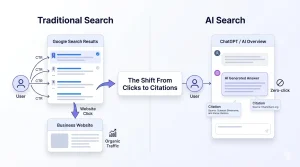
Traditional Search vs. AI Search
Traditional Search (Google, Bing):
- User types a query → receives a ranked list of ten links
- User clicks through to a website to find their answer
- Websites receive traffic and potential customers
- Every step assumes the user leaves the search engine
AI Search (ChatGPT, Perplexity, Google AI Overviews):
- User asks a conversational question → receives a synthesized AI-generated answer
- The answer draws from multiple sources, which may or may not be cited visibly
- The user gets what they need — often without clicking a single link
- Your website may never be visited, even if your content shaped the answer
That last point is what changes everything. The user may never leave the AI interface. If AI doesn’t cite your business, you had zero presence in that interaction — regardless of where you rank in traditional results. That’s why working with an AI SEO expert in Texas is becoming essential for brands that want visibility inside AI-generated answers, not just traditional search rankings.
The Zero-Click Reality for Texas Businesses
Zero-click searches have been growing since Google introduced featured snippets. AI search has accelerated this trend dramatically. When a Texan asks ChatGPT “What’s the best pest control company in Austin?” or asks Perplexity “How much does it cost to hire an employment lawyer in Houston?”, they receive direct answers. If your competitors are being cited and you are not, you are losing customers you never even knew you were competing for.
Major AI Search Platforms in 2026
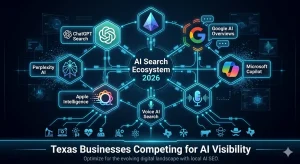
ChatGPT Search (OpenAI)
Launched in Q4 2024 and now handling an estimated 15–20% of informational search volume, ChatGPT Search has grown at a pace that has caught many Texas marketers off guard. With over 200 million weekly active users and particularly strong adoption among the 18–45 demographic — the core customer base for most Texas consumer businesses — this platform is now a non-optional search channel. In tech-forward Texas cities like Austin and Dallas, ChatGPT search adoption is even higher than national averages.
ChatGPT retrieves real-time web results, synthesizes them into a conversational answer, and includes source citations. Being a cited source here is the equivalent of a page-one ranking in a channel that’s growing faster than traditional search ever did.
Google AI Overviews (formerly SGE)
Google AI Overviews now appear in 60–70% of all Google search results pages. They sit at the very top of the page — above every traditional organic result — and provide a synthesized answer before the user sees any links. Research consistently shows this reduces click-through rates on organic results by 20–40%. Even if your Texas business ranks number one organically, you may be receiving substantially less traffic from that ranking than you did two years ago.
Perplexity AI
Perplexity has carved out a distinct position as the AI search engine for high-intent, research-driven queries. Purpose-built for research and consistently citation-forward, it is particularly valuable for Texas B2B companies and professional service providers. A commercial real estate developer in Dallas, a CFO in Fort Worth evaluating software vendors, or a healthcare administrator in Houston comparing providers — these are Perplexity users making high-value decisions. Being cited on Perplexity reaches exactly the decision-makers who generate premium business.
Microsoft Copilot (Bing + AI)
Integrated directly into Windows, Microsoft 365, and the Bing search engine, Copilot reaches enterprise users and a significant portion of the market still on Bing. For B2B Texas businesses and any company targeting corporate clients, Copilot is a meaningful channel that is frequently overlooked.
Apple Intelligence and iOS Search
With Apple integrating AI into Siri and iOS search across hundreds of millions of devices, local search on iPhone is increasingly AI-driven. “Find a plumber near me” or “best tacos in San Antonio” — queries that Texas consumers make constantly — are now partially resolved by large language models.
Emerging Players
Meta AI search features, specialized vertical AI tools, and new entrants continue adding to a fragmented but growing AI search ecosystem. Businesses that build genuine authority will benefit across all platforms, since the underlying quality signals — content depth, structured data, E-E-A-T — are consistent across systems.
AEO, GEO, and AIO: The Three New Disciplines of AI Search Optimization
Modern AI SEO services in Texas now combine AEO, GEO, and AIO into one unified optimization strategy. The SEO industry has developed these new disciplines to help businesses improve visibility across ChatGPT, Google AI Overviews, Perplexity, and other AI-driven search platforms. Understanding how these strategies work alongside traditional SEO is now essential for Texas businesses that want to maintain long-term online visibility.
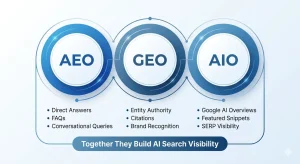
AEO — Answer Engine Optimization
Definition: AEO is the practice of optimizing your content specifically to be used by AI engines that answer questions directly. The goal isn’t to rank in a list — it’s to be the source the AI cites when it answers a question in your area of expertise.
Traditional SEO optimizes for keywords and click-through rates. AEO optimizes for direct answers and citations. Where traditional SEO values keyword density, AEO values clarity, authority, comprehensiveness, and conversational structure. The fundamental question shifts from “will Google rank this?” to “will ChatGPT cite this when someone asks about my topic?”
AEO is heavily dependent on E-E-A-T signals — Experience, Expertise, Authoritativeness, and Trust. AI engines use these signals to decide which content is reliable enough to include in answers that users will act on. A Texas business with strong E-E-A-T signals — verified credentials, established reviews, expert content, reputable media mentions — is far more likely to be cited than a competitor with weak signals, regardless of traditional keyword rankings.
Texas application: An Austin-based financial advisor practicing AEO shouldn’t simply target the keyword “financial advisor Austin.” They should be creating comprehensive content that fully answers questions like “How do I find a fiduciary financial advisor in Austin?” or “What’s the difference between a fee-only and commission-based financial advisor in Texas?” — the exact questions their prospective clients are typing into ChatGPT and Perplexity.
GEO — Generative Engine Optimization
Definition: GEO is the practice of optimizing your business to be recognized and cited as an authoritative entity by AI systems — not just for individual content pieces, but as an established, trustworthy source in your field.
AI systems understand the world through entities — recognizable, well-defined subjects with established attributes, relationships, and authority. A business that has been written about in Texas media, is referenced on authoritative directories and association websites, maintains consistent information across the web, and has a track record of quality content is recognized as a strong entity. Businesses that lack these signals are ambiguous — and ambiguous entities don’t get cited.
Core GEO strategies:
Citation-worthy content: Producing original research, local data, expert insights, and comprehensive guides that other websites and AI systems want to reference.
Entity establishment: Ensuring your business has a consistent, authoritative presence across Google Business Profile, industry directories, chambers of commerce listings, and other authoritative sources that help AI systems build a clear picture of who you are.
Backlink quality: A mention in the Houston Chronicle, Dallas Business Journal, or a respected industry publication signals to AI that you’re a recognized authority. Dozens of links from low-quality directories do not. Texas-specific authoritative sources — local news outlets, university websites, state association sites — carry particular weight for local AI queries.
Structured data: Schema markup communicates your entity attributes directly to AI in a machine-readable format. Without it, AI has to infer — and inference introduces errors.
Texas application: A Dallas commercial cleaning company practicing GEO is being featured in the Dallas Morning News’s small business section, earning a listing on the Dallas Regional Chamber website, publishing original research on commercial cleaning standards, and implementing a comprehensive LocalBusiness schema. When someone asks ChatGPT “What are the most trusted commercial cleaning companies in Dallas?”, that entity profile makes citation far more likely.
AIO — AI Overviews Optimization
Definition: AIO is the specific practice of optimizing content to appear in or prominently alongside Google’s AI Overview boxes.
AI Overviews are generated primarily from content that Google has already identified as high-quality and relevant. Featured snippets remain the single strongest predictor of AI Overview inclusion. Comprehensive FAQ sections, well-structured headers, concise direct answers, and strong topical authority all contribute significantly.
For Texas businesses, appearing in the AI Overview for a high-value query like “best business attorney in San Antonio” or “how to choose a roofing contractor in Dallas” provides brand exposure to every user who sees that search results page — whether they click or not.
Core AIO strategies: Featured snippet optimization; FAQPage schema implementation (Google’s AI Overview system parses this directly); comprehensive topical depth; and quality inbound links from Texas-relevant, high-authority sources.
How All Four Disciplines Work Together
| Discipline | Primary Channel | Core Goal | What Success Looks Like |
| Traditional SEO | Google/Bing organic results | Traffic through click-through | Page 1 rankings, organic visits |
| AEO | ChatGPT, Perplexity, Claude | Citations in AI-generated answers | Named as source in AI responses |
| GEO | All AI platforms | Entity recognition and authority | Consistent citations across AI platforms |
| AIO | Google AI Overviews | Visibility at top of Google | Appearance in Overview boxes |
Texas businesses that excel at all four maintain full-spectrum search visibility as the market continues to shift. Businesses optimizing only for traditional SEO are progressively ceding the growing AI search channel to forward-thinking competitors.
Behind the Scenes: How ChatGPT and AI Search Actually Find Texas Businesses
Understanding the mechanics of AI search helps you make smarter optimization decisions.
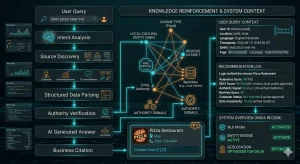
Step 1: Query Interpretation
AI search engines interpret user intent with far greater sophistication than traditional keyword matching. They understand context, nuance, conversational phrasing, and implicit intent. When a user types “Who handles hail damage roofing in the Dallas Metroplex and has good reviews?”, the AI simultaneously parses location (Dallas Metroplex), service type (hail damage roofing), and qualification criterion (reviews) in a single evaluation.
This means your content must match how real people phrase real questions — not how SEOs historically wrote for keyword algorithms.
Step 2: Source Selection
AI systems evaluate potential sources against a set of quality and relevance signals:
Training data quality: AI prioritizes sources that have historically been accurate, well-structured, and authoritative.
Real-time retrieval: For live queries, AI retrieves current web results and evaluates freshness, relevance, and authority simultaneously.
E-E-A-T signals: Named expert authors, verifiable credentials, established track records, and trust indicators all influence which sources are selected.
Structured data: Schema markup gives AI precise, machine-readable information about your business — what you do, where you are, who your experts are. Businesses with comprehensive schema are easier to understand and cite accurately.
Local signals: For Texas-specific queries, AI factors in geographic relevance, Google Business Profile completeness, local backlinks and citations, NAP consistency, and review volume from Texas-based reviewers.
Step 3: Answer Synthesis and Attribution
The AI generates a natural language response by synthesizing information from multiple selected sources. The quality of your content directly determines whether your information shapes the answer.
ChatGPT Search and Perplexity typically show visible source citations — being named is a brand awareness win regardless of whether the user clicks. Google AI Overviews are less consistent with visible attribution, but even when sources aren’t displayed, the content that shaped the answer contributes to that business’s authority profile in Google’s system — influencing future traditional rankings and AI Overview appearances.
What AI Looks for in Texas Businesses Specifically
Authority signals: Domain age and quality, inbound links from Texas-relevant authoritative sources, professional credentials and licenses, certifications, industry association memberships, and media features in Texas and national publications.
Content quality markers: Comprehensive topic coverage, accurate and verifiable information, content updated in 2025–2026, named authors with demonstrable credentials, proper attribution of statistics and claims, and specific expert perspective that goes beyond generic information.
Technical quality: JSON-LD structured data (correct and complete), fast page loading, mobile optimization, clean crawlable site architecture, and HTTPS security.
Local presence signals: Fully optimized Google Business Profile with complete service listings, Texas city and region mentions throughout content, local backlinks and structured citations, consistent NAP data across all platforms, and a strong review profile on Google and industry-specific sites.
How to Optimize for AI Search in Texas: The Complete 2026 Strategy
Strategy 1: Build Unassailable E-E-A-T Signals
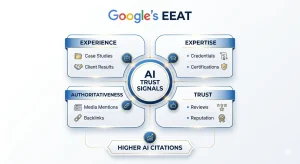
E-E-A-T — Experience, Expertise, Authoritativeness, and Trust — is the most critical framework for AI search optimization. Every major AI system uses some version of these signals to evaluate which sources to include in answers. Businesses with strong E-E-A-T signals get cited. Businesses with weak signals get passed over, regardless of how well-optimized their keywords are.
Experience signals: Demonstrate real-world experience through case studies, project portfolios, before-and-after examples, and detailed testimonials describing specific outcomes. An Austin home builder should have a portfolio of completed projects with location details, square footage, timelines, and client results — not just generic stock photography and vague claims.
Expertise signals: Every piece of content your business publishes should have a named author with a clear professional bio listing credentials, years of experience, certifications, education, and any publications or media appearances. An anonymous blog post carries almost no E-E-A-T weight. The same content attributed to “Dr. Maria Gonzalez, Board-Certified Dermatologist, practicing in Houston since 2009, member of the American Academy of Dermatology and Texas Dermatological Society” carries substantial weight.
Authoritativeness signals: Get written about. Texas media coverage — Houston Chronicle, Dallas Morning News, Austin American-Statesman, San Antonio Express-News, Texas Monthly, Fort Worth Star-Telegram, and local business publications — creates authoritative mentions that both AI systems and Google use to evaluate your standing. Industry publications and professional organizations add additional authority layers.
Trust signals: Reviews are trust signals that AI systems actively evaluate. A Texas business with 200 verified Google reviews averaging 4.7 stars is significantly more trusted by AI systems than a competitor with 12 reviews. Pursue reviews actively — email past customers, train staff to request them, and respond to every review (positive and negative) to demonstrate engagement and accountability.
Professional licenses, certifications, BBB accreditation, and verified credentials on your website — with links to verifying bodies — all contribute. For regulated industries in Texas (healthcare, law, finance, construction), displaying and linking to verified licenses is both legally important and algorithmically valuable.
Strategy 2: Create Genuinely Citation-Worthy Content
The bar for AI citation is meaningfully higher than the bar for traditional search ranking. AI systems don’t cite the page that best matches a keyword — they cite the page that best answers a question with accuracy, depth, and authority. Thin content and generic summaries will never earn AI citations, regardless of how technically optimized they are.
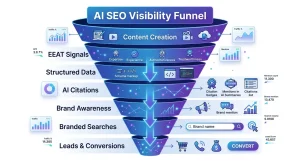
What makes content citation-worthy in 2026:
Original data and research: AI systems preferentially cite original sources over those that aggregate others’ data. If your Texas business can publish original research — a survey of Texas consumers in your industry, proprietary data from client work, analysis of local market trends — that content becomes citation-worthy in a way that republished statistics never are.
Comprehensive depth: Content that covers a topic completely — addressing main questions, edge cases, exceptions, local Texas context, and follow-up questions — is far more citation-worthy than content that answers only the narrow query. A comprehensive guide to commercial lease negotiation in Texas that covers market norms by city, common Texas-specific clauses, recent changes in Texas commercial real estate law, and practical negotiation strategies will earn citations where a 600-word overview will not.
Expert perspective: AI citations strongly favor content with a clear expert voice — specific, opinionated, detailed, and backed by demonstrable expertise. Generic content that could have been written by anyone about anywhere will not be prioritized over content that could only have been written by a Texas expert with years of relevant experience.
Accurate sourcing: Cite your sources throughout your content — studies, data, expert opinions. AI systems are more likely to cite sources that themselves demonstrate good citation practices, because it signals editorial rigor.
Regular updates: AI search systems prioritize recent and current information. Content with 2025–2026 publication or update dates is favored over older content, particularly for topics where information changes (regulations, pricing, market conditions, technology).
Content formats that consistently earn AI citations for Texas businesses:
Definitive local guides: “The Complete Guide to Local seo in Texas” or “Everything [City] Business Owners Need to Know About [Topic]” — comprehensive, authoritative, locally grounded.
Step-by-step how-to content: Specific, actionable, sequenced instructions. AI cites these because they are directly useful to users asking procedural questions.
Texas-specific cost guides: “How Much Does SEO Services Cost in Texas in 2026?” with real price ranges, factors that affect cost, and Texas-specific context (cost-of-living differences by city, regulatory factors, Texas climate considerations).
Comprehensive FAQ pages: FAQ sections that answer real questions thoroughly — 200–400 words per question with specific, actionable answers, not one-line responses.
Original research and local data: Survey results, proprietary statistics, market analyses, trend reports specific to your Texas market.
Comparison and alternatives content: “X vs. Y: Which is Right for Your Texas Business?” — decision-making content that users and AI both value highly.
Strategy 3: Implement Comprehensive Structured Data
Structured data is the most direct communication channel between your website and AI systems. Without it, AI must infer everything about your business from unstructured text — and inference introduces errors that mean missed citations and inaccurate representations.
Critical schema types for Texas businesses:
LocalBusiness Schema is the foundation. It should include your business name, address, phone number, website, hours of operation, service area (list specific Texas cities and regions — not just “Texas”), accepted payment methods, price range, and aggregate review rating.
FAQPage Schema feeds directly into Google AI Overviews and is parsed effectively by ChatGPT and Perplexity. Implement it on every FAQ section of your site. Texas businesses should create FAQ content that addresses the specific questions their Texas customers ask — including city-specific variations.
Article Schema should be implemented on every blog post, guide, and resource page. Include headline, author (with Person schema), datePublished, dateModified, publisher, and image. This is how AI systems understand authorship and publication recency.
Organization Schema establishes your business as a recognized entity, shows your logo, social profiles, founding date, and leadership structure — contributing to a comprehensive entity profile that AI can confidently reference.
Service Schema describes exactly what you offer: serviceName, description, areaServed, and provider. This helps AI accurately recommend you when users ask about specific services in specific Texas locations.
Person Schema for key team members — founders, lead professionals, named experts — reinforces E-E-A-T and helps AI recognize individual expertise alongside business authority.
Always validate all schema using Google’s Rich Results Test before deploying.
Strategy 4: Optimize Aggressively for Conversational Queries
AI search users ask complete, natural questions with context and nuance — not the short keyword strings that traditional SEO historically targeted.
| Traditional Query | AI Search Query |
| “seo agency dallas” | “What should I look for when hiring an SEO agency in Dallas for my small business?” |
| “electrician houston” | “How do I find a licensed electrician in Houston for a panel upgrade and what should it cost?” |
| “family lawyer austin” | “What’s the difference between a mediator and a divorce attorney in Austin, and which do I need?” |
| “ac repair san antonio” | “My AC is blowing warm air in San Antonio in July — should I repair or replace it?” |
Your content must answer the conversational version of these queries, not just target the keyword version.
Conversational headers: Use question-format H2 and H3 headings throughout your content. “How Do I Choose an HVAC Contractor in Texas?” works far better for AI than “Texas HVAC Contractors.”
Direct, upfront answers: State the answer clearly in the first 1–2 sentences after each question header. AI systems look for extractable answers — don’t bury yours in paragraphs of preamble.
Complete follow-up coverage: When answering “How much does a commercial roof replacement cost in Houston?”, also address: what factors affect cost, how to find reputable contractors, what questions to ask, what warranties to expect, and how Houston weather specifically affects roofing decisions and material choices.
Natural language throughout: Write the way a Texas expert speaks to a client — direct, specific, regionally aware, and clear. AI models were trained on human conversational text and cite sources that sound authoritative and natural.
Strategy 5: Build Genuine Topical Authority
AI systems don’t just evaluate individual pages — they evaluate the authority of your entire domain within a topic area. A website that comprehensively covers all aspects of a subject, with deeply interconnected content demonstrating real expertise, is treated as a topical authority. Topical authorities get cited across many queries, not just the specific ones their individual pages target.
The topic cluster model for Texas businesses:
Build a comprehensive pillar page covering your core service or topic area in depth — 3,000–5,000 words covering the full landscape of what your Texas audience needs to know. Then build 15–25 cluster articles, each going deep on a specific subtopic, all internally linked to the pillar and to each other.
Texas HVAC company topic cluster example:
Cluster articles:
- How to Size an HVAC System for a Texas Home
- AC Maintenance Schedule for Texas Climate: Month-by-Month Guide
- Common HVAC Problems in Texas Summers and How to Solve Them
- Heat Pump vs. Traditional AC in Texas: Which is Right for Your Home?
- How to Prepare Your HVAC for Texas Winter Freezes
- HVAC Energy Efficiency in Texas: Available Rebates and Tax Credits in 2026
- Average HVAC Replacement Costs in Houston vs. Dallas vs. Austin
- Questions to Ask Before Hiring an HVAC Contractor in Texas
- HVAC Permits and Regulations in Texas: What Homeowners Need to Know
- Emergency AC Repair in Texas: What to Do When Your System Fails in Summer
This cluster doesn’t just help with individual keywords — it establishes the website as the authoritative HVAC resource for Texas homeowners. AI systems recognize this pattern and cite it broadly across related queries.
Strategy 6: Invest in Video Content with Full Transcripts
AI systems are increasingly capable of processing video content, and YouTube carries meaningful signals for content authority. Produce substantive, information-rich videos on subjects your Texas audience actively searches. Upload to YouTube with complete, accurate transcripts. Embed the video on your website alongside the full transcript — giving AI systems both the video signal and the text content to parse and potentially cite.
Optimize video titles and descriptions using conversational question formats. Add VideoObject schema markup to embedded videos.
Texas-specific video content that performs well:
- “What to Expect When Filing a Personal Injury Claim in Texas” (law firm)
- “How to Protect Your Home During a Texas Freeze: HVAC and Plumbing Guide” (home services)
- “Texas LLC vs. S-Corp: Which is Right for Your Business?” (accounting/legal)
- “Austin Real Estate Market Update: Q1 2026 Analysis” (real estate)
- “Dallas Commercial Real Estate: What Tenants Need to Know About Texas Lease Law” (commercial real estate)
Strategy 7: Embrace Zero-Click Optimization as a Strategy
The instinct to resist zero-click search — seeing AI answers without clicks as pure loss — misses an important reality. Brand exposure in AI answers builds awareness and trust that drives downstream behavior. A user who sees your Texas firm cited three times across their research process is significantly more likely to choose you when they’re ready to act, even if they never clicked any of those citations directly.
Featured snippet dominance: Identify high-value queries where AI Overviews appear. Optimize specific pages to capture those positions with direct, well-structured answers using the “question-heading → direct answer → supporting detail” format.
Google Business Profile excellence: Keep your GBP fully updated with complete service listings, current photos, active posting, and responses to all reviews. GBP data feeds directly into local AI answers for “near me” and city-specific queries.
Knowledge panel development: A business with a Google Knowledge Panel is far more likely to appear in AI answers for branded queries. Strengthen yours by ensuring consistent entity information across your website, social profiles, Google Business Profile, and third-party directories.
Review ecosystem expansion: Beyond Google, build review presence on industry-specific platforms — Avvo for lawyers, Healthgrades for medical practices, Houzz for home services, Yelp for restaurants. AI systems aggregate these signals when evaluating trustworthiness.
Measuring zero-click impact: Track brand search volume in Google Search Console (rising branded searches indicate AI citations are driving awareness). Monitor the impression-to-click gap for your most important queries. Measure direct traffic trends. Track phone call volume and contact form submissions relative to organic traffic — if calls are rising while organic clicks are flat, AI citations are likely driving assisted conversions.
AI SEO Tools for Texas Businesses: What to Use in 2026
Content Optimization and Research
SurferSEO, Clearscope, or Frase analyze top-ranking pages and identify the topics, questions, and content structure needed to compete — essential for building citation-worthy comprehensive content. SEMrush and Ahrefs have integrated AI features for competitive analysis and conversational keyword discovery. MarketMuse provides topic modeling and content intelligence for planning cluster content systematically.
Schema and Structured Data
Schema.org is the authoritative reference for all schema types. Google’s Rich Results Test validates every schema implementation before publishing — errors in schema can cause indexing issues and must be caught before deployment. Merkle’s Schema Markup Generator simplifies JSON-LD creation for common schema types.
AI Search Monitoring
BrightEdge provides enterprise-level AI search visibility tracking. For most Texas businesses, manual monitoring — searching your top Texas queries in ChatGPT and Perplexity monthly, documenting citations and gaps — is free and often more immediately actionable. Google Alerts set up for your brand name and primary service keywords in Texas catch indexed citations automatically.
Technical SEO Foundation
Screaming Frog for complete technical audits. Google Search Console for index coverage, Core Web Vitals, featured snippet data, and the impression-to-click gap that signals AI Overview presence. PageSpeed Insights for performance — Texas business sites should target LCP under 2.5 seconds, CLS under 0.1, and INP under 200ms.
Local SEO Tools
Google Business Profile Manager is non-negotiable for every Texas local business. BrightLocal covers citation tracking, rank monitoring, and review management across multiple Texas city markets. Moz Local handles citation management and NAP consistency monitoring across every directory that AI systems reference.
Recommended minimum stack for Texas businesses: Google Search Console, Google Business Profile Manager, one content optimization tool (SurferSEO or Clearscope), schema validation via Google’s Rich Results Test, and monthly manual AI monitoring across ChatGPT and Perplexity.
How to Track Your AI SEO Performance in Texas
Measurement in the AI search era requires expanding beyond traditional metrics without abandoning them.
Traditional Metrics — Still Essential
Organic traffic, keyword rankings, conversion rates, and backlink acquisition all remain meaningful and should be tracked consistently. Flat or declining rankings despite consistent optimization effort may indicate AI Overview displacement that needs to be addressed directly.
AI-Era Metrics
Impression-to-click gap: For your most important Texas queries, track impressions vs. clicks over time in Google Search Console. A growing gap — rising impressions with flat or falling clicks — strongly indicates that Google AI Overviews are appearing for those queries. You’re getting brand exposure, but losing direct traffic.
Featured snippet capture rate: Track which of your pages hold featured snippets. Featured snippets are the single strongest predictor of AI Overview inclusion.
Brand search volume: Monitor how often your business name is searched on Google. Rising brand search volume — particularly from Texas users — indicates that AI citations and zero-click exposure are creating awareness that drives people to search for you directly. This is one of the most reliable downstream indicators of AI search success.
Direct traffic growth: Users who encountered your brand in an AI answer and remembered it appear in your analytics as direct traffic. Consistent growth in direct traffic alongside stable organic traffic often signals healthy AI search presence.
AI citation documentation: Keep a log of AI citations identified through manual monitoring. Track which queries you’re cited for, which platforms cite you, and how accurately your business is represented. This qualitative data directly informs content and schema strategy.
Assisted conversion tracking: In Google Analytics 4, examine the conversion paths of your customers. Users whose path includes a branded search — indicating they found you first through AI, then searched your name — are AI-assisted conversions.
What Healthy AI SEO Performance Looks Like
A Texas business with strong AI search optimization typically shows: stable or growing total organic traffic despite declining CTRs on specific queries; rising brand search volume quarter-over-quarter; featured snippet captures for 20–40% of targeted informational queries; documented AI citations across ChatGPT, Perplexity, and Google AI Overviews; and growing direct traffic that suggests brand recall driven by AI exposure.
5 AI SEO Mistakes Texas Businesses Make — and How to Avoid Them
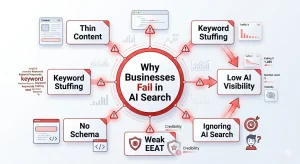
Mistake 1: Abandoning Traditional SEO for AI Optimization
Some Texas business owners hear about AI search and redirect all SEO investment toward AI-specific optimization. This is costly. Traditional Google rankings remain the dominant traffic channel for most businesses in 2026 — AI search is growing rapidly but hasn’t overtaken traditional search. The correct approach is integration: use AI optimization to amplify your traditional SEO, not replace it. The content quality, authority building, and structured data that helps AI cite you also helps Google rank you.
Mistake 2: Keyword Stuffing
Keyword density as a tactic is dead in AI search. AI engines are trained on natural language and specifically evaluate the quality of answers, not the frequency of target phrases. Content that reads like it was written for a keyword algorithm — repetitive, forced, stilted — performs poorly in AI citation regardless of keyword frequency. Write for expertise and clarity. The right keywords will be present naturally when you do.
Mistake 3: Publishing Thin, Generic Content
A 400-word blog post with generic information that could apply to any business in any state will never earn AI citations. AI systems cite sources that are comprehensive, specific, authoritative, and locally grounded. Every piece of content you publish should be something a Texas expert would be proud to put their name on.
Mistake 4: Neglecting Structured Data
A surprising number of established Texas business websites have zero structured data. No LocalBusiness schema, no FAQPage schema, no Article schema. Without this, AI systems must infer everything about your business from unstructured text — and inference errors mean missed citations and inaccurate representations. Structured data is table stakes in 2026. Fix this before any other AI optimization work.
Mistake 5: Treating E-E-A-T as a Content Checklist
Many Texas businesses approach E-E-A-T as a content task — add author bios, link to credentials, done. But E-E-A-T is a signal that AI systems evaluate across your entire web presence. Your Google reviews, media mentions, association memberships, LinkedIn presence, industry publications, speaking engagements, awards, and citations across the web all contribute. Building E-E-A-T requires business development and community involvement, not just content editing. Texas businesses that join the Texas Association of Business, earn features in local press, obtain meaningful industry certifications, and build genuine community relationships will consistently outperform those trying to shortcut the process.
What’s Next: AI Search in Texas Through 2026 and Beyond
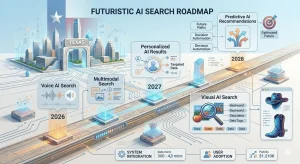
Voice AI and Conversational Search
Voice search through Siri, Alexa, and Google Assistant is now largely powered by the same large language models driving text-based AI search. For Texas businesses, voice search skews heavily local — “find a trusted plumber near me,” “best BBQ in Austin,” “emergency AC repair San Antonio.” As voice AI becomes more sophisticated, the optimization principles mirror text-based AEO but with an even greater premium on conversational language, direct answers, and strong local signals.
Multimodal AI Search
AI systems that understand images, video, and audio are advancing rapidly. Visual search — pointing a phone camera at a product, building, or storefront and asking AI to identify or research it — is a real and growing behavior. Texas businesses with physical locations, distinctive visual branding, or products that benefit from visual representation should be investing in image SEO, video content, and alt text optimization now, ahead of multimodal AI making these signals more valuable over the next 12–18 months.
Hyper-Personalized AI Results
AI systems are increasingly learning user preferences and personalizing results accordingly. A user who consistently asks about sustainable businesses will see AI answers weighted toward sustainability-focused citations. A user in Austin who regularly searches for local services will get answers tuned to Austin context. This personalization creates opportunities for Texas businesses that establish consistent, authoritative presence across multiple touchpoints — the more times a Texas user encounters your business (AI answers, Google results, reviews, social media), the more likely AI personalization will favor your business in their specific search experience.
The Competitive Window Is Open Now
Here is the strategic reality for Texas businesses in 2026: the majority of your competitors have not yet made meaningful investment in AI search optimization. The businesses that move decisively now — building topical authority, implementing comprehensive structured data, creating citation-worthy content, establishing strong E-E-A-T signals — will create an authority advantage that becomes progressively harder for late movers to overcome. In traditional SEO, domain authority compounds over time. AI search authority works similarly. The time to build that advantage is before your competitors do.
Why Businesses Need AI SEO Services in Texas in 2026
AI search is not a future development your Texas business can prepare for later. It is the current reality for a meaningful and growing percentage of Texas consumers who are finding businesses, making decisions, and developing purchasing intent right now. The 25–30% of informational queries already handled by AI search represent real customers — customers who may or may not be finding you, depending on whether you’ve optimized for this channel.
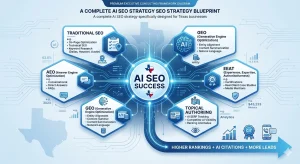
The businesses succeeding in Texas AI search in 2026 share several characteristics: they’ve invested in genuine E-E-A-T development, they produce comprehensive and authoritative content, they’ve implemented complete structured data, they’ve built strong local authority signals, and they measure performance across both traditional and AI-era metrics.
Your action plan starts today:
- Audit your E-E-A-T signals — document author profiles, credentials, review volume, media mentions, and association memberships. Identify the gaps and build a 90-day plan to close them.
- Implement comprehensive structured data — start with LocalBusiness and FAQPage schema across every relevant page on your site. Validate with Google’s Rich Results Test before deploying.
- Audit your existing content for depth and authority — identify your top 10 pages and evaluate honestly whether they are citation-worthy. Upgrade the ones that aren’t.
- Map and begin building a topic cluster — identify your pillar topic and plan 15–20 cluster articles. Start publishing with a consistent schedule.
- Start monitoring AI search appearances — manually search your top 5 Texas queries in ChatGPT and Perplexity monthly. Document what you find and use it to refine your strategy every quarter.
For SEO services in Texas that integrate AI optimization, traditional search, and local authority building into a single cohesive strategy, the time to start is now — not when your competitors have already built the advantage. The team at Webxtalk specializes in exactly this kind of full-spectrum AI SEO for Texas businesses of every size and industry.
FAQs: AI SEO Services in Texas (2026)
Q1. What is AI SEO?
AI SEO is the process of optimizing your website so that AI platforms like ChatGPT, Google AI Overviews, and Perplexity cite your business in their answers. Unlike traditional SEO — which focuses on Google rankings and clicks — AI SEO focuses on getting your business recommended directly inside AI-generated responses.
Q2. What is the difference between SEO and AI SEO?
Traditional SEO gets your website ranked in Google’s list of links. AI SEO gets your business cited inside the AI-generated answer that appears before those links. In 2026, you need both — traditional SEO drives click traffic, while AI SEO drives brand citations and zero-click visibility.
Q3. Does AI SEO work for small businesses in Texas?
Yes. Small Texas businesses can compete effectively with AI SEO by building hyper-local content authority, collecting strong Google reviews, and implementing structured data (schema). AI platforms prioritize relevance and trust over company size, which levels the playing field for local businesses.
Q4. How does ChatGPT decide which businesses to recommend?
ChatGPT recommends businesses that have authoritative content, strong E-E-A-T signals (expertise, reviews, credentials), consistent business information across the web, and properly implemented structured data. Businesses with more reviews, expert authors, and citation-worthy content are more likely to be named.
Q5. What is Google AI Overviews and how do I appear in it?
Google AI Overviews are AI-generated answer boxes that appear at the top of Google search results — above all organic links. To appear in them, you need FAQ schema markup, featured-snippet-optimized content with direct question-and-answer structure, and strong topical authority in your niche.
Q6. What is GEO (Generative Engine Optimization)?
GEO stands for Generative Engine Optimization. It is the practice of optimizing your content and online presence so that AI search engines like ChatGPT, Perplexity, and Google AI Overviews cite your business as an authoritative source when generating answers. GEO focuses on entity authority, structured data, and citation-worthy content.
Q7. What is AEO (Answer Engine Optimization)?
AEO stands for Answer Engine Optimization. It involves structuring your content to directly answer the questions your audience asks AI assistants. This includes using FAQ sections, question-format headings, and concise direct answers that AI systems can easily extract and cite.
Q8. How long does AI SEO take to show results?
Basic structured data and schema improvements can show results in 2–4 weeks. Content improvements and AI citations typically develop within 1–3 months. Full topical authority and consistent AI citations across multiple platforms usually take 6–12 months of sustained effort.
Q9. Is traditional SEO still important in 2026?
Yes. Traditional Google rankings remain the primary source of search traffic for most businesses in 2026. AI SEO builds on top of your traditional SEO — it does not replace it. The content quality, authority, and structured data that earns AI citations also improves your Google rankings.
Q10. How much does AI SEO cost in Texas?
AI SEO pricing in Texas varies based on competition level and scope. Most agencies charge between $1,000–$5,000 per month for a full AI SEO strategy covering content, structured data, local authority, and performance tracking. Webxtalk offers flexible packages for Texas businesses of all sizes — contact us for a free audit and custom quote.
Q11. What is the best AI SEO agency in Texas?
The best AI SEO agency in Texas is one that covers both traditional SEO and AI search optimization — including GEO, AEO, structured data implementation, and E-E-A-T development. Webxtalk specializes in full-spectrum AI SEO services for Texas businesses, helping them get cited across ChatGPT, Perplexity, and Google AI Overviews.
Q12. What structured data does my Texas business need for AI SEO?
The most important schema types for Texas businesses are: LocalBusiness (your address, hours, service area), FAQPage (on every FAQ section), Article (on every blog post with author name and date), and Organization (to establish your business as a recognized entity). All should be validated with Google’s Rich Results Test.
Q13. Do “near me” searches still work with AI search?
Yes. “Near me” and city-specific queries are increasingly answered by AI assistants. When someone asks ChatGPT “best plumber near me in Houston,” AI cites businesses with strong local signals — complete Google Business Profile, local backlinks, consistent NAP data, and location-specific content on their website.
Q14. How do I know if my business is being cited in AI search results?
Search your top keywords directly in ChatGPT (chat.openai.com) and Perplexity (perplexity.ai) once a month. For Google, check if AI Overviews appear for your key search terms. In Google Search Console, a growing gap between impressions and clicks often signals that AI Overviews are showing your content without generating clicks.



 Yes, I Want Growth