
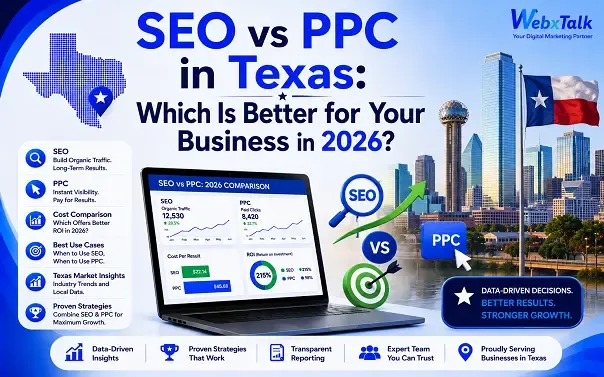
SEO vs PPC in Texas: Which Is Better for Your Business in 2026?
Every day, your competitor gets to be on Google’s first page – and you don’t even know if they are doing Google Ads, ranking organically, or doing a combination of both. Your phone is not ringing the way it should be. If you are a Texas business owner who is at a loss about where to spend the marketing budget, this guide is meant for you. Just a clear and honest breakdown of SEO vs PPC in Texas: the real costs of each, who should use what, and when the combination of both gives you the biggest competitive advantage.
What Is SEO and How Does It Work for Texas Businesses?
Most business owners have a vague idea of what SEO is, and very few know how it really works in a highly competitive market like Texas. Understand the true value of what you are investing before spending a single dollar.
What Is SEO?
SEO is the abbreviation for Search Engine Optimization. It involves the steps for securing a place in Google’s unpaid, organic search results. A Houston homeowner who types “best roofing company near me” and your website pops up naturally without you having to pay for that click, this is SEO at work. You are not buying that visibility. Rather, you are earning it through the quality of your website, the relevance of your content, your local presence, and the authority that other reliable websites give you by linking to yours.
How SEO Works for Texas Businesses
For a Texas business specifically, SEO is not simply about placing keywords on a webpage. It means optimizing your Google Business Profile, so you appear in the local map pack when someone searches for your service in Fort Worth, San Antonio, or Plano. It means building location-specific pages for every city you serve. It means earning mentions and links from Texas-based directories, local news publications, and industry sites. Texas has over 2.8 million small businesses competing for online visibility — and local SEO is what separates the businesses that consistently show up from the ones that stay invisible.
Key Benefits of SEO for Texas Businesses
The most powerful advantage of SEO is permanence. The rankings you build continue driving traffic even when you are not actively spending on them. A well-optimized page can bring in visitors for years. SEO also earns measurably higher trust — 81% of legal firms report more qualified leads from organic traffic than from paid search. Organic search carries a 14.6% conversion rate compared to PPC’s 10%, and in trust-driven Texas industries like healthcare, law, and finance, that gap widens even further.
What Is PPC and How Does It Work for Texas Businesses?
PPC is the other side of Google’s first page — the paid side. Understanding how it actually works helps you decide when it makes sense to use it and when it burns money unnecessarily.
What Is PPC Advertising?
PPC stands for Pay-Per-Click advertising. You pay Google every time someone clicks your ad. Your business appears at the very top of search results — above all organic results — almost instantly after a campaign launches. The most common form is Google Ads, where you bid on specific keywords, and Google places your ad based on your bid, your ad quality, and its relevance to the search query.
How PPC Advertising Works in Texas
Simply put, not all visitors produce the same number of conversions. Those coming from organic results generally show a higher level of trust and have a greater intent. Organic search results have a 14.6% conversion rate while PPC conversions stand at 10%. In some sectors, the variation is huge. SEO converts 7.3x more than PPC in financial services, 3.4x more in legal services, and 3.5x more in real estate. The reason is quite obvious: if somebody discovers your company via an organic result, they automatically see your company as a well-established authority, but not just an advertiser who has paid to get to the top.
Scalability and Growth Potential
PPC scales fast in the short term — increase your budget, and your ad reach expands proportionally. But click costs rise with competition, meaning your cost-per-lead increases unless campaigns are constantly refined. SEO scales differently — and far more powerfully over time. A single well-ranking page can generate thousands of monthly visitors for years with minimal additional spend. 85% of digital entrepreneurs report that once SEO matures, it consistently outperforms PPC revenue by at least 28%.
Long-Term vs Short-Term ROI: The Real Numbers
The data is stark. SEO’s median ROI is approximately 748%, meaning roughly $7.48 returned for every $1 invested over the long term. PPC averages 200% ROI. The crucial distinction: PPC ROI is linear — spend this month, get results this month, repeat indefinitely. SEO ROI is cumulative — the same investment keeps compounding in value month after month. 40% of local SEO campaigns achieve 500% or higher ROI, and that number grows the longer the campaign runs.
SEO vs PPC for Texas Businesses: What the Market Data Shows
Discussing SEO against PPC in Texas without considering the Texas market itself will lead to very generic responses. Texas is not a single market – it’s a combination of diverse, rapidly expanding, highly competitive ecosystems.
Texas Market Competition and Search Trends
There are 2.8 million small businesses in Texas. Each major city in Texas offers a unique competitive digital landscape: Austin with its rapidly growing tech industry, Houston with its energy and healthcare sectors, Dallas with its concentration of Fortune 500 companies, and San Antonio with its expanding service economy. Fierce competition means that being noticed online is really tough unless you have a planned and well-funded strategy. SEO and PPC in Texas require more funding than smaller areas, but the business that invests strategically will have stronger returns.
Local SEO Opportunities in Texas
Due to Texas’s large size, local SEO in Texas makes a great strategy for many companies that simply do not think about it. When a person in El Paso does a search, he/she has a totally different local intent than a person in Beaumont, and Google treats them differently. The number of “near me” searches has increased 136% since 2018, with 1.5 billion monthly searches worldwide, and 76% of people who do a local search on their phone end up visiting a nearby business within 24 hours. For Texas businesses, creating city-specific landing pages, optimizing a Google Business Profile fully, and having consistent local citations are not extra options – they are the main elements of capturing local search demand in cities like Houston, Dallas, Austin, and San Antonio.
PPC Advertising Costs in Texas by Industry
Texas PPC costs are mostly influenced by the industry rather than by geography. Still, the highly competitive metro areas like Austin and Dallas exhibit higher CPCs against rural Texas markets. What Texas companies are paying per click in the period 2025-2026 is as follows:
- Legal services — $8 to $137+ per click, depending on practice area and city
- Home services (HVAC, plumbing, roofing) — approximately $5.10 per click
- Healthcare and professional services — around $5 per click
- E-commerce and retail — $3 to $4 per click
- Restaurants and local services — $1.50 to $2 per click
These numbers matter because a home services company spending $5 per click converting at 5% is paying $100 per lead — and that math has to work against the average value of each job they close.
Industry-Specific Considerations for Texas Businesses
Some industries can hardly benefit from each channel here in Texas at the same level. Here is an honest industry-wise assessment of what works and what does not:
Home Services
Houston-based emergency service contractors, such as HVAC, plumbing, electrician, and roofing companies, are among the heaviest Google advertisers – and rightly so. Emergency searches have extremely high intent: a person who types “AC repair Houston” at 2 pm in July is in immediate need of help. PPC is the perfect embodiment of capturing that urgency. Yet, local SEO is equally powerful for home services in Texas to generate steady leads throughout the year at a much lower cost per lead over a period of time. The sharpest Texas home service companies combine running PPC during peak demand seasons with investing in SEO to gain sustainable long-term growth.
Law Firms
The legal is the priciest PPC market of all. Personal injury keywords in the biggest Texas cities can easily go beyond $100 per click, which means that even a modest Google Ads budget disappears before you know it. Yet 81% of legal firms say that they have more qualified leads from organic traffic than paid search, and organic rankings, in a way, communicate authority that Google Ads simply cannot. Texas law firms need to see PPC as a temporary solution by which SEO can establish organic authority that eventually produces lower-cost, higher-quality leads.
Healthcare Businesses
Both channels are beneficial for healthcare providers in Texas; Though, in this industry, the trust factor that comes with the organic search element is the main thing. When patients are looking for doctors and specialists, they not only read the reviews and check out the websites in detail, but they base their decisions on credibility rather than mere placement in an ad. SEO generates healthcare leads that are converted at quite a high rate, while PPC, again, is more suitable for running specific service promotions or launching a new clinic in the competitive markets of Dallas or Houston.
E-Commerce Brands
Texas-based e-commerce brands often find PPC advertising in Texas the fastest path to initial revenue — Google Shopping ads and search campaigns can generate sales within days of launch. However, SEO product optimization and content strategies build a growing base of free organic traffic that dramatically reduces cost-per-acquisition over time. 60% of e-commerce business owners prefer reinvesting strong PPC returns back into evergreen SEO once their business reaches consistent revenue.
Small Local Businesses
For a small Texas business — a barbershop in Lubbock, a cleaning company in Corpus Christi, or a restaurant in Waco — local SEO Texas is almost always the highest-ROI starting point. Ranking in Google’s local map pack does not require massive ad spend. A well-optimized Google Business Profile, consistent local citations, and a steady stream of genuine customer reviews can drive meaningful foot traffic and inbound calls at a fraction of the daily cost of running Google Ads.
When Should You Choose SEO Over PPC in Texas?
SEO is not the right choice for every Texas business at every stage of growth — but when conditions align, it is the most powerful long-term digital investment available.
Best Situations for Investing in SEO
SEO makes the most sense when your business can absorb a 3 to 6 month runway before results begin compounding. It is the right call when you are targeting specific Texas cities with consistent search demand, when your industry relies on trust and research before purchase, or when you want to reduce long-term dependence on paid advertising. It becomes especially smart after running PPC — using the conversion data from ads to build precisely targeted organic content around the exact keywords already proven to generate revenue.
Which Texas Businesses Benefit Most From SEO?
Law firms, healthcare providers, real estate agencies, financial services companies, and established home service businesses in Texas consistently see the strongest returns from SEO services in Texas. These are industries where customers research extensively before making a decision, where the lifetime value of a single client is high, and where appearing organically signals leadership in a way that ads never can. 29% of local businesses focus exclusively on SEO, citing the greater trust it creates with local customers as their primary reason.
Why SEO Delivers Better Long-Term ROI in Texas
A well-executed SEO campaign yields a median ROI of approximately 748% — roughly $7.48 returned for every $1 invested. One Texas cleaning company invested $900 per month in local SEO and, after nine months, saw inbound calls increase by 67%, booking an additional $13,000 in revenue in a single month — earning back their entire nine-month investment in just four weeks. That compounding effect is structurally impossible with PPC, where results stop the moment spending stops.
When Should You Choose PPC Over SEO in Texas?
There are specific moments in a business lifecycle where speed matters far more than long-term cost efficiency. PPC was built for exactly those situations.
Best Situations for Running PPC Ads in Texas
If you are a newly established business in Texas with no organic presence, PPC can be a great way to help you get leads in the shortest possible time, like within 30 days. If you work with a seasonal campaign, PPC is the best way to go for a company that does roofing after a Texas hailstorm, a tax office during the tax season, or an HVAC company launching their services just in time for the summer. Besides, if you want to run a pilot project for a service that you are thinking of launching in a new market in Texas, or a business that wants to limit the duration of promotion and specific metro areas geographically, then PPC is your reliable tool.
Which Texas Businesses Benefit Most From PPC?
Typically, businesses that are just starting, e-commerce brands that are launching a product, law firms that need case inquiries without further delay, emergency home service companies, and healthcare clinics that are entering a new market, which is competitive, tend to turn to the Google Ads Texas campaigns with the expectation of achieving a good return on investment. That is on the condition that the ads are managed by professionals, the landing pages are designed to encourage conversions, and proper call tracking is set up right from the first day. 65% of small to mid-sized businesses run active PPC campaigns, and 74% of brands say PPC advertising in Texas is a major driver of overall business growth.
Why PPC Works Faster for Lead Generation in Texas
With PPC, you completely avoid the waiting that SEO entails. If you rely on SEO, you tend to wait months for Google to recognize your authority. Your ad may be the first thing that users will notice in the search results on the very first day when your campaign goes live. A study revealed that PPC accounts for around twice the number of visitors, while 75% of users agree that paid ads help them find what they need. That means, if there is any company in Texas that cannot wait for the results of the quarter but needs the money immediately, then the digital channel other than PPC cannot deliver the same results within the given timeline.
Breakdown of Cost: SEO vs PPC in Texas (2025 Pricing)
Before investing a penny in one of the two channels, you should have a clear idea of both the amount of a practical investment and the results that will be achieved.
Average SEO Costs in Texas
The price of SEO services in Texas depends on the scope, competition level, and the proficiency of the agency. Here is a list of what businesses are paying these days:
- Local single-location campaigns — $500 to $1,000/month for Google Business Profile optimization, local citations, and foundational on-page SEO
- Growth-oriented plans with content marketing and link outreach — $1,000 to $2,500/month
- Mid-sized multi-city campaigns — $2,500 to $5,000/month
- Enterprise or statewide campaigns — $5,000+/month
- One-time SEO audits — usually starting at $1,000
- Hourly consulting — $75 to $150 per hour
Expectedly, prices in highly competitive zones like Austin and Dallas are higher than those in secondary Texas markets. Many winning Texas SEO campaigns recoup their costs by the 6th to 8th month, with momentum gaining significantly after month 12.
Average PPC Advertising Costs in Texas
There are two cost elements in PPC that Texas business owners usually fail to take into account: the actual ad spend and the management fee.
- Monthly ad spend — $1,000 to $10,000+, depending on industry and competition level
- Agency management fees — $500 to $3,000/month, or 10 to 20% of total ad spend
- Combined investment — most competitively-run Texas businesses invest $3,000 to $10,000+ monthly, combining both
- Legal keywords — $20 to $200+ per click in major Texas markets
- Home services — approximately $5.10 per click
- Healthcare / professional services — around $5 per click
Which Strategy Offers Better ROI for Texas Businesses?
For short-term ROI — within the first 3 months — PPC typically wins. 22% of businesses see higher ROI from PPC within the first quarter. But that advantage reverses over time. After 9 months, 63% of marketing leaders confirm SEO delivers higher ROI than PPC. After 24 months, 80% of businesses see compounding revenue growth from SEO that surpasses PPC returns. The honest answer: PPC wins the sprint. SEO wins the marathon.
Budget Planning Tips for Texas Businesses
If your total monthly marketing budget is under $1,000, invest primarily in local SEO Texas — it compounds in value, and a single-location campaign can begin generating results at $500 to $750 per month. Between $1,000 and $3,000 per month, a combined approach becomes viable with a lean version of both channels. Above $3,000 per month, a properly managed combined strategy is what separates market leaders from everyone else in competitive Texas cities. A practical starting split: 70% SEO and 30% PPC, adjusting as organic rankings grow and PPC data informs your content strategy.
Can SEO and PPC Work Together for Texas Businesses?
The most aggressive winners in Texas digital markets are not simply deciding on one channel. They are balancing both – and getting the best of each by the other.
Benefits of Combining SEO and PPC in Texas
When your advertisement is shown at the top in Google’s paid results while your website is in the organic results just below, you are ahead of the competition. People see your brand twice in one search, which helps to increase brand recognition, trust, and click-through rates altogether. Combining paid and organic visibility results in higher brand recall and stronger overall engagement, according to studies, compared to the reliance on either channel.
How SEO and PPC Complement Each Other
In Texas, PPC and SEO enhance each other in a number of ways that most businesses don’t even realize. PPC gives you immediate traffic and conversion data – you find out in a flash what keywords make people buy, not just click. Such data is priceless for SEO as well: content creation no longer has to be a guessing game since you develop pages around terms that have already been through the conversion test. But SEO data about your top organic keywords can improve your PPC targeting and allow you to quickly stop underperforming campaigns. All in all, they create a synergy that enhances both channels at the same time.
The Ideal SEO vs PPC Budget Split Strategy
Most of the experienced agencies offering digital marketing in Texas propose 75% SEO with 25% PPC spending after the organic rankings have stabilized. During the initial phase, first to fourth months, in particular, 60% PPC and 40% SEO breakdown provides you with immediate leads while you are also building your SEO. Many Texas businesses by the time months nine to twelve, will have made a successful shift to 80% SEO with 20% PPC for maintenance without the loss in lead volume.
Using PPC Data to Strengthen Your SEO Campaign
This is one of the most underutilized strategies in Texas digital marketing. Your Google Ads account shows exactly which search terms converted into calls, form fills, or purchases. Rather than guessing which blog topics or service pages to build for SEO, you create content around the keywords your PPC data has already proven to drive revenue. This shortens the SEO guessing period dramatically and produces organic content that both ranks and converts — not just ranks.
Common SEO and PPC Mistakes Texas Businesses Make
Most Texas businesses do not fail at digital marketing because they chose the wrong channel. They fail because of predictable, avoidable mistakes in execution.
Focusing Only on Short-Term Results
Abandoning a channel every 60 to 90 days because results have not appeared yet is one of the most expensive habits in Texas digital marketing. SEO requires a minimum six-month commitment before compounding effects take hold. PPC needs 30 to 60 days of data before campaigns can be meaningfully optimized. Quitting either channel prematurely means paying the full learning curve cost and receiving none of the returns.
Ignoring Local Search Intent in Texas
A Dallas resident searching for a criminal defense attorney and a Houston resident searching for the same thing have different local contexts, different competing businesses in their results, and different expectations. Ignoring city-specific targeting — through geo-targeted PPC or location-specific SEO landing pages — means spending budget to reach audiences who are geographically wrong for your business.
Poor Keyword Targeting
Bidding on broad, high-volume PPC keywords burns budget on searchers who were never going to convert. Similarly, targeting SEO keywords that are far too competitive for your current domain authority means you will never rank, regardless of content quality. Both channels demand precise, research-backed keyword strategies — especially in competitive Texas markets where even niche terms attract significant competition.
Not Tracking ROI and Conversions Properly
A large number of Texas businesses run Google Ads campaigns without proper conversion tracking configured. If you cannot identify which clicks are generating phone calls, form submissions, or purchases, optimization is impossible. Without measurement, you are spending money in complete darkness. Google Analytics, call tracking software, and CRM integration are non-negotiable requirements for both SEO and PPC to generate accountable returns.
Choosing the Wrong Marketing Strategy for Your Stage
Choosing PPC when long-term growth is the goal creates a perpetual spend cycle that builds zero equity. Choosing SEO when you need leads this week means your phone stays quiet for months. The mismatch between business stage and marketing channel is one of the most common and costliest mistakes Texas businesses make — and it is entirely avoidable with the right diagnostic questions before investing.
How to Decide Between SEO and PPC in Texas
If you are still undecided after reading so far, you may find these two practical decision-making guide sheets very clarifying.
Questions to Ask Before Choosing SEO or PPC
Before you decide to use one of these channels, answer these questions truthfully:
- How fast do I want leads, this week or this quarter?
- Do I have an existing website with traffic and content?
- What is my monthly marketing budget, and can I sustain it for six or more months?
- How competitive is my specific industry in my Texas city?
- Am I testing a new offer or scaling an established one?
These answers most likely lead to the decision.
Choose Based on Your Business Goals
If your main objective is steady growth while your cost per lead keeps coming down, SEO is the method. Then again, if you want to get leads right away, enter the market quickly, or test a new offer in a short time, then PPC is the way to go. To get full search visibility in your Texas market, doing both is the only way that results in complete supremacy.
Choose Based on Your Marketing Budget
If your marketing budget is less than $1,000 per month, local SEO Texas is usually the highest-ROI investment for a small business. Between $1,000 and $3,000 per month, a combined approach becomes doable. Anything above $3,000 per month, a well-managed dual-channel strategy is what separates growing businesses from market leaders in competitive Texas cities like Houston, Dallas, and Austin.
Choose Based on Your Industry in Texas
Professionally trusted, research-oriented Texas industries like law, healthcare, financial services, and real estate will target SEO. Pipelines, high-intent, and time-critical industries, emergency home services, e-commerce, and seasonal contractors will choose PPC first. Most other Texas industries do best over time by implementing a phased approach: starting PPC-heavy and gradually moving toward SEO dominance as organic authority builds.
Final Verdict: SEO vs PPC in Texas — Which One Wins?
After thoroughly analyzing every aspect with actual figures, here is a direct answer.
Which Strategy Is Better for Long-Term Growth in Texas?
SEO emerges as the clear winner for long-term sustainability. The exponential element of organic rankings, the reliability that they establish with Texas consumers, and the gradually lowering cost-per-lead over a period of time are the reasons why SEO is the better medium for any Texan business planning to have serious competition in the next three to five years.
Which Strategy Generates Faster Leads in Texas?
Speed-wise, PPC prevails. Paid advertising will be the only platform that puts the leads into your pipeline a few days after the launch. If you are a new Texas business, come up with a new service, or are in a high-urgency industry. It is more costly per lead eventually, but it is easy to track, manage, and grow from the first day.
The Best Digital Marketing Strategy for Texas Businesses
Leading Texas businesses from Houston, Dallas, Austin, San Antonio, and even the most competitive markets in between do not pick a side. They initially rely on PPC to create instant drive, they continue to do SEO to get permanent exposure, and gradually reallocate their funds as the organic ranks lead to less use of paid ads.
Ready to Grow Your Texas Business With the Right Strategy?
The decision of whether to use SEO or PPC in Texas does not have one right answer because every business is different. The important thing is to align the strategy that fits your unique timeline, budget, industry, and business goals. That is exactly where most Texas businesses struggle – not because the solution is difficult, but because they try to figure it out without a suitable partner.
With Webxtalk, we help small businesses, mid-sized ones that are growing, and well-known Texas brands develop digital marketing strategies based on their real business, not a template that is recycled. If you want, we can help you with a finely focused PPC campaign that will bring you leads this week, a long-lasting local SEO Texas strategy that will give you higher rankings with time in Houston, Dallas, Austin, or San Antonio – or a clever, data-driven combination of both – Webxtalk will build it per your goals, your market, and your budget.
Texas is among the most fiercely competitive digital markets in the entire country. If you require leads this very week or if you are looking for rankings that will steadily grow for the coming years, Webxtalk designs the strategy based on your business, your market, and your budget. Get in touch today and let us create something truly effective.
Frequently Asked Questions About SEO vs PPC in Texas
1. Is SEO a better investment than PPC for small businesses in Texas?
Yes, this makes up many small Texas businesses, since local SEO yields better long-term ROI at a fraction of the cost. Still, new companies without a website generally pay for PPC first and let the SEO increase its “power”.
2. What is the price for SEO services in Texas?
The price of local SEO in TX is around $500-$1,000 /month for the base package, $1,000-$2,500 for a growth plan, and $3,000-$5,000+ for statewide campaigns. Dallas and Austin are on the higher side because of the competition.
3. What are the CPC rates for PPC advertising in Texas?
Many businesses in Texas spend anywhere from $1,000-$10,000+/month on Google Ads with CPCs between $1.50 per restaurant keyword to 137+ for legal keywords and a minimum of $500-$3,000+/month in fees paid to an agency management team.
4. Can SEO and PPC work together Without Going Over Budget?
Of course, PPC drives fast traffic, while SEO is a slow road to authority. As channels work well together, they lower your cost-per-acquisition over time and build effectiveness.
5. In Texas, Which Is Faster: SEO or PPC?
PPC is fast. You get immediate results. SEO takes 3-6 months to become known and 9-12 months to generate a complete ROI. If revenue is the priority now, get PPC. Though for long-term growth, put your money in SEO.
6. Which Industries in Texas benefit most from PPC(Pay Per Click) Advertising?
The best results we have seen in Texas for Google Ads have been across the board for law firms, HVAC, roofing, plumbing, healthcare clinics, and e-commerce brands. As long as these brands are managed well and landing pages are built to convert, then they can see the best results.



 Yes, I Want Growth