
How Search Engines Work: The Complete Guide to Crawling, Indexing & Ranking
Have you ever wondered what happens when you search for something?
No, I guess, as it occurs in just one click. When you search for anything on Google or ChatGPT, a huge operation begins: the links are crawled, processed, and, after passing through a lot of steps, you get your answer.
But why does it matter?
A lot of people upload tons of content in a day, but only a few will rank because search engines determine whether your website appears or remains hidden. It is very similar to opening a cafe inside the forest where no one comes.
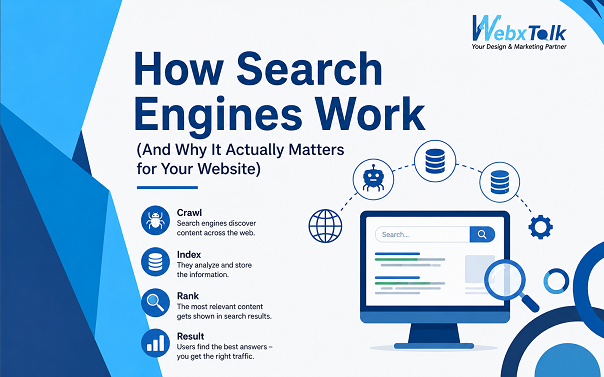
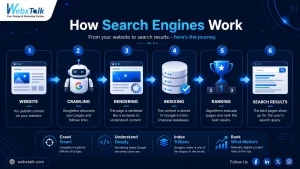
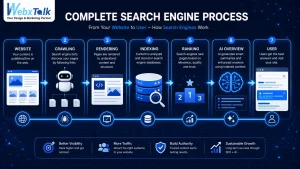
To understand how the search engine works, you have to understand that the four fundamentals include (discovering pages), rendering and processing (understanding pages), indexing (storing pages in a searchable database), and ranking (ordering the results by relevance and quality).
If your website fails at any of these points, no matter how good your product or content is, no one will find it.
Key Takeaways
- Search engines operate through four steps: crawling, rendering/processing, indexing, and ranking.
- A search engine basically consists of two parts: a searchable index and a ranking algorithm.
- Backlinks, page experience, content relevance, and relevance to the user’s search intent are among the best-proven ranking factors.
- Before being able to rank, pages must first be crawled and indexed; AI Overviews draw from that same index.
- Understanding these mechanisms allows you to sidestep costly technical errors and focus on SEO activities that truly result in significant outcomes.
What is a Search Engine? (Quick Definition)
A search engine is software that goes through the content on the Internet and offers the most relevant information matching your inquiry. Among the major players are Google, Bing, Yahoo, and DuckDuckGo. From the StatCounter data, Google still takes about 90% of worldwide search traffic with all devices as the search engines of last resort. The share gets even larger on mobile phones because of the default search deals built into Android and iOS, and the truth is, most users are already used to searching on mobile.
How Search Engines Differ from AI Search Tools (ChatGPT, Perplexity)
Traditional search engines provide a list of links, which are ranked. AI tools such as ChatGPT Search and Perplexity function differently: They use large language models to provide a direct, conversational response and typically cite only a few sources, not ten blue links. Both methods still rely on a crawled and indexed web, but the difference is primarily in the way the results are presented to the user, not how the content is found in the first place.
The Two Core Components: Index and Algorithm
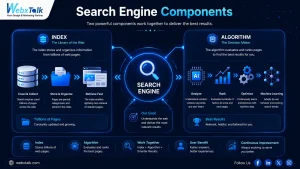
There are only two components to every search engine. The index is a huge database of information about billions of web pages that is continually updated. The algorithm consists of formulas and machine learning models that determine which of those pages is best suited to answer a query and the order in which they appear. All other elements, such as crawlers, ranking signals, and personalization, are there to help these two elements.
How Search Engines Make Money
Most search engines operate on a dual results basis: organic results, which are earned based on relevance, and paid results, which are auctioned off to advertisers via pay-per-click campaigns. This is important to site owners because it is the reason why search engines have an incentive to make their organic results useful — otherwise people will stop using them, and that will negatively affect the ad business. That is one of the reasons why algorithm changes are continually moving toward quality and away from manipulation.
Popular Search Engines Beyond Google
Google is the leader in search in most Western countries, but not the only one in the world. Bing has a decent percentage of desktop search traffic and is the index behind Yahoo’s search service. In China, Baidu is the leader, and in Russia, Yandex still has a foothold. DuckDuckGo has cultivated a smaller but loyal user base for its privacy-centric approach. If your business is geared towards foreign markets, it is best to find out which search engine is the dominant one in that area, rather than taking it for granted that it is Google.
Why Understanding How Search Engines Work Actually Matters for Your Website
You might think of SEO as a checklist: Add some keywords, write a meta description, and you’re done. However, all “best practices” in SEO are based on something that a search engine is trying to do at the crawling, indexing, or ranking phase. After you grasp how it works, most SEO choices cease to be guesswork.
Free, Compounding Traffic vs Paid Ads
Once you stop paying, paid traffic goes away. Once you’ve built up a good ranking, you can expect a lot of traffic from your organic efforts, and it costs a lot less per month. It’s not an excuse to not use paid channels, but it is a reason to not see organic search as a campaign with a beginning and an end.
Reaching People Who Are Already Looking for You
Search is a pull channel, not a push channel. When someone types in “best CRM for small teams” or “vacuum furnace manufacturer,” they already know they want an answer, and you’re just there to be the best answer. That traffic that’s driven by intent is more likely to convert at a meaningful rate than interruption-based advertising, since the audience chooses to be there.
Building Trust and Authority Through Visibility
Being at the top of search results is a trust signal in and of itself. Users have come to believe, rightly or wrongly, that high rankings mean credibility. A site that appears for relevant searches over and over again creates brand awareness, and no one ad impression does this alone.
Avoiding Costly SEO Mistakes
Site owners make avoidable mistakes when they don’t understand crawling and indexing, such as blocking important pages in robots.txt, hiding content behind JavaScript that doesn’t render for bots, or duplicating content across URLs and accidentally telling Google which version not to show. Knowing how it works from the start is much more cost-effective than figuring out what went wrong with the traffic six months later.
Step 1: Crawling — How Search Engines Discover Your Website
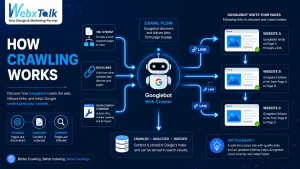
Crawling is kind of a discovery phase in which the engine finds the new and updated pages before it can rank; it’s is very similar to a person who is visiting every room to see how it is.
What Web Crawlers (Bots/Spiders) Actually Do
Search engines use automated programs, known as crawlers, bots, or spiders, to regularly crawl the Internet, download the content of the pages, and follow links to find new URLs. Googlebot is the name of Google’s crawler, and Bingbot is the name of Bing’s crawler. These bots work 24/7, revisiting known pages to see if they’ve been updated and following new links to map new content.
How Search Engines Find New URLs
Search engines use a handful of primary methods to find all the pages on the web, and there is no single list of all the pages. The most natural are backlinks: if a known page links to your new page, the crawler can follow the link and find the page. XML sitemaps allow you to provide a search engine with a list of URLs that you want it to consider. And there are tools like Google Search Console that enable site owners to manually ask Google to crawl a particular URL, which is helpful for getting new or updated pages indexed sooner.
Common Crawling Issues That Block Your Pages
A few technical errors keep pages out of search altogether: A robots.txt file that accidentally blocks an important folder, a stray noindex tag left over from a staging environment, broken internal links that leave pages orphaned with no path in, or slow server response times that cause crawlers to back off. Most of these can be uncovered by a simple crawl audit that you can run periodically without losing visibility.
Crawl Budget and Why It Matters for Larger Sites
Crawl budget is the number of pages that a search engine can crawl on your site within a specific time period. This is not usually a problem for a small business site with a handful of pages. However, if you have a large e-commerce catalog, marketplace, or website with thousands of URLs, then you may be wasting your crawl budget on low-value pages (filtered category variations, duplicate parameters, thin tag pages), which can result in your important pages being crawled less often than they should be.
Step 2: Rendering and Processing — Making Sense of Your Page
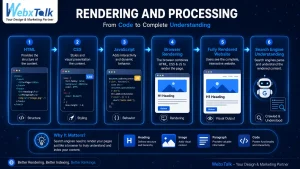
After downloading a page, the search engine must also interpret the content of the page — which is a different process and requires more resources than just downloading the HTML. It basically means watching the pages, pictures, and layouts of a book, which is found by the crawling method.
Why JavaScript-Heavy Pages Can Cause Problems
A lot of modern websites deliver a ton of content via JavaScript instead of just HTML. A crawler must execute the code as a browser would do to view that content, not just read the source code. Rendering is more costly to compute, so it can be done later, and sometimes content that relies heavily on client-side JavaScript is not fully rendered or indexed. This is a very common and easily overlooked cause of a technically “live” page not appearing in search.
What Search Engines Extract During Processing
The search engine extracts the signals it needs to match and rank the page later during processing: main topic and themes, type of content (text, video, product listing), structural hierarchy (headings, paragraphs, lists), specific keywords and phrases used, and how the page is connected to other pages through internal and external links. This is basically where the “meaning” of a page is pulled from the raw code.
Mobile-First Indexing Explained
Now, the mobile version of a page’s content is given more weight than the desktop version when it comes to indexing and ranking, as the majority of people use mobile devices for their major searches. If your site is missing mobile-friendly content, images, or links, then it would be a threat to your ranking process.
Step 3: Indexing — Getting Your Content Into the Database
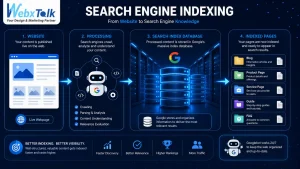
Not all pages that are crawled are added to the index. The filtering and storing phase, in which a search engine determines whether a page should be stored and how it should be cataloged, is called indexing. It is just like when you make notes to revisit them quickly rather than opening the huge book again and again.
What Happens Inside the Search Index
The index is really a large, organized library. As soon as a page is processed, the extracted signals (topic, keywords, content type, structure, freshness) are stored in a manner that enables the ranking algorithm to retrieve and compare them with billions of other pages immediately when a similar query is received again.
Why Some Pages Never Get Indexed
Search engines regularly ignore pages that are identical or very close to existing pages, have a noindex tag, or provide little original content (thin product descriptions, boilerplate, or pages with very little original content). This is not punishment; it’s housekeeping: If every low-value page is indexed, then no one will be better off.
The most frequent causes for a page being excluded from the index are:
- Robots.txt exclusion — the page is not even seen by robots because it is excluded.
- A noindex directive – the page is crawled but explicitly told not to be indexed.
- A canonical tag that redirects to another URL — the page is a redirect to another URL that it considers the “real” version.
- Duplicate or near duplicate content – the page contains no additional information that is not already indexed.
- Thin or low-value content – Not enough original text or content to warrant indexing.
- A 404 or other error response — the URL doesn’t resolve to a live, servable page.
Canonicalization and Duplicate Content Grouping
If there are several URLs with very similar content, such as print versions, session IDs, or URL parameters, search engines will cluster them together and display one of the URLs in the results. The rest are stored as alternatives for certain situations, such as a mobile-specific URL. Correctly using canonical tags means that you won’t be inadvertently competing with your own pages.
How to Check If Your Pages Are Indexed
The best way to check is to use Google Search Console’s URL Inspection tool, which will let you know if a page is indexed or not, and why. Google will provide a second opinion, a less precise one, with a quick search of yourdomain.com. If you have a site that has a history of indexing problems, you should regularly review the Coverage report instead of just when traffic declines.
Step 4: Ranking — How Search Engines Decide the Order of Results
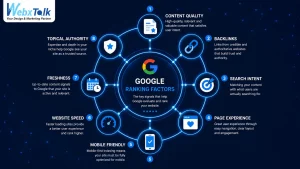
Crawling and indexing are only useful when it comes to ranking. This is the stage that will determine where you will appear on the results page.
Understanding Search Intent and Query Meaning
The algorithm first attempts to understand the intent of the searcher, whether it’s a quick answer to a factual question, a detailed guide, a product to purchase, or a particular website (navigational intent). Even if the page has the right keywords, it may not be optimized for the intent of the query.
Core Ranking Factors
The complete list of ranking signals is never released, but a few are always confirmed as important. Backlinks, or links from other websites that link to yours, are still one of the best indicators of trust and authority, especially if they are from relevant and reputable websites. The relevance and quality of the content, as indicated by the titles, headings, and depth of coverage, is what determines whether a page really answers the query. For time-sensitive topics (breaking news, trending products), freshness is more important than for evergreen topics like historical facts, etc. But organically added keywords in titles, headings, and body copy still help the algorithm determine the page’s content.
Page Experience Signals
In addition to the content itself, search engines take into account the usability of a page. The loading speed is important for ranking because slow pages make for a poor user experience, and mobile-friendliness has been a standard since the mobile-first indexing update. These signals are more like filters that prevent weaker pages from rising to the top than signals that drive a page to the top on their own — strong content with a poor experience will still underperform.
Personalization: Location, Language, and Search History
In this, totally depends on the search behaviour history, like if you search “AC repair,” then you get the results of your nearby locals rather than a global list. As localized versions of content are provided by language detection. If you’re signed in, what you’ve searched for before might show up on the screen.
How AI Is Changing Search (AI Overviews, ChatGPT, Perplexity)
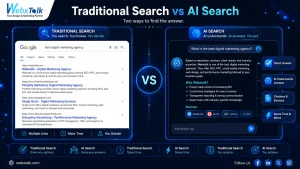
In recent years, the way that people find information online has changed because individuals depend on artificial intelligence to generate results. As readers often prefer brief content over long documents, Google now displays summaries that artificial intelligence creates on many pages. For many users, tools like ChatGPT provide answers to questions directly, and this process removes the requirement for a traditional list of results.
How AI Overviews Pull From the Same Index
To produce AI Overviews, Google uses its existing database of web content. It is true that the feature relies on the same crawled and indexed data that standard search results use. By generating those summaries, the system does not change the fact that the underlying data collection methods are essential.
What does GEO (Generative Engine Optimization) Mean?
If you use Generative Engine Optimization (GEO), you format content so that artificial intelligence can identify, understand, and reference the information easily – this practice requires that you write answers that are easy to understand and use headings that are clearly labeled. And you must support your statements with data from reliable sources. It is an additional method that works with SEO, but it is not a substitute for it.
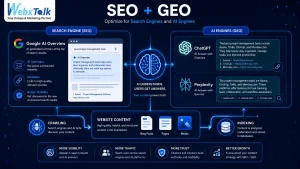
Should You Still Focus on Traditional SEO?
There is still a reason to focus on traditional SEO – due to the fact that standard search engines produce more visitor traffic than artificial intelligence tools, traditional methods are important. On the web, both systems are based on the same crawled data.
What This Means for Your Website: Practical Takeaways
I have put some practical and real lessons that look very easy, but at the same time, they are so effective in improving your search engine ranking, you can check the list below:
Earn Backlinks and Build Topical Authority
Not all backlinks are created equal. Instead of linking to any site, concentrate on sites that are related to your industry, and create a group of related content around your main topics. That’s how search engines begin to view your site as an authority, rather than a lucky page.
Create Content That Matches Real Search Intent
Before you start writing, check out the top pages for your target keyword and copy their style and length. A query seeking a quick answer does not require a 3,000-word essay, and a comparison query requires a comparison, not a sales pitch for one product.
Make Sure Your Site Can Be Crawled
It is not unusual for people to overlook crawlability problems. Make sure robots.txt is not by mistake blocking the significant parts of your site, make sure critical pages do not accidentally have a noindex tag, keep an updated XML sitemap and submit it, and do make sure that vital content relies on JavaScript only, which may not be rendered by crawlers.
Monitor Performance With the Right Tools
Google Search Console provides you with indexing status, search queries, and click-through data from Google. When combined with a rank tracker and a simple crawl audit tool, you will have visibility into all four stages – crawling, indexing, ranking and real-world performance – not just traffic.
Final Thoughts
Google keeps its precise ranking factors a secret, making the search engine seem like a black box. However, once you understand how search works, the mechanism becomes much clearer. Search operates in three key phases: web pages are discovered and stored in the search index, the indexed content is matched against the user’s query, and finally, the results are ranked based on how well they satisfy that query. That is essentially the whole game. If you create valuable content that can be crawled, indexed, and genuinely helps users, you’ve already accomplished most of what SEO requires. If your website is underperforming, don’t rely on guesswork—verify each of these three core stages to identify where improvements are needed.
At Webxtalk, we help businesses optimize every stage of this search journey—from technical SEO and indexing to higher rankings and AI visibility. Ready to turn your website into a powerful growth engine? Let’s build your SEO success together.
FAQs
How do search engines decide a first-place ranking?
Relevance, of course! Yet, you also have content quality, the authority of the site is determined a big part through backlinks, and factors like page load times and mobile friendliness of the site. Each of these is given a weight based on the specific search to determine the ranking.
Do search engines and AI tools such as ChatGPT take their data from the same website?
In general, yes both the search engine and the AI tool get the data mainly by crawling the websites on the Internet. But, there is some subtle differences. The search engine will list you links to the webpages that it considers relevant and the AI tool will skip that part, and the answer will be generated immediately, usually accompanied by some references.
How long does it take for a new website to appear in search engine results?
The period could be from a couple of days to up to a month – it is all dependent on how easily the search engine will stumble across the site, usually through links or a sitemap, and how much value it will give to the crawl based upon the site’s rank overall.
Is it possible for a website to rank if it has no backlinks?
Possible for the one with low competition, but a real competition is another scenario and even if a website has excellent content quality alone, it would still rank much lower if it does not have any backlinks.
Can you explain crawling and indexing?
Crawling is when you explore web pages; a crawler goes into the page and collects it. The indexing process is where the search engine determines whether to store the discovered page in its database. A lot of pages are crawled but never get indexed.
Will a faster website speed influence the rankings?
The website speed is definitely going to affect the rankings, but maybe not just the way you might imagine. For example, a website that is really slow will, of course, get punished but, then again, speed alone will not necessarily push your website up if you have very well-written content.




 Yes, I Want Growth