
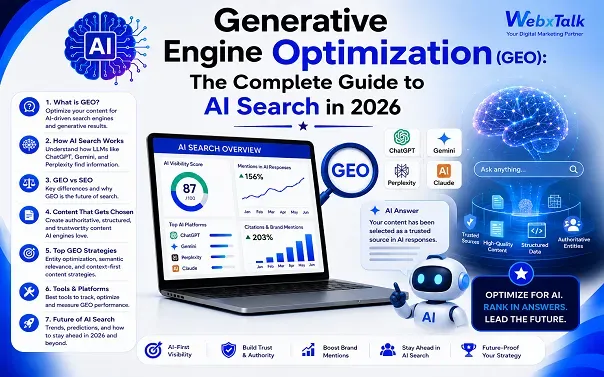
Generative Engine Optimization (GEO): The Complete Guide to AI Search in 2026
When someone’s comparing project management tools today, they don’t scroll through ten blue links. They ask ChatGPT, get three names, and open a tab. Parents don’t Google “best pediatrician near me” anymore — they ask Gemini and take its word for it. Search didn’t just change. It got a new gatekeeper, and that gatekeeper doesn’t rank pages. It picks winners and announces them.
If your brand isn’t showing up in AI-generated answers, the problem isn’t that you’re ranking lower. You’re not in the conversation at all. This guide covers what GEO actually is, why it’s overtaking traditional SEO, and what a working strategy looks like right now.
What Is Generative Engine Optimization (GEO)?
Before you optimize anything, you need to know what changed and why it matters. This section covers the basics of GEO and how it differs from the SEO you already know.
Definition of GEO
GEO stands for Generative Engine Optimization — the practice of shaping your content, data, and brand signals so AI systems like ChatGPT, Google’s AI Overviews and AI Mode, Perplexity, Gemini, and Claude choose to cite or recommend your brand when generating an answer. SEO earns you a spot on a list of links. GEO earns you a mention inside the answer itself.
Why GEO Is Transforming Search
Roughly a third of US consumers now start product research with an AI tool instead of a search engine. AI Overviews already appear on a large and growing share of Google searches, and once one shows up, clicks to the underlying pages drop sharply — some tracking puts zero-click queries around 83% in these cases. “Rank on page one and wait for the click” isn’t a strategy anymore.
What makes this shift unusual is the speed. Mobile-first indexing took Google about five years to roll out fully. This is happening in quarters, not years. A page that ranked #1 in late 2024 can vanish from AI answers by mid-2025 without its Google ranking moving at all. That gap alone is why GEO went from a side project to a boardroom topic inside a single budget cycle.
How AI Search Differs from Traditional Search
A traditional search engine hands you a list of results and lets you pick. A generative engine picks for you, and shows its work while doing it.
The old model matched search terms against an index of web pages. The new model retrieves the most relevant passages across the web and stitches them into an answer — a process called retrieval-augmented generation — usually citing a handful of sources along the way.
The more surprising part: some 2026 data shows that among pages ranking in Google’s top 10, the share also cited by AI systems has dropped from around 70% a year ago to somewhere between 17% and 38% now. Ranking well and getting cited have become two different games, and you can win one without coming close to the other.
How Does Generative Engine Optimization Work?
AI engines don’t crawl and rank the way search engines do. They retrieve, synthesize, and decide who’s worth naming. Here’s what’s actually happening underneath.
Understanding AI Search Engines
Every engine pulls from different sources. ChatGPT leans on Bing for live data. Google’s AI Overviews and AI Mode draw from Google’s own search index and knowledge graph. Perplexity runs almost entirely on live retrieval and discloses its sources openly. Gemini combines Google’s search infrastructure with its own reasoning layer. Claude blends retrieval with heavier reasoning over what it finds. None of these guarantees success on the others — one study found ChatGPT and Claude cited the same source for the same query only 8% of the time.
How LLMs Find and Generate Answers
Ask a complex question and most AI engines will quietly split it into smaller sub-queries before answering. Ask “what’s the best CRM for a 10-person sales team,” and the model might run separate background searches on CRM basics, small-team pricing, and feature comparisons — each pulling from different sources — then merge the findings into one answer with a handful of citations. Winning a single query isn’t the goal. Covering every reasonable angle of the topic is.
Because you can’t predict which sub-query will end up mattering, the safer bet is building broad, multi-angle content — a single page or a connected cluster that anticipates the follow-up questions. That’s what gives you an edge in AI answers even when two competing pages rank about the same on Google.
Factors That Influence AI Visibility
A handful of signals show up consistently in what gets cited: a clear, direct answer near the top of the page, specific numbers and statistics, quotes from named experts, genuine depth instead of a surface pass, clean structure, and — maybe most underrated — how often the brand gets mentioned across the web without a link at all, in news coverage, forums, and product reviews.
One widely cited 2024 GEO study found that adding statistics was the single most effective lever tested, and that brand mentions correlated with AI visibility more than three times as strongly as backlinks did. Domain-level trust matters more than most people assume — it’s not just a good page that gets reused, it’s a domain with a broad base of referring sites that AI models keep coming back to as a trust shortcut. That’s a big part of why digital PR and earned coverage now sit inside the GEO workflow instead of off to the side.
A mention in a respected trade publication does double duty: it strengthens your backlink profile for SEO and adds to your brand-mention count for GEO — which is exactly the kind of signal these models weight.
The New Era of Search: Why GEO Matters
Search has reinvented itself before, just never this fast. Here’s the shape of that shift and why it matters now.
Evolution of Search Engines
Search moved through distinct phases: keyword matching, then link-based ranking, then intent and semantic understanding, and now generative synthesis — where the model pulls from multiple sources to write you a new answer on the spot.
Rise of AI-Powered Search
By early 2026, ChatGPT had roughly 900 million weekly active users — more than double its 2025 number — and AI-referral traffic has become one of the primary ways people now land on websites. Google has rolled out AI Overviews and AI Mode across a large and growing share of results. Perplexity now handles hundreds of millions of queries a year. This isn’t a niche behavior anymore.
Changing User Search Behavior
People increasingly arrive at AI tools already deep into research mode, having pre-filtered their own shortlist through conversation. That’s a big reason AI-referred visitors convert at a noticeably higher rate than average organic traffic — by the time they click through, they’ve effectively already decided.
GEO vs SEO: Understanding the Difference
GEO and SEO get lumped together constantly, but they reward different things. Here’s the actual split, and why most teams end up running both anyway.
Traditional SEO Explained
SEO is about ranking high in a search engine’s results, driven by keywords, backlinks, technical performance, and page experience. Success looks like rank position and organic click-through.
GEO Explained
GEO is about earning a citation, mention, or recommendation inside an AI-generated answer. Success is presence — whether your brand gets named, regardless of where the source page ranks. SEO content is written to satisfy an algorithm’s ranking factors. GEO content is written to give the model a well-supported, high-confidence answer it can lift directly into its response.
GEO and SEO Working Together
GEO isn’t a replacement for SEO — it’s SEO’s faster-moving sibling. The technical fundamentals (crawlability, indexing, schema, site speed) are still the groundwork AI crawlers need to find and understand your content in the first place. What’s changed is that ranking high no longer guarantees a citation, and a citation doesn’t require a top-10 ranking. Agencies like Webxtalk have started running GEO and SEO as one workstream instead of splitting budgets, since the content strategies diverge but the technical base barely does. Most teams won’t need to tear down their SEO strategy and start over — it’s more a matter of extending what’s already there. Keywords become questions. Meta descriptions still matter, but so does the opening line of the page, since that’s often the exact fragment an AI model lifts.
Link-building campaigns are increasingly planned alongside PR and mention-building, because both feed the trust signals AI systems rely on. In effect, you’re doing the work twice — once for people, once for the algorithms reading over their shoulder.
Why Businesses Need a GEO Strategy
Whether you’re a brand or a publisher, showing up in AI answers is becoming table stakes. Here’s who benefits most, and why waiting gets more expensive over time.
Benefits for Brands
Getting mentioned in an AI answer works like an unprompted recommendation from someone the buyer already trusts, delivered right at the decision point. It’s brand-building and conversion happening at once, often before the buyer has even opened your website. For smaller brands, this can be a genuine leveler — a thoroughly researched, well-sourced page can beat a large competitor’s generic corporate page.
Benefits for Publishers
For publishers, GEO opens a distribution channel that doesn’t depend entirely on clicks. Getting cited repeatedly on a topic builds authority that compounds. Models seem to develop familiarity with sources over time, so consistent coverage in a niche pays off more than scattered one-off articles.
Industries That Benefit Most
SaaS, finance, healthcare, travel, and B2B services — categories with long research cycles — see the clearest ROI, since these are exactly the searches where people let AI narrow the field before comparing vendors directly. Local and transactional businesses see a smaller effect for now, though that’s shifting as assistants get better at comparison and location-aware questions, like which of three clinics has the shortest wait.
Core Principles of Generative Engine Optimization
GEO isn’t one tactic — it’s a handful of principles that show up across every engine. Get these right and everything else gets easier.
User Intent
AI systems are goal-focused. A page built to answer one specific, well-defined question will usually beat a page trying to cover a broad, vague topic. Content written to appeal to everyone tends to satisfy no one in particular, while a narrowly focused page reads as a reliable, low-risk source to cite.
Topical Authority
Depth beats breadth. A cluster of connected, well-explained content on one subject is one of the clearest signals of expertise a domain can send. Models appear to weigh consistency across a domain more heavily than a single standout page surrounded by thin content. A brand that shows up credibly again and again on one theme outweighs one great article buried in mediocre ones.
Entity Optimization
AI systems read text for underlying concepts — people, brands, products, places — not just keywords. Keeping your brand, founders, and products consistently described across the web (About pages, structured data, directory listings) gives the model enough signal to confidently tie content back to the right entity. Even small inconsistencies in a product name or description across sources can cause a model to miss the connection entirely, even when the content itself is strong.
E-E-A-T Signals
Experience, expertise, authoritativeness, trustworthiness — the same old standards, still holding up. A named writer with real credentials, original research, and open sourcing all raise the odds that a model treats your content as safe to cite. This is where GEO and honest writing line up almost exactly: the things that build reader trust — a real author, real experience, an honest caveat here and there — are the same things a model looks for when deciding what’s safe to restate.
Best Practices for Generative Engine Optimization
Knowing the principles is one thing. Here’s what to actually do with them.
Create Helpful Content
Answer the question thoroughly first. Don’t pad it out with filler to hit a word count. Models reward clarity and brevity, and content written purely to rank tends to lose out once it’s competing for citations instead of just clicks.
Structure Content for AI
Open each section with the direct answer in the first sentence or two, then expand. Keep paragraphs to two or three sentences. Use headers phrased as the questions people actually ask. This structure is easy to scan for readers and exactly what retrieval systems are built to pull from.
Optimize for Conversational Queries
Write the way someone would actually talk. Someone typing into Google might search “CRM pricing small business.” The same person talking to ChatGPT is more likely to ask “what’s a good CRM for a 10-person sales team on a tight budget?” Content phrased closer to that second version tends to match how these systems actually retrieve information.
Use Credible Sources
Reference specific studies, quote real people, and link to primary data where you can. Content that cites its sources reads as more credible and tends to get cited more in return. Original research — even something as small as a survey of your own customers — usually outperforms recycled statistics, since it gives the model something new to point to, with your page as the only source for that particular claim.
Keep Content Updated
Old SEO optimized for search intent once and left it there. Freshness now carries real weight. Stale statistics or outdated comparisons get quietly swapped out for a competitor’s newer numbers, which is why a refresh schedule belongs in your content strategy from the start, not bolted on as an afterthought.
Building a Practical GEO Strategy
A handful of optimized pages won’t move the needle. GEO rewards consistency. Here’s how to turn the principles above into an actual plan.
Content Planning
Start by finding the real questions customers ask AI tools — these often look nothing like the keywords they’d type into Google. One useful exercise: take the five questions a salesperson hears most often about your product and run them through ChatGPT, Perplexity, and Gemini. See which model gives the most useful answer, compare the responses, and treat any gaps as your next content opportunities.
Topic Clusters
Group content around a central subject and build out related articles from there, so your brand keeps showing up for that topic instead of appearing once and disappearing. One good article might get referenced. A connected cluster of a dozen pages on the same subject reads as genuine expertise.
Brand Authority
Chase mentions, not just links. GEO research keeps pointing to brand-mention frequency — how often you’re discussed without a link back to your site — as a real visibility signal. Digital PR, expert interviews, podcast appearances, and industry roundups all build that signal.
Content Distribution
Publishing the same core idea across multiple credible third-party platforms, not just your own site, measurably increases citation odds, since these models draw from a wide spread of sources rather than any single domain.
Technical Optimization for GEO
Good content still needs to be found and read correctly by AI crawlers. Here’s the technical layer underneath everything above.
Schema Markup
Add Article, FAQPage, Organization, and Author schema. This gives crawlers unambiguous, structured signals about who wrote a page and what it actually answers.
Crawlability
Make sure AI crawlers — GPTBot, PerplexityBot, Google-Extended, ClaudeBot, and similar — are allowed in your robots.txt. Content also needs to be reachable without relying on JavaScript rendering, logins, or paywalls. Some sites now publish an llms.txt file to help AI systems map their structure directly. Worth an independent check: teams often spend months building content only to discover a CDN rule or an overly aggressive bot-blocking setting has been quietly excluding them from AI retrieval the entire time, with nothing showing up in standard analytics to flag it.
Core Web Vitals
Speed still matters, for readers and for bots. Page performance factors into how a retrieval system rates overall quality. A page that loads slowly or partially forces the retrieval system to work harder just to read it — and it’s less likely to be treated as a serious candidate, no matter how good the content actually is.
Mobile Experience
A growing share of discovery now starts on a phone, often inside a chat app. A broken mobile layout undercuts the same trust signals GEO relies on elsewhere. More people are clicking straight from an AI answer to a site, and a slow or broken mobile experience can undo the work that earned the citation in the first place.
Common GEO Mistakes to Avoid
Knowing what kills visibility matters as much as knowing what helps. Watch for these.
Thin Content
Short, generic pages rarely get cited. Models favor specificity over volume. A 400-word page stating facts everyone already knows just blends into a pile of near-identical pages, and there’s no reason for a model to pick yours over the others.
Overusing AI
Mass-produced, unedited AI content tends to converge on the same generic phrasing as everything else, which works against the specificity that earns citations. Without human input, original insight, or real editing, it settles toward the statistical average — giving readers nothing distinct enough to cite.
Ignoring Search Intent
Ranking for the right keyword is only step one. If the content doesn’t actually answer the question behind that keyword, it gets ignored regardless. A page that repeats a keyword phrase without backing it up with a real answer might still index fine on Google, but generative engines — which need something concrete to cite — will pass right over it.
Weak Authority Signals
Anonymous, heavily templated corporate blogs tend to underperform for a quiet but real reason: there’s no clear “who and why” for a reader, or a model, to trust. No named author, no data, no third-party reference doesn’t automatically make a page bad — but if you can’t show where your information comes from or why you’re the one writing it, there’s little reason for anyone, human or machine, to keep reading.
Measuring GEO Performance
You can’t improve what you don’t measure. Tracking generative engine performance gives you a real read on visibility and what’s actually driving it.
AI Mentions
Regularly check whether your brand comes up when you ask ChatGPT, Gemini, and Perplexity the questions relevant to your business. Manual checks work early on; AI-visibility tracking tools can automate this as you scale. Make it a monthly habit — citations shift fast enough that an article cited last week can quietly drop out of a chatbot’s answer within weeks, usually because a competitor updated their content first.
Brand Visibility
Look past your own blog and track how often your brand comes up across the web generally — mentions without a link back are still a major driver of citations. PR-monitoring tools, originally built for press teams, now double as visibility trackers for marketers, giving a reasonable read on how often your brand shows up in news, forums, and reviews.
Traffic and Engagement
Separate AI-referred traffic from regular organic in your analytics. It’s usually a smaller slice, but it converts noticeably better. A lot of AI referrals arrive without a clean referrer header, so most standard analytics setups undercount this traffic — meaning a fair number of organizations are missing conversions they’re actually getting credit for.
Conversion Metrics
Track conversions and assisted revenue from AI-referred visits separately. Several 2025 and 2026 benchmarks show this segment converting well above typical organic search, which is reason enough to give it its own line in reporting — even if the volume looks small next to organic or paid.
Future-Proofing Your Digital Presence with GEO
GEO is still moving fast in 2026, and today’s best practices won’t hold for long. Here’s how to build something that survives the next shift.
Future AI Search Trends
Expect AI interfaces to keep absorbing more of what used to be the search box. AI-citation reporting is starting to show up inside the analytics tools marketers already use, and competition for citations will only get sharper as more brands catch on. That search consoles and analytics platforms are already building dedicated AI-visibility reports suggests this isn’t a passing feature — it’s becoming permanent infrastructure.
Preparing for Search Evolution
Move now, while a lot of competitors haven’t started. Enterprise teams are already deep into GEO work; small and mid-sized brands mostly aren’t yet, which is exactly the kind of window that closes fast once an industry catches on. Brands that establish themselves as trusted, well-referenced sources early tend to hold that position, since models default to sources they already recognize — a durable head start that’s harder to unseat than a traditional SEO ranking.
Long-Term GEO Success
Treat GEO as an ongoing habit, not a project with an end date. Content needs regular updates. Brand mentions have to be continually earned. Citation monitoring deserves the same routine attention rank tracking used to get. This is why agencies increasingly structure GEO work as an ongoing monthly partnership rather than a one-time audit — brands that treat it as a quarterly habit are still showing up in AI answers a year later, while slower competitors have quietly dropped out of the conversation.
Conclusion
The brands winning in AI search in 2026 aren’t just the most cited — they’re the ones models have learned to trust enough to recommend without hesitation. Because this shift is moving so fast, whoever builds and executes a strategy first tends to keep that lead. Whether you’re just starting to think about AI visibility or already fighting for backlinks against a competitor, working with a team that understands this space — like Webxtalk — can turn months of trial and error into a working strategy that actually builds mentionability. GEO isn’t replacing SEO. It’s the next stage of it, and the fundamentals still get you there.
Frequently Asked Questions
What is Generative Engine Optimization (GEO)?
GEO is the practice of optimizing content and brand signals so AI tools like ChatGPT and Gemini cite or recommend you directly in their answers.
How is GEO different from SEO?
SEO targets your rank position in search results. GEO targets getting named inside an AI-generated answer, regardless of where you rank.
Is GEO replacing traditional SEO?
No. GEO builds on SEO fundamentals like crawlability and authority, and most brands now run both together.
Which AI search engines should I optimize for?
Prioritize ChatGPT, Google AI Overviews and AI Mode, Perplexity, Gemini, and Claude, since each sources and cites differently.
How can I improve my website for GEO?
Lead with direct answers, add schema and statistics, make sure AI crawlers can access your content, and build genuine brand mentions.
What are the best tools for Generative Engine Optimization?
AI-citation trackers, schema generators, and crawlability checkers form the core toolkit. Agencies typically pair these with manual prompt testing.
How do you measure GEO success?
Track AI citation frequency, brand mentions across the web, AI-referral traffic, and conversion rates from that traffic segment.
What is the future of Generative Engine Optimization?
Expect deeper AI-native search interfaces, built-in citation reporting, and rising competition as more brands adopt GEO strategies.


 Yes, I Want Growth