
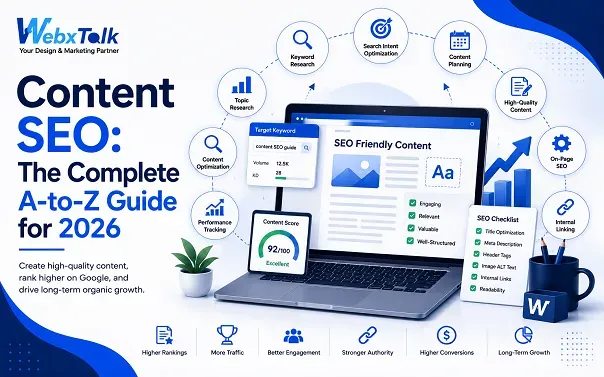
Content SEO: The Complete A-to-Z Guide for 2026
Creating good content in 2026 is no longer about quantity or keyword stuffing. Google wants content that answers questions, matches search intent, and genuinely helps people. Search engines favor useful content, which is why optimizing your content matters — it increases visibility, attracts the right audience, and boosts both brand image and sales.
Content SEO covers keyword research, planning, optimizing, and refining content to deliver maximum value to both website visitors and search engine crawlers. A strong content SEO strategy helps a website become a stronghold in its niche, build authority, and drive free organic traffic alongside any paid promotion.
This piece covers Content SEO: The Complete A-to-Z Guide for 2026, helping you understand what SEO content is, develop a strategy to reach your goals, optimize your content, track your performance, and prepare your website for future changes.
What is Content SEO?
Content SEO involves optimizing and creating content to achieve higher rankings on search engines and attract the right target audience. The process includes selecting topics that are relevant, picking the appropriate keywords, structuring content in a logical manner, and presenting valuable information that aligns with the search intent. Two individuals write the same article about “How to Make Pasta?” The first person writes about the origin of the pasta, how it is cultivated, and gives a little information about how to cook pasta. The second one, on the other hand, includes subheadings such as “How to make pasta at Home easily?” and explains the entire process in simple steps with keywords as the headings.
Now, ask yourself who will show up in the search results on Google?
Of course, the one who mentioned the keywords in the headings organically and described the process in simple steps will easily rank in the search results, as it provides what the audience wants. Thus, Content SEO involves creating what people want to search for, in a manner that Google is able to understand and rank it.
Content SEO vs. Technical SEO vs. Off-Page SEO
Content SEO, Technical SEO, and Off-Page SEO each play a different role in improving your website. Understanding the difference helps you build a stronger SEO strategy.
| SEO Type | Focus | Example |
| Content SEO | Creates useful and optimized content for users. | Blog posts, guides, landing pages |
| Technical SEO | Improves your website’s performance and crawlability. | Page speed, mobile-friendly design, indexing |
| Off-Page SEO | Builds your website’s authority outside your site | Backlinks, brand mentions, digital PR |
Each type of SEO has a unique purpose, but together they help improve your website’s rankings, visibility, and organic traffic.
Why Content SEO Matters for Ranking & Traffic?
Content SEO gives the opportunity for search engines to become familiar with your pages and link them to relevant searches. Content that offers value, is logically organized, and is search intent-optimized will have a stronger chance of appearing as the top result. Such a strategy not only helps in raising the number of visitors to a website but also attracts organic traffic from people who need the services, information, or products you offer.
How Content SEO Works in 2026
Adding keywords to a page is not a content SEO tactic that people think, as the Google algorithm updates and now it can easily detect content stuffed with keywords and genuine content that provides and satisfies the search intent rather than sharing fluff. Now, the question is what kind of content do search engines like? Content which don’t contain vague answers, jargon, and keyword stuffing; instead, it solves real queries, answers what people are searching for, and can be easily understood.
There is one catch: if you are providing value, but your content is not organised properly, has typos, and is not presented clearly, then it will be of no use; users will not be able to understand what you want to say, and this is the major factor that affects the rankings. Search engines are updated enough, as they are able to check the logical framework of the content, like clear headings, and the content is supported with real facts and stats. Creating your content by keeping these points in mind can help improve your ranking, attract the right audience, and achieve sustainable growth.
Understanding Search Intent
Before developing any content, it is vital to recognize the reason behind a person’s search. Search intent tells you what someone expects to find when they enter a query — whether they’re looking for information, evaluating options, or prepared to do so. Content creation is clearly not trying to find anyone to work, unlike the basics of search engine marketing. That’s exactly why search intent subjects exist: it tells you what your target market is really looking for, so you can deliver the right answer to the right person at the right time.
E-E-A-T, Experience, & Trust
This is the foundation on which SEO works. E-E-A-T stands for experience, expertise, authoritativeness, and credibility. It is a framework that is used by engines like Google to estimate the quality and credibility of your content. To improve E-E-A-T of your content, you need to create unique content that guides your factors with reliable resources when needed, and maintain your information correct and updated, supported by accurate statistics, so that it can perform well in search results.
The Impact of AI Search on Content SEO
As people are using more AI rather than reading a long page article so, instead of focusing only on keywords, content now needs to give direct answers, accurate information, and in a simple manner. It increases the chances of being recognized and visible in the AI search results.
Content SEO Strategy & Planning
If you create content and do not have a strategy, you often lose chances to reach your goals. To begin a Content SEO approach that is planned well, you must identify what your audience searches for plus how those searches relate to your business objectives. Every article, guide, or landing page is required to have a specific function, like when you answer a question, resolving a difficulty, or increasing the rate at which users perform desired actions.
By using a structured plan, it is easier for you to write about the correct topics, focus on relevant keywords, and arrange content in a logical way across your website. When pages that are related to one another provide mutual support, and you create content that focuses on what users intend to find, your website is more useful for both people and search engines. In the sections below, you can find the necessary parts for building a Content SEO strategy that is effective as well as assists with regular increases in visitors from search results.
How to Plan Content That Ranks
Start by choosing a topic that your audience is actively searching for and make sure it matches their search intent. Have a clear structure, use relevant keywords naturally, and include useful information that addresses their questions or solves their problems. Content that is well-structured and easy to read is more likely to be well-ranked and to generate steady organic traffic.
Aligning Content with Business Goals
Every piece of content should support a specific business goal, whether it’s increasing brand awareness, generating leads, driving sales, or educating your audience. Instead of creating content just to publish more pages, focus on topics that attract the right visitors and encourage them to take the next step. When your content meets both user needs and business objectives, it becomes more valuable and delivers better long-term results.
Building Topic Clusters & Internal Linking
By organizing your content around related topics, both customers and search engines understand your website better. Instead of creating separate pages without connections, companies build content material, supporting a major topic through special articles that cover related areas. You can use internal hyperlinks to clearly connect those pages, guide users to more helpful resources, and show the connection between your content. This approach can help you to boost your website’s authority, improve navigation, and increase the chances of important pages ranking better.
Content SEO Keyword Research
Content SEO Keyword Research is the process of finding the words and phrases your audience uses when searching online. It helps you understand what people want to know so you can create content that matches their needs instead of relying on guesswork.
The goal is to choose relevant keywords that fit your business and search intent, then use them naturally throughout your content. Good keyword research also helps you discover new topic ideas, identify content gaps, and attract the right audience through organic search.
Finding Topics People Actually Search For
Start by thinking about the questions, problems, or topics your audience is most interested in. You can find content ideas by using Google Search suggestions, the People Also Ask section, Google Trends, online forums, competitor websites, and keyword research tools. These sources show what people are actively searching for and the language they use.
Focus on topics that are relevant to your business and have clear search demand. Choosing subjects that answer real user questions increases the chances of your content reaching the right audience and performing well in search results.
Using Search Intent for Keyword Research
Good keyword research starts with knowing why people are searching. Some people want to find information about something; some are looking at options, and some are prepared to do something or buy something. Picking keywords that fit these reasons helps you make content that matches what people are looking for. When your content matches what people are looking for, it is more useful for them and, for search engines, which can lead to rankings and more people clicking on your content.
Using Competitor Content to Find Gaps
Analysing competitors’ content helps you discover opportunities to create better and more valuable resources. Review the pages ranking for your target keywords and identify areas where they lack depth, have outdated information, or fail to answer user questions. Instead of copying existing content, improve upon it by adding fresh insights, useful examples, updated information, and a clearer structure. Filling these gaps allows you to create content that better serves users and has a stronger chance of standing out in search results.
Structuring and writing SEO content
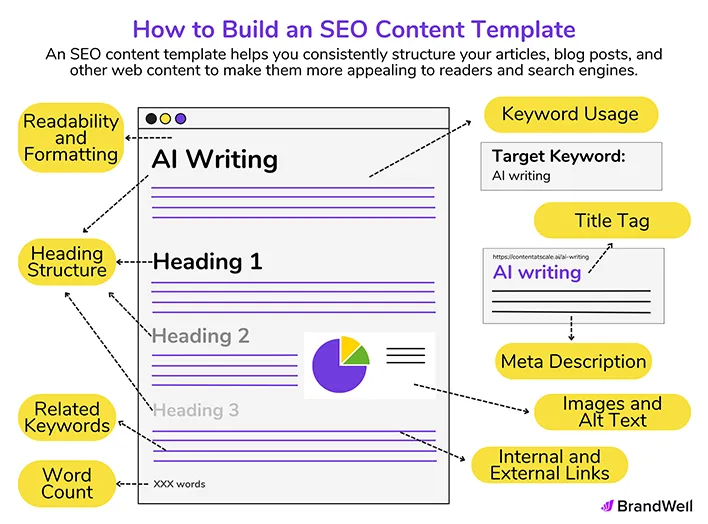
Creating SEO optimized content isn’t just about picking the right terms; it also has to be readable by humans and easy to understand by Google. Regardless of the accuracy of the content, a well-structured page makes it easy for visitors to find what they’re looking for, and a poorly structured page can just as easily bury the useful information away and turn readers off. How you organize and craft your content influences the outcome of search results. If a page is organised well, has logical flow, and is easy to read, the search engine will see this as a true sign of usefulness, not just optimisation. You can take reference from the image mentioned below to build an SEO template.
H1, H2, & H3 Headings
Think of headings as a roadmap for your page as they guide both readers and search engines through your content. The H1 works as the main title, clearly stating what the page is about. From there, H2 and H3 headings break everything into organized, digestible sections.
When headings follow a logical order, readers can quickly scan the page and jump straight to what they need. At the same time, this structure helps search engines understand how your content is organized, making it easier for them to crawl and index your page correctly.
Writing Clear, Scannable Paragraphs
Keep your paragraphs short, simple, and focused on one idea at a time. Break up long blocks of text, use bullet points where they help, and cut anything that doesn’t add value. Plain language, real examples, and smooth flow all make readers want to keep going.
This matters because most people don’t read a page word for word — they skim to find what they need. When your paragraphs are easy to scan, readers stay engaged longer, explore more pages, and actually absorb your message faster.
How to Place Keywords Naturally
The keywords that you include will be used to help search engines determine the topic of your content, but you should make sure that you are including them in a natural way, and not forcing them into sentences. Include keywords in significant places such as the title, headings, introduction, and body areas as they are relevant. Keyword stuffing should be avoided since it makes it difficult to read and gives a poor user experience. Rather, concentrate on the topic in detail and include related words that give context. Modern search engines can interpret the meaning of a search query, rather than just the exact words used in the query; therefore, it is better to produce useful content for readers than to repeat a phrase several times.
Avoiding Thin & Generic Content
Creating lots of web pages to publish for no particular reason is not likely to yield good results. Readers want information that is useful and provides a solution to their questions or problem, or helps them make a decision. If content is thin on information or is only giving basic information, it is unlikely to become visible in search engine results. Avoid repeating content that is readily available on the Internet, but provide a more comprehensive and significant learning experience. Use layman’s terms to explain concepts, add examples if applicable, and discuss the topic in multiple ways. If your content is original, informative, and really helpful to users, it can be more valuable, and thus more search engine-friendly.
On-Page SEO for Content
On-Page optimization provides search engines with information about your page and content and what it’s relevant to for certain searches. This involves optimizing various aspects such as title tags, meta descriptions, URLs, headings, internal links, images, and structured data. These enhancements help your pages be more crawlable and enable visitors to easily see what your pages are about.
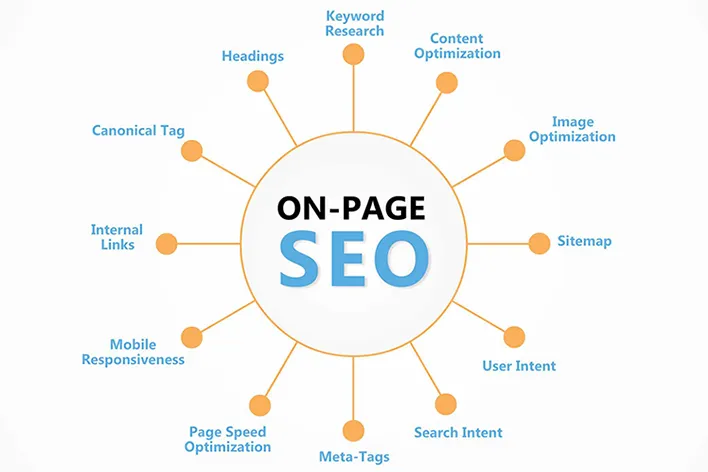
One of the key goals of a strong on-page SEO strategy is to make it better for visitors to your site than for search engines. Using clear page elements, appropriate keywords, descriptive links, and optimized media can enhance the visibility, readability, and organic traffic of your content. If these factors align, your website content is more likely to rank higher in search results.
Title Tag & Meta Description
The meta description and title tag are the initial impression of your page when it appears in search results. The page title should provide an instant understanding of the page’s content and contain the main keyword in a natural way. An attractive and clear title can attract more clicks. The meta description helps to complement the title by giving a summary of the page content and to inform the user whether the page content matches their search. Meta descriptions may not directly impact rankings, but they can have an effect on click-through rates when they are well-crafted. Ensure both are accurate, useful, and in line with what users are viewing on the page.
URL Structure & Internal Linking
A good URL structure allows users and search engines to understand the content of a page. Avoid using “long and confusing” URLs; use short, descriptive, and on-topic URLs. For internal linking, it involves linking various pages to each other on the website and helping search engines find the important pages. It also helps visitors to delve deeper into the information, thereby enhancing their overall experience. Employ appropriate anchor text and links that add value to a page. A properly designed internal link structure and URL design can enhance website organisation and boost SEO performance.
Image Optimization, Alt Text, & Schema
It’s crucial to optimize images to boost your content’s SEO. Save images at suitable compression levels to ensure quicker page load times, use meaningful names for images, and include relevant ALT text to let search engines know what the image is. Schema markup is also useful when it comes to adding additional context to your pages, which makes it easier for search engines to present relevant information in search results. All of these practices help to make your content more accessible, user-friendly, and visible.
Content Types for SEO
Not every piece of content is created equally, and the appropriate format relies upon what your viewers are looking for and what stage of the buyer’s journey they are in. When employing a combination of content types, you can appeal to various search intents, while also maintaining the website’s relevance in a large number of queries. You will find some primary content for SEO:
- Blog Posts
Blog posts are one of the most versatile pieces of content that you can make and are perfect for answering questions, following a trend, and targeting a variety of keywords. These are good for informational search intent, where users are not interested in purchasing products outright.
- How-To Guides & Tutorials
Guide by step, for users who need solutions. These tend to do well because they address a specific problem and often have a longer reader retention rate because the steps are detailed and actionable.
- Listicles
List-based content (‘Top 10…’, ‘Best…’) is easy to scan and can often be effective as it responds to the way people look for comparisons or recommendations. It works well for search intent, particularly when it is a comparison or commercial search.
- Product & Service Pages
These pages are geared toward users who are nearer to making a decision. Optimize them with relevant keywords, benefits, and clear descriptions, as they directly influence conversion and are helpful in the revenue-generating intent of the searches made by users.
- Case Studies
Case research helps establish credibility by demonstrating real consequences and tangible evidence of skills. They are accurate for users considering which product or service to buy.
- Pillar Pages & Topic Clusters
Pillar pages discuss a broad topic in-depth, whereas linking out to related cluster pages that discuss subtopics. This will help build topical authority and enhance internal linking – both of which are good signals for SEO.
- FAQs
FAQ sections directly answer popular user queries with clear and structured content, which can help capture long-tail keywords and boost the chances of being featured in AI-generated answers or snippets.
Content Refreshing & Updating
Content refreshing and updating is important because if the content is old it can impact your search engine rankings as they want fresh and updated information which is accurate and also relevant too. When the content on your site is updated regularly, it is a clear indication that your site is relevant and up-to-date.
But it doesn’t mean that you need to rewrite everything from scratch. It can be as easy as adding statistics, adding fresh examples, extending thin sections, or adding structure and readability. Try to refresh pages that once ranked well but have seen a decrease in traffic to the site, as these pages may hold the greatest potential to rank well with little effort.
When to Update Old Content
Losing rankings, traffic, or engagement signals it’s time to update your content. Regularly check for outdated info, broken links, old stats, and irrelevant examples. Shifts in user intent or search behavior are also warning signs. Regular content audits help you catch these issues early and stay visible in search results.
How to Improve Underperforming Pages
Sometimes pages that aren’t performing well can be enhanced by the addition of the latest content material. Go through the page and look for negative elements like old information, poor keywords, or old content that doesn’t align with the search intent. Adding updated information, revising the headline, adding applicable facts, and improving internal linking can increase its cost. Optimization is a technique that helps boost scores, increase organic traffic, and keep a website relevant over the years.
Pruning Low-Value Content
Regularly checking and updating your website keeps it useful and relevant. Get rid of or fix outdated pages, wrong information, and low-quality content that no longer benefits your visitors. A content audit can show you which pages need updating, combining, redirecting, or deleting. Keeping only valuable and relevant content makes the site easier to use, helps search engines understand it better, and can improve your search rankings over time.
Content SEO & AI search
Content SEO is no longer focused only on improving search rankings. As AI-powered search tools like Google AI Overviews, ChatGPT, and Perplexity become more common, people are getting answers directly instead of clicking through multiple websites. To stay visible, your content should be easy to understand, answer questions clearly, and provide accurate, trustworthy information that AI systems can confidently reference.
Creating content that AI can understand also helps build your brand’s authority. Even when users don’t click your website immediately, seeing your content mentioned in AI-generated answers increases trust and keeps your brand top of mind. Clear headings, direct answers, reliable facts, and content that closely matches user intent all improve your chances of being featured.
How AI Overviews Use Content
AI search engines like Google pull information from across the web to give users quick, helpful answers. They look for content that is clear, accurate, credible, and relevant to the question being asked. Pages with clean titles, well-organized data, and direct answers tend to get ranked and prioritized higher by AI algorithms. When you create content that covers a topic thoroughly, you increase your chances of showing up in AI-powered search results.
Writing Content That AI Can Cite
Create content that’s clean, reliable, and well-organized, making it easy for AI to recognize and reference. Answer questions right away, use descriptive headings, back everything up with solid facts, and explain topics using real examples. Avoid vague statements and stick to clear, accurate details. When your content meets the reader’s needs and positions you as a knowledgeable source that understands what people are searching for, you’re far more likely to be cited as a trusted reference in AI-powered search.
Measuring Content SEO Performance
The best way to know if your content is performing well is to track the right metrics. Monitor your search rankings, organic traffic, user engagement, and conversions such as signups or sales. Reviewing these metrics regularly helps you understand which content delivers results, identify areas that need improvement, and make informed decisions to strengthen your overall SEO strategy.
Organic Traffic, Rankings, & Engagement
Rankings, traffic, and engagement all indicate where your content is being successful or unsuccessful. Rankings will let you know whether search engines trust the content enough to display it. Traffic gives you an indication if people are clicking through to visit. Engagement gives you an idea if they liked what you’ve got when they arrived on your page. By checking all three, you can be sure what to fix, rather than just “assuming”.
Conversions & Business Impact
Conversions are a measure of Content SEO performance and indicate actual business results, not just traffic. Tracking pages allows you to see how many visitors actually convert to a sign-up, sale, or a lead, such as 2000 visitors and 40 sign-ups gives you a 2% conversion rate. This indicates that something has changed with the content or offer if traffic increases next month and sign-ups decrease. Conversions are a good, measurable indicator of whether content is effective or not.
Common Content SEO Mistakes
Most content fails not because of poor writing, but because of avoidable SEO mistakes that are quietly holding it back. These errors can ruin even the best written articles, from not knowing what users are looking for to stuffing pages with keywords. The bright side is that they can be easily repaired if you know what to search for. Here are the mistakes to watch out for.
- Stuffing Keywords Instead of Writing Naturally
Repeating the keywords in the content will irritate the reader, and also these types of content are flagged by the search engines, so use your main keyword organically along with its synonyms so the article doesn’t break the flow just because of the keyword.
- Writing for Google, Not for People
Content that is created solely for search engine optimization can come across as robotic and impersonal. Search engines are increasingly recognizing content that is helpful to readers. Answer the reader’s question first — good rankings typically come with good content.
- Skipping Search Intent
If you just write to satisfy the search engine but not what people are searching for, like a user searching ” how to fix the tap” and you are writing an article on what is plumbing, which is not an answer to the user’s question, then creating content doesn’t make any sense. So, it becomes necessary to search intent before writing and checking what type of content is already ranking for your keyword: a guide, a list, or a comparison.
- Publishing Thin, Low-Value Content
Publishing short articles that only provide the surface level of information, especially for competitive topics, can cause a sudden fall in your rankings. The more searched and the deeper you cover the topic, answer queries as well as add real examples the better your rankings will become.
- Ignoring Content Planning
Without research, you will be writing about topics that no one is looking for. Research keywords, audience interests, and competitor gaps to plan your content calendar.
- Forgetting On-Page Basics
Improper reading, missing meta titles, or messy formatting make the content unstructured and hard for search engines and readers to understand. Using clear headings and writing compelling meta titles and descriptions on the page can help you make the content clean and well structured.
- Not Updating Old Content
One of the most frequent errors is publishing and forgetting — over time, outdated content will lose rankings. Periodically update and review older posts to ensure that they remain relevant and competitive.
FAQs
What is content SEO?
Content SEO is the practice of planning, creating, and optimizing content so it ranks well in search engines while genuinely helping the reader. It combines keyword research, search intent, and quality writing to make content both useful and discoverable.
How do you make SEO content?
To make SEO content, start with keyword research to know what your audience is searching for, then write content that matches their search intent. Structure it with clear headings, use keywords naturally, add helpful facts or data, and make sure it’s easy to read and genuinely useful.
What are the 4 types of content?
The 4 types of content are informational (educates the reader), navigational (helps them find a specific page or brand), transactional (drives a purchase or action), and commercial investigation (helps them compare options before deciding).
Can a beginner do SEO?
Yes, a beginner can absolutely do SEO. It does take time to learn the fundamentals — like keyword research, on-page optimization, and content structure — but with consistent practice and the right resources, anyone can build these skills.
What are the 4 pillars of SEO?
The 4 pillars of SEO are technical SEO (site speed, crawlability, mobile-friendliness), on-page SEO (content, keywords, headings), off-page SEO (backlinks, brand mentions), and content quality (relevance, usefulness, search intent match).
Which type of SEO is best?
There isn’t a single “best” type of SEO — on-page, off-page, and technical SEO all work together. That said, on-page SEO is often considered the foundation, since strong content and structure make everything else more effective.
How many types are there in SEO?
There are generally 3 main types of SEO: on-page SEO, off-page SEO, and technical SEO. Some also count local SEO as a fourth distinct type, especially for businesses targeting specific locations.
How do you create SEO keywords?
To create SEO keywords, start by researching terms your audience actually searches for using tools like Ahrefs, Semrush, or Google Keyword Planner. Look at search volume, competition, and intent, then group related keywords together to target naturally within your content.
What are the major SEO tools?
The major SEO tools include Ahrefs, Semrush, Google Search Console, Google Keyword Planner, and Moz. Each helps with different tasks like keyword research, site audits, and tracking rankings.
What are the 4 C’s of content?
The 4 C’s of content are clear (easy to understand), concise (no unnecessary fluff), compelling (engaging enough to hold attention), and credible (backed by facts and trustworthy sources).




 Yes, I Want Growth