
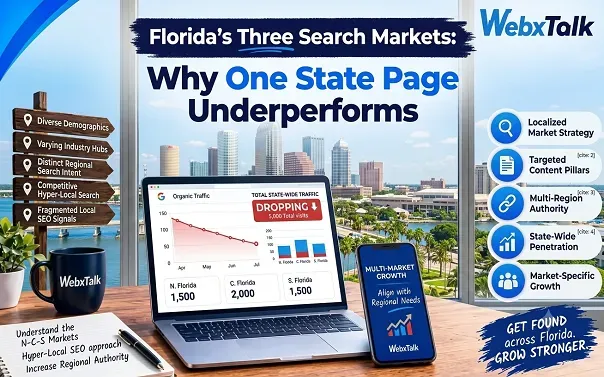
Florida’s Three Search Markets: Why One State Page Underperforms
Florida looks like one market on a map and behaves like three in search. South Florida runs on cross-border commerce with a majority-Hispanic population and a winter demand peak. Central Florida runs on tourism and conventions with a school-calendar demand curve that peaks in summer. North Florida runs on logistics, finance, and insurance with almost no seasonal swing at all.
A business building one Florida page and expecting it to serve all three is targeting a term that carries a fraction of the volume its city equivalents do, in a state where the commercial realities have nothing in common. Getting florida seo strategy right starts with accepting that the state is a container rather than a market, which is worth settling before evaluating the best SEO services in Florida.
Key takeaways
- South, Central, and North Florida operate as distinct commercial and search markets with minimal keyword overlap
- Miami-Dade is roughly 70% Hispanic with around 1.8 million Spanish speakers, the largest Spanish-speaking city in the US
- Orlando drew a record 76.7 million visitors in 2025 on a school-calendar demand curve that peaks in summer
- Jacksonville covers roughly 747 square miles and holds about 11% of its workforce in finance and insurance
- Google returns separate local pack results for each incorporated city, so a state page cannot win local placement anywhere
- Seasonality runs in opposite directions between South and Central Florida
- Most businesses need both a state page and city pages, arranged as a hierarchy rather than as alternatives
Why does a single Florida page underperform?
Google’s local results depend not only on where a business is located, but also on where the person searching is located. A successful SEO strategy for Florida should take these differences into account instead of treating the entire state as one market. A single state page cannot appear in the local pack for cities such as Miami, Orlando, and Jacksonville. Most people searching for a local service are also looking for options in their city rather than across the entire state.
Buyers search cities, not states
Someone in Coral Gables searches Coral Gables or Miami. Someone in Winter Park searches Winter Park or Orlando. Almost nobody adds the word Florida when they need someone to come to their address. That is the difference between state pages and city pages.
State-modified queries appear mainly in research, in remote-delivery categories, and in searches originating outside Florida, all of which convert differently from local intent.
The local pack is closed to state pages
Local placement requires a verified address in a specific municipality. In categories where most clicks come from map results, that alone settles the state page vs city pages question.
State pages still earn a place as hubs
The most valuable function of a Florida page for most businesses is routing rather than ranking. It gives search engines a clear parent for Florida location pages, gives users a way to find the right location, and concentrates topical relevance before distributing it downward.
Treated that way, it earns its keep regardless of how much traffic it captures directly.
What defines the South Florida search market?
Cross-border commerce, Spanish as a working business language, and a winter demand peak. Miami-Dade holds more than 1.8 million Hispanic residents, roughly 70% of the county population, with around 1.8 million Spanish speakers, making it the largest Spanish-speaking city in the United States and one of the most distinct Florida regional markets.
Spanish is not an accommodation here
In most parts of the U.S., people often switch to English for professional searches. South Florida is different. In places like Doral and the surrounding trade areas, Spanish is commonly used in day-to-day business, including accounting, legal, banking, and IT services. That makes language an important part of multi city seo florida, especially when creating pages for different local audiences.
The audience is diverse as well. Miami has large Cuban, Colombian, Venezuelan, and Argentine communities, so the Spanish used can vary from one market to another. Using the same language approach everywhere may not work as well.
The buyer is frequently outside the United States
Miami handles roughly 45% of all US trade with Latin America, with around $137 billion in annual customs district volume, and more than 1,200 multinational companies run their Latin American headquarters from Miami-Dade.
A large share of buyers searching for Miami suppliers are in Bogotá or São Paulo, which changes geographic targeting entirely. Our florida seo strategy for SEO services in Miami is built around that cross-border reality rather than around local-only targeting.
Demand peaks in winter
South Florida’s season runs roughly December through April, driven by northern visitors, seasonal residents, and international travel. Summer compresses occupancy and spending, so multi city seo florida planning has to account for the seasonal shift.
What defines the Central Florida search market?
Tourism and conventions on a school-calendar curve. Orlando welcomed a record 76.7 million visitors in 2025, the most of any US destination, with roughly 81% domestic leisure travellers whose travel timing is set by when children are out of school rather than by weather. A florida seo strategy needs to account for these different seasonal patterns.
The season runs opposite to South Florida
The summer and spring break seasons, as well as the winter holidays, are the peaks of Orlando, for that is when American families can travel. South Florida is busy during the winter when northerners come to escape the cold weather.
Using the same time schedule for both markets turns the order of the seasons upside down, allowing for a time shift of about six months—this is one of the more prevalent and costly mistakes made when planning multi city seo florida.
Brand search absorbs much of the apparent volume
Orlando gets a huge number of searches because of well-known attractions such as Magic Kingdom and Universal. But many of those searches include specific park or brand names, meaning people already know where they want to go. That leaves less opportunity for businesses competing for broader, non-branded searches. Webxtalk’s SEO services in Orlando start by separating these branded searches from the broader terms that businesses can actually compete for.
The convention economy runs its own calendar
The Orange County Convention Center hosted 187 events with 2,047,768 attendees in 2025, a record, and Orlando holds the top meeting destination ranking in the country. Convention demand fills periods that leisure demand does not, which gives the region two overlapping curves that need to be considered in a Florida seo strategy.
What defines the North Florida search market?
Nearly a flat end-to-end logistical, financial, and insurance sector. About 11% of the city’s workforce is in the financial and insurance services cluster, compared to about 9% in Tampa and 8% in Orlando and Miami, and Jacksonville is the largest city in the contiguous 48 states by land area.
Geography breaks city-level targeting
The 1968 consolidation with most of Duval County produced a footprint where a customer in Mandarin and one on the Northside are forty minutes apart and see different local results while nominally searching the same city.
District targeting rather than city targeting is the necessary adjustment, which shapes how we approach Florida regional markets for SEO services in Jacksonville for local businesses there.
The economy is diversified and stable
North Florida has a broad business base, with JAXPORT handling 1,388,841 TEUs in fiscal 2025 and supporting hundreds of thousands of jobs through cargo activity. The region also has a strong finance and insurance sector, with companies such as Deutsche Bank, Bank of America, Florida Blue, Citi, JPMorgan Chase, and Wells Fargo. This makes it one of the more distinct Florida regional markets, with steady demand and a stronger B2B focus than the more seasonal parts of the state.
Different content standards apply
With finance and insurance so concentrated, a large share of North Florida content falls under Google’s Your Money or Your Life classification, requiring named authors with verifiable credentials and visible review dates. That is a different production standard from tourism or trade content, which matters when building Florida location pages for these categories.
How different are these three markets in practice?
Sufficiently different that having a common list of keywords will yield little. The languages are different, the leading industries are not the same, the seasonal trend is different, and the quality of the content varies according to the category. A strong florida seo strategy needs to account for those differences.
The regional comparison
| Region | Dominant sectors | Language profile | Demand peak |
| South Florida | Cross-border trade, real estate, hospitality | Spanish as a working business language | December to April |
| Central Florida | Tourism, conventions, home services | Predominantly English | Summer, spring break, holidays |
| North Florida | Logistics, finance, insurance, healthcare | Predominantly English | Minimal seasonal variation |
A vendor selling the same service into all three is selling into three different conversations.
Competitive density varies sharply
The real estate and hospitality industries are already crowded in Miami. The Orlando tourist industry is dominated by the brands of attractions. The number of businesses aimed at Jacksonville’s district-level queries is low, and thus the queries are relatively open.
With the same amount of money, the same results are seen in different areas.
Suburbs and secondary cities are separate again
Fort Lauderdale, Boca Raton, Naples, Sarasota, Tampa, St. Petersburg, Kissimmee, Winter Park, and the Beaches communities all return their own local pack results. Florida location pages built only at the metro level leave substantial demand uncovered everywhere.
How should a Florida hierarchy be structured?
If your business serves the whole state, start with a Florida page, followed by regional or metro pages, and then city pages where you have a verified address. This structure helps a Florida SEO strategy target different types of searches at each level, while keeping the website organized. Links should also be added naturally within the content instead of placing a long list of city links in the footer.
Give each level its own job
The Florida page owns statewide-intent queries, which genuinely exist in regulated and remote-delivery categories such as insurance, licensing, and business filing. Metro pages own regional intent. City pages own service-plus-city terms and feed the local pack.
When they all chase service terms, they cannibalise each other permanently regardless of writing quality.
The swap test decides each page
Change the city name. If the content still reads correctly and nothing becomes factually wrong, the page has no reason to exist as a separate URL.
Florida makes this easy to pass, since the regional differences are large and documented.
Sequence rather than spreading
Three weak positions are generated by a fixed budget across three regions. The same budget on 1 region, which is built to completion, will give you something that creates leads and a template for the next region. It’s the heart of multi city seo florida planning.
Start where existing customers and references already give you a foundation.
Conclusion
Florida may be one state, but its business markets are very different. South Florida has a strong connection to Latin America and a large Spanish-speaking customer base, while Central Florida depends heavily on tourism and school vacation periods. North Florida is more focused on areas such as shipping, finance, and business services, with much less seasonal demand. Because of these differences, the same keywords or content strategy will not work equally well across the entire state.
A better approach is to build a clear location structure instead of treating Florida as one market. Keep the main Florida page for statewide searches, then create metro or city pages where the business actually has a presence. Each page should feel specific to its location rather than using the same template everywhere. Webxtalk follows this approach when creating Florida SEO services, planning the site structure and regional focus before developing the content.
Frequently asked questions
Can one Florida page rank across the whole state?
No, a state page does not have a specific business address, so it cannot appear in local map pack results for cities like Miami, Orlando, or Jacksonville. But it can still rank in regular organic search for people looking for services across Florida.
How different are Florida’s regional markets?
They are very different, as South Florida has strong cross-border trade, Central Florida depends heavily on tourism, and North Florida is more focused on industries like logistics and finance.
Why do South and Central Florida have opposite seasons?
Because they serve different customers. South Florida’s winter peak is driven by northern visitors and seasonal residents escaping cold. Orlando peaks in summer, spring break, and holidays because that is when American families with school-age children can travel.
Does Miami really need Spanish-language content?
In more categories than other US markets. Miami-Dade is roughly 70% Hispanic with around 1.8 million Spanish speakers, and in Doral and the trade corridor Spanish functions as a working business language rather than an accommodation.
Why is Jacksonville targeting different from other Florida cities?
Because it covers roughly 747 square miles after the 1968 Duval County consolidation, making it the largest city by land area in the contiguous US. Residents in different districts see entirely different local results while nominally searching the same city.
Should I delete my Florida city pages to avoid cannibalisation?
No. The volume of combined cities substantially outstrips statewide volume in the categories of local services, so combining puts you out of the meaningful searches. Focus on thin pages instead with local content.
How many Florida markets should a business target at once?
One, constructed and then copied. The 3 regions with a fixed budget create 3 weak spots, and focusing creates something that leads and a blueprint for the next market.




 Yes, I Want Growth