
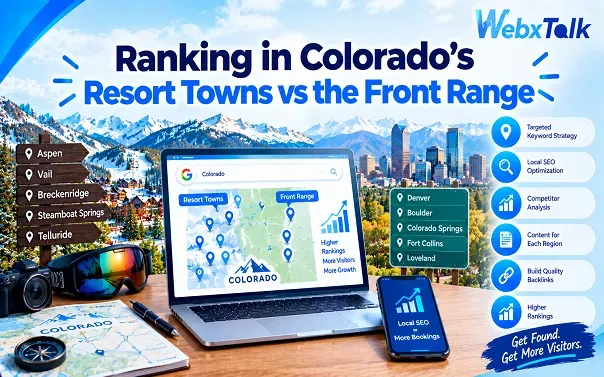
Ranking in Colorado’s Resort Towns vs the Front Range
Pitkin County, home to Aspen, has only around 18,000 year-round residents, while Summit County has about 31,000 and welcomes roughly 1.9 million visitors. Eagle County, where Vail and Beaver Creek are located, sees around 1.5 million visitors as well. Across five Colorado mountain counties, visitors spent about $3.4 billion and supported roughly 40,100 jobs. This makes SEO services in Colorado a little different for resort businesses that serve a much larger visitor audience.
That is why resort towns work differently from regular cities. Along the Front Range, most local searches come from people who live nearby. In mountain towns, many searches come from travelers who may only stay for a few days or weeks. Colorado resort town SEO needs to account for that difference and focus on both local residents and visitors.
Key takeaways
- Pitkin County has roughly 18,000 residents, while Aspen’s search demand is national and international
- Summit County has about 31,000 residents and receives approximately 1.9 million visitors
- Across five mountain counties, visitors spent $3.4 billion, around $24,000 per permanent resident
- Visitor spending supported 40,100 jobs in those counties, about 41% of all employment
- Resort search demand is overwhelmingly non-local, so proximity-based targeting misfires
- Short-term rental bookings across Colorado resort markets fell between 5% in Vail and 35% in Telluride
- Front Range and resort markets need entirely separate strategies within the same state
Why does resort town search work differently?
Because the searcher is usually not there yet. In a Front Range city, most local searches come from people already in the area. In a resort town, the majority of commercially valuable searches come from people planning a trip from somewhere else, often months in advance.
Proximity targeting misfires
Google uses the local results to promote businesses in the immediate vicinity of the people searching. This is fine for services in your area, but not so great for resorts. A traveler that’s thinking of going skiing can be looking for a vacation from Dallas, Chicago, or even London all the way before heading to Colorado. Local map results still have their relevance once in the town, but a lot of the research and booking takes place elsewhere.
Two distinct audiences in one place
The resident population needs everyday services: groceries, healthcare, trades, childcare, vehicle repair. The visitor population needs lodging, equipment, dining, guiding, transport and activities.
A business serving both is serving two markets with different vocabulary, different timing and different channels. Most resort businesses skew heavily to one, and content should reflect which.
The resident base is too small to build on
With 18,000 people in Pitkin County and 31,000 in Summit County, a business relying on resident search volume alone has very little to work with. The volume is in the visitors, and visitors are not searching from inside the county.
What is actually happening to resort demand?
Bookings are contracting. AirDNA reported short-term rental bookings across ski destinations down roughly 5% overall, with Colorado resort markets falling anywhere from 5% in Vail to 35% in Telluride. The variation between markets is as important as the average.
Individual markets diverge sharply
A 5% decline in Vail and a 35% decline in Telluride are not the same market condition. Businesses reading a headline national figure and applying it locally will misjudge their own position badly.
Ski town marketing in Colorado planning needs market-level data rather than category averages, because the spread between resort markets is wider than the spread between ski and non-ski destinations nationally.
Supply is adjusting too
Breckenridge had 3,289 active short-term rental listings as of August 2026, with active listings down 43% year over year while average revenue per listing rose 35.4%. Occupancy fell 10.4% to around 51% and average daily rate declined 4.9% to $581.
Fewer listings earning more each is a consolidating market rather than a collapsing one, which is a different strategic situation from a simple downturn.
Published figures conflict, and explaining that is valuable
Public data often doesn’t match up, and that is a thing that needs to be explained rather than ignored. The average daily rate for Breckenridge was $658.80 to $590, with AirDNA reporting occupancy rates around 53% and AirROI reporting rates of around 41%. The distinction lies in the manner in which each company gathers and analyzes their data. If a business clarifies that and directs readers to the sources, they have more useful and trustworthy information.
Which resort queries are actually winnable?
Planning, logistics, conditions and comparison content. Resort brand names belong to the operators, and booking terms belong to the platforms. What remains open is everything a visitor needs to decide and everything they need once they arrive.
Concede brand and booking terms
Resort names are navigational searches by people who already chose. Accommodation booking terms are held by platforms with inventory scale no individual property matches.
Competing for either reliably wastes budget.
Planning and comparison content
People often need help deciding which resort is right for their skill level, whether to stay in Summit County or Eagle County, how much a trip will cost, when to book, and which weeks are less busy. They may also want to understand how multi-resort passes work.
These are useful questions, but individual resorts are unlikely to give unbiased comparisons with their competitors. That creates an opportunity for local businesses and independent websites to provide practical advice that helps visitors make better travel decisions.
Logistics and access content
Travelers often need simple, practical details, like how to get from DIA, where to park, whether a shuttle is available, and what to expect with winter driving or chain laws. They may also need tips for altitude or an alternate route when I-70 is backed up. These are real questions visitors have, but many local sites barely cover them.
Cost transparency
Breckenridge is expensive, with a cost-of-living index of 144.9, about 44.9% higher than the U.S. average. Visitors also spend around $301 per person each day, so many people want to know what their trip will actually cost. Clear breakdowns for different seasons and travel budgets can be especially useful because this information is not always easy to find.
How should the seasonal calendar work?
With longer lead times than metro markets. Resort trips are booked months ahead, frequently four to six for the best value, which means content has to rank before the planning window opens rather than before the season starts.
Publish for the planning window, not the season
Winter season content needs to be ranking by late summer, because booking research for a January trip often begins in September or October. Content published in November serves the following year.
Seasonal resort demand therefore requires an earlier publishing deadline than a metro business would assume.
Summer is a genuine second season
Resort towns increasingly run summer operations with hiking, mountain biking, festivals and events. That content needs publishing by February or March, and it faces far less competition than the winter equivalent.
Shoulder seasons are nearly empty
Mud season in April and May and the pre-snow period in October and November carry real activity and almost no dedicated content. For a business with capacity, that is the cheapest demand available in these markets.
What about the local side of resort businesses?
It still matters for arrived visitors and for residents, and the usual rules apply. Each mountain town returns its own local pack results, and the towns are genuinely separate markets despite being clustered in the same counties.
Towns are separate, not interchangeable
Breckenridge, Frisco, Silverthorne, Dillon and Keystone all sit in Summit County and return their own local pack results. Vail, Avon and Beaver Creek do the same in Eagle County.
A business in one does not rank in the next, regardless of the short drive.
The arrived-visitor search is high intent
Someone already in town searching for dinner, equipment rental or a guide is minutes from a decision. Profile completeness, accurate hours and current reviews decide that entirely.
Seasonal hours must be updated
Resort businesses frequently change hours or close between seasons. Profiles that do not reflect that produce wasted journeys and poor reviews at exactly the moments that matter.
Review recency is decisive with visitors
Visitors have no local network and rely on reviews completely. Review recency ranks among the top local ranking factors and roughly 74% of consumers look for reviews from the last three months.
With a customer base that turns over entirely each season, continuous review collection matters more here than in a market with repeat local customers.
Conclusion
There are two very unique search markets in Colorado. The Front Range is primarily business-to-consumer (B2C), and resort regions are business-to-tourist (B2T). For businesses in communities such as Summit and Pitkin, the ratio of tourists to year-round residents can be much higher, which presents a different kind of challenge in reaching individuals.
This is because the same strategy won’t be effective in all places. Resort businesses have to overcome the challenge of creating content that will help people to plan, compare prices, find their way around and make booking decisions at the right time. Local listings and reviews should also be regularly updated to reflect the seasonal variation in its customer base. That’s because booking patterns can differ greatly from town to town. Webxtalk considers this distinction when developing Colorado SEO services, and plans for resort towns and Front Range cities differently from one another.
Frequently asked questions
Why is resort town SEO different from city SEO?
Most of the valuable searches are of people who aren’t there yet. The majority of the market is not targeted based on proximity, such as resort counties with about 18,000 people each, compared to the national search demand
How large is the visitor-to-resident gap in Colorado resort counties?
Summit County has about 31,000 residents and receives approximately 1.9 million visitors. Across five mountain counties, visitors spent $3.4 billion, roughly $24,000 per permanent resident, supporting 40,100 jobs or about 41% of all employment.
Are Colorado resort bookings declining?
By market. Thus, AirDNA found ski destination short-term rental bookings were down approximately 5% overall, with an average of Colorado resort markets ranging from a 5% drop in Vail to a 35% drop in Telluride, and no averages can be used as a reliable indicator of any single market.
When should resort town content be published?
Earlier than for metro markets. Winter content should rank by late summer because booking research for a January trip often begins in September or October, with the best value typically found booking four to six months ahead.
Which resort searches can an independent business win?
Planning and comparison content, logistics and access guidance, conditions information, and honest cost breakdowns. Resort brand names are navigational, and booking terms belong to platforms with inventory scale no property matches.
Do mountain towns in the same county compete separately?
Yes. All of these communities are located in Summit County and provide separate local pack results to Breckenridge, Frisco, Silverthorne, Dillon, and Keystone. Short distance from one business to the next, but one does not rank in the next.
Why do published resort occupancy figures disagree?
The methodologies and the samples used to create the list vary by tracker. For the same Breckenridge period, one source reported around 53% occupancy at $658.80 while another reported 41% at $590. Acknowledging that discrepancy with sources is establishing real authority.





 Yes, I Want Growth