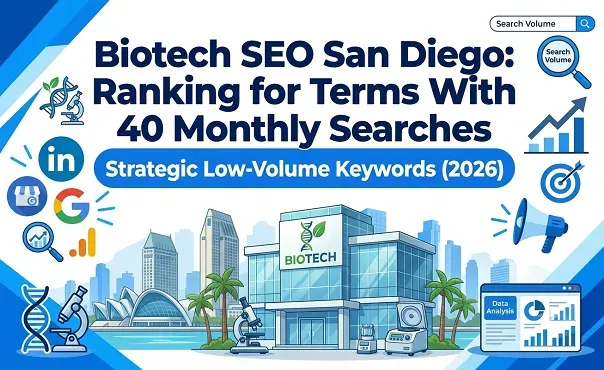
Biotech SEO San Diego: Ranking for Terms With 40 Monthly Searches
Success in biotech SEO San Diego comes from ranking for precise, low-volume technical searches, not big category terms. A keyword with 40 monthly searches can be worth more than one with 4,000 when a single new client might bring in hundreds of thousands of dollars.
Life sciences is a major part of San Diego’s economy. In 2024, around 2,000 companies employed more than 71,000 people and generated about $54.1 billion in economic output. The biggest cluster sits on the Torrey Pines Mesa and stretches into Sorrento Valley, Sorrento Mesa, La Jolla and Carmel Valley, and UC San Diego alone brought in $1.7 billion in research funding in FY2025.
The catch is that standard keyword tools hide this value. A term with a handful of monthly searches looks too small to bother with, until you remember who is searching and what one deal is worth. So in this niche, judge a search by its value, not its volume, and choose partners offering the best SEO services in San Diego who understand how scientists actually search and buy.
Key takeaways
- San Diego had roughly 2,000 life sciences companies, around 71,448 workers and $54.1 billion in economic output in 2024.
- The Torrey Pines Mesa houses over 1,200 biotech and life sciences companies in a single corridor.
- UC San Diego secured $1.7 billion in research funding in FY2025.
- Alexandria Real Estate signed its largest-ever life science lease, 466,598 square feet at Campus Point, with construction starting in 2026.
- The $1.9 billion Research and Development District is adding lab and innovation space downtown.
- Scientists search by technique, assay, instrument, catalogue number and specification, not by commercial terms.
- In life sciences, low volume high value keywords carry more revenue potential than high-volume category terms.
Why do high-volume keywords fail in biotech SEO San Diego campaigns?
High-volume keywords fail in life sciences because the buyer is a scientist checking a technical requirement, not a consumer browsing options. Scientists search by assay type, instrument model, reagent specification, catalogue number or published protocol. Those terms are precise, low in volume and almost completely uncontested.
The searcher already knows what they need
A principal investigator sourcing an antibody, a sequencing service, a contract research organisation (CRO) or a specialist instrument is checking whether a supplier meets a specification. They aren’t browsing.
That’s why scientific buyer search uses the language of the method, not the language of the market. A vendor page written in sales language matches none of it.
Precision makes terms uncontested
Phrases like “leading provider” and “cutting-edge” appear on nearly every competitor’s website and don’t set anyone apart. Technique names, assay formats and instrument models are far more useful, because they match exactly what a researcher types. These low volume high value keywords bring fewer visitors, but the traffic is highly relevant and the competition is thin.
The revenue per search is extraordinary
In consumer marketing, a keyword with forty monthly searches would be dropped. In life sciences, some of those forty searches could come from a lab about to commit to a multi-year platform, a CRO contract or a major instrument. Pick keyword targets by search volume instead of revenue per qualified visit, and your list will be wrong in this industry.
What is actually happening in the San Diego cluster?
The San Diego life sciences cluster is growing fast, with major new lab space on the Torrey Pines Mesa and a second hub forming downtown. The region is home to research institutes such as the Salk Institute, Scripps Research and UC San Diego, and companies like Illumina, Dexcom and Neurocrine Biosciences. Alexandria Real Estate signed its largest-ever life science lease, 466,598 square feet at Campus Point, with construction starting in 2026. Downtown, the $1.9 billion Research and Development District has the J. Craig Venter Institute as its first life sciences tenant, with more than 3.2 million square feet of lab and office space delivered or planned.
The corridor is physically growing
Torrey Pines, Sorrento Valley and University Town Center are among the busiest lab and R&D construction areas in the country. The City of San Diego also runs a Life Science Industry Accelerator that speeds up permitting.
Vendors serving this expansion are selling into a growing market, and content that reflects these specific developments reaches buyers who are planning around them in the Torrey Pines corridor.
Cost advantage sustains the cluster
Lab space on the Torrey Pines Mesa costs roughly 30 to 40% less than comparable space in Cambridge. That gap is a real reason companies choose San Diego, and for life sciences marketing, San Diego vendors can use it as a genuine selling point.
Downtown is becoming a second node
The Research and Development District is bringing life sciences to East Village without pulling it away from the Torrey Pines corridor. For vendors, that means a second cluster of customers where none existed before.
Talent moves freely
California doesn’t enforce non-compete agreements, so scientists in Sorrento Valley, Torrey Pines and University City move between competitors freely. Information spreads quickly, and reputation matters more here than in most markets.
Which biotech queries are actually winnable?
The winnable biotech queries are specific searches about techniques, assays, instruments, applications and troubleshooting. Big suppliers and major publishers dominate broad biotech terms, but the detailed questions researchers ask are far less crowded.
Technique and protocol pages
Create a useful page for each major technique, assay or application. Explain what it’s used for, when it makes sense, what the alternatives are and what people commonly get wrong. It’s the kind of life sciences marketing San Diego researchers actually respond to, because it gives practical answers instead of another generic service page.
Troubleshooting and failure-mode content
Researchers search for answers when an assay gives an odd result, a reagent doesn’t behave as expected or a protocol won’t reproduce. Most of the useful answers are scattered across forums. A supplier that gives clear, practical fixes earns trust early, often long before the researcher is ready to buy.
Specification and compatibility content
Technical details decide purchases. If your specifications only live in PDFs, they’re harder for search engines and AI tools to pull from. Put the equipment data directly on the web page so Google can extract it and match it to the right searcher.
Regulatory and compliance content
For clinical, diagnostic and GMP-adjacent suppliers, content on the regulatory pathway answers the questions that stall purchases, and almost nobody publishes it clearly.
How long are life sciences buying cycles?
Life sciences buying cycles are long. Researching, evaluating, budgeting, procuring and installing instruments and platforms can take 12 to 24 months. Services and reagents move faster but still include a validation period, so content published today can shape purchases made next year.
Evaluation happens invisibly
A researcher identifies candidate suppliers, checks specifications, reads published methods and rules out most options before contacting anyone. This stage of scientific buyer search is completely invisible to the vendor.
Fail the specification check in month one and no amount of sales effort can recover it later. You were removed before anyone knew you were being considered.
Grant cycles govern timing
Academic and institutional purchasing often follows grant awards and the fiscal year. Suppliers need to be visible during the planning months, before budgets are released.
Multiple stakeholders evaluate separately
One person rarely makes the decision. The principal investigator cares about the science, the lab manager about ease of use, and procurement about pricing, contracts and paperwork. Each has different questions, so the website needs content that helps all of them.
Measure at twelve months
The first sign of progress is usually more traffic to technique and specification pages, without an immediate jump in enquiries. Agree upfront that content built around low volume high value keywords will be judged on qualified enquiry quality at month twelve, not traffic at month three.
What do most San Diego biotech sites get wrong?
Most San Diego biotech sites make three mistakes: they lock technical information inside gated PDFs, they write capability pages in marketing language, and they don’t name scientific authors. Each one undermines biotech SEO San Diego efforts, because it removes the supplier from the exact searches its buyers run.
Datasheets sit in PDFs behind forms
This is the most common and most expensive mistake in the sector. Specifications, validation data, protocols and application notes get published as downloadable PDFs, often behind a lead capture form. It’s a habit that quietly undercuts life sciences marketing, San Diego included.
Search engines read HTML far more easily than PDFs, and many AI tools struggle to read PDFs at all. Publish specifications on indexable web pages and offer the PDF as an extra download.
Capability pages describe rather than specify
A page saying a company “provides innovative solutions for life sciences research” matches nothing anyone searches for. The version that ranks names the techniques supported, sample types handled, detection limits, throughput and validation performed, which is exactly what scientific buyer search looks for.
It reads worse to a marketer and much better to a scientist.
No named scientific authors
Scientists judge credibility by people and sources. Content written by a named scientist with real credentials carries weight that a corporate byline never will. In the Torrey Pines corridor, where the scientific community is dense and people change jobs often, a named author’s reputation also travels through real professional networks.
Does AI search matter in life sciences?
AI search matters a lot in life sciences, because technical questions are exactly what tools like ChatGPT, Perplexity and Google AI Overviews summarise, and almost no suppliers compete for them yet. Researchers increasingly use AI for method selection, troubleshooting and comparisons, and the source with the clearest answer gets cited. That makes AI visibility a natural extension of biotech SEO San Diego work.
Technical questions have definable answers
Researchers often want simple, factual answers: how a particular assay handles a certain sample type, how two methods compare, or why they keep getting the same odd result. These answers are clear and backed by data. Content that targets these low volume high value keywords gives a supplier a strong chance of becoming a trusted, repeat source, yet few San Diego life sciences companies produce it.
Access is the binding constraint
PDF-only datasheets, gated application notes and JavaScript-rendered product configurators all hide content from AI tools. Life sciences suppliers are among the worst offenders of any sector.
Fixing crawler access helps traditional search and AI citations with the same work.
Citations compound in a mobile community
Because California doesn’t enforce non-competes and scientists move often between Torrey Pines and Sorrento Valley employers, a supplier known for useful technical content builds a reputation that travels with people across the cluster.
Conclusion
Life sciences is a growing part of San Diego’s economy. According to Biocom California’s Life Science Economic Impact Report, the region had around 2,000 companies, more than 71,000 direct employees and about $54.1 billion in economic output in 2024. More than 1,200 businesses sit around Torrey Pines, and new developments keep adding space for the industry. Reaching these companies online isn’t like marketing to a general audience, because researchers search for very specific things: a method, an assay type, an instrument or a product number.
That’s why search volume doesn’t tell the full story in biotech SEO San Diego. A keyword with 40 monthly searches could bring in a client with a budget of hundreds of thousands of dollars. Webxtalk’s San Diego SEO services focus on these high-value searches instead of chasing big numbers, with content that answers real technical questions, shows specifications clearly and makes it obvious who’s behind the information.
Frequently asked questions
How large is San Diego’s life sciences cluster?
San Diego’s life sciences cluster had about 2,000 companies, 71,448 jobs and $54.1 billion in total economic output in 2024. It’s one of the three largest clusters in the US, alongside Boston-Cambridge and the San Francisco Bay Area.
Why do low-volume keywords work in biotech?
Low-volume keywords work in biotech because low search volume doesn’t mean low value. The people searching are often scientists looking for very specific information, and a single search can come from a lab planning a major purchase.
How do scientific buyers actually search?
Scientific buyers search for very specific details: a technique, assay type, instrument model, reagent specification, catalogue number or the name of a published protocol. These searches are far more focused than broad commercial terms.
Should technical datasheets be PDFs or HTML?
Technical datasheets should be published as HTML pages, with the PDF offered as an extra download. When a datasheet only exists as a PDF, search engines and AI tools find it harder to read and use the information inside.
How long do life sciences buying cycles run?
Life sciences buying cycles for large instruments and platforms can run 12 to 24 months. Buyers spend months researching options, testing products, getting budget approval and going through procurement, so content published today may help win a sale much later.
Is San Diego’s biotech cluster still growing?
Yes, San Diego’s biotech cluster is still growing. Alexandria Real Estate signed a 466,598-square-foot life science lease at Campus Point, and the $1.9 billion Research and Development District is adding space downtown, with more than 3.2 million square feet delivered or planned.
Why does named authorship matter in life sciences content?
Named authorship matters because researchers judge credibility by people and publications. A named scientist with links to their publications and employers carries credibility a generic byline doesn’t, and in San Diego’s mobile scientific community, that recognition stays with the person.



 Yes, I Want Growth