
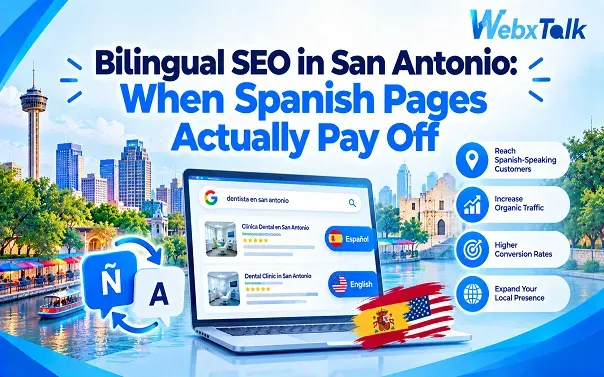
Bilingual SEO in San Antonio: When Spanish Pages Actually Pay Off
The American Community Survey data from the Census Bureau shows that 64.7% of San Antonio is Hispanic or Latino and 37.9% of households indicate Spanish is spoken in the home. According to a study by Preply, the 25 largest cities in the United States had bilingual residents, with San Antonio having almost 30% of its population speaking two languages, ranking fourth in the country.
Those numbers convince many companies to hire a website translation service to convert their website into Spanish. Those translations yield virtually no leads. The issue is not the choice of publishing in Spanish, but rather that translation and localisation are distinct activities, with only one yielding search visibility. To get bilingual seo San Antonio right, you need to understand which of your services has actually got Spanish-language search demand, and it’s well worth taking the time to get it right before you dedicate budget to the best SEO services in San Antonio.
Key takeaways
- San Antonio is 64.7% Hispanic or Latino, with 37.9% of households reporting Spanish spoken and 58.2% reporting English only
- Nearly 30% of residents are bilingual, ranking San Antonio fourth among the 25 largest US cities in a Preply analysis
- Bilingual residents frequently search in English even when they speak Spanish at home, which is why demographic share alone is a poor guide to Spanish keyword volume
- Machine-translated pages fail because Spanish search terms are often not translations of the English terms
- Spanish demand concentrates in specific categories such as healthcare, legal, insurance, home services, and immigration-adjacent professional services
- Bexar County’s Spanish is predominantly Mexican, which changes vocabulary choices in ways generic Latin American Spanish does not cover
- Around 14% of San Antonio residents are foreign-born, a smaller share than the Hispanic percentage suggests
Why does a large Hispanic population not automatically mean Spanish search demand?
Language spoken at home and language used for search are different behaviours. A bilingual San Antonio resident may speak Spanish with family and search Google in English, particularly for professional services, technical topics and anything researched at work. Demographic share tells you who lives there; it does not tell you which language they type in, which is why spanish seo san antonio requires more than demographic data alone.
Household language and search language diverge
Census data shows 58.2% of San Antonio households report speaking English only, while 37.9% report Spanish. Those figures describe the home, not the browser. Spanish language search behaviour can differ significantly from household language patterns.
Bilingual users routinely default to English for search because English results are more numerous, because their professional vocabulary is English, or simply out of habit. A business that understands bilingual seo san antonio must recognize that 37.9% of its potential search volume is not necessarily Spanish and avoid overbuilding and underperforming.
Generational patterns matter more than totals
The Hispanic population in San Antonio is not composed of recent immigrants, but of long-term residents. Nearly 14% of residents are foreign-born, a rate much lower than that Hispanic residents would suggest based on the 64.7% of the population who are identified as Hispanic.
This generational gap also has a significant impact on search habits. Third- and fourth-generation residents tend to do an English search, while Spanish searches are more common with first-generation and older residents – particularly by a family member on their behalf, which is important for spanish seo san antonio.
The proxy searcher is a real pattern
In many San Antonio households, an English-dominant adult child researches services for a Spanish-dominant parent. The search happens in English; the service delivery must happen in Spanish. Bilingual SEO San Antonio strategies need to account for this pattern.
That combination is invisible in keyword data and decisive in conversion. It means English pages that clearly state Spanish-speaking staff availability often outperform full Spanish pages for the same customer.
Which categories genuinely carry Spanish search volume?
Spanish search demand in San Antonio concentrates in healthcare, legal services, insurance, home and trade services, financial services, and anything with a documentation or compliance component. It thins out sharply in B2B, technology, professional consulting, and most retail, where even Spanish-dominant users tend to search in English.
High-demand categories
Medical and dental practices, personal injury and family law, immigration-adjacent professional services, insurance, tax preparation, home repair and construction trades all show meaningful Spanish query volume in this market, making spanish seo san antonio particularly relevant for these businesses.
These share a pattern: the stakes are high, the terminology is unfamiliar, and getting it wrong has consequences. Users default to their most comfortable language when precision matters personally.
Low-demand categories
B2B services, software, marketing, engineering, professional consulting and most retail categories show thin Spanish volume even in a majority-Hispanic city. The vocabulary of those fields is English-dominant regardless of the user’s home language.
Building spanish seo san antonio pages for these categories usually produces indexed pages with no traffic, which is a cost with no offsetting return.
The test before you translate anything
Pull search volume for your actual service terms in Spanish before deciding. If the Spanish variants show negligible volume while the English variants show healthy volume, you have your answer regardless of what the demographic data suggests. This is especially useful when evaluating spanish seo san antonio opportunities.
This one check prevents most wasted bilingual investment.
Why do translated pages fail to rank?
Because Spanish search terms are frequently not translations of English search terms. Users search using the words they would actually say, which vary by country of origin, by generation, and by region. A grammatically correct translation of your English page can miss every term real users type.
Translation produces the wrong words
A translator converts your English phrase into correct Spanish. A searcher types the colloquial term their family uses. These are often different words entirely, and only one of them has search volume.
Spanish language search behaviour requires keyword research conducted natively in Spanish, not translation of an English keyword list. That is a different piece of work with a different cost, and skipping it is why most bilingual projects produce nothing.
Bexar County Spanish is specifically Mexican
San Antonio’s Hispanic population is predominantly of Mexican descent. Vocabulary, idiom, and even service terminology differ meaningfully between Mexican Spanish and the Caribbean or South American varieties.
Generic Latin American Spanish, which is what most translation services default to, sits between all of them and matches none precisely. For a market this concentrated, that mismatch costs relevance.
Accents and spelling variation break exact matching
Users search with and without accents inconsistently. Content should account for both forms naturally rather than assuming search engines normalise perfectly in every case.
This is a small technical point that separates pages built by someone who works in Spanish from pages built by someone translating into it.
How should bilingual pages be structured technically?
Use separate URLs for each language with hreflang annotations linking them, never automatic redirection based on browser language or IP. Automatic redirection prevents proper crawling and indexing of both versions, which is the most common technical failure in bilingual implementations.
Separate URLs with hreflang
Each language version needs its own indexable URL. Implement hreflang Spanish and English annotations declaring the relationship between them, with a self-referencing tag on each page.
This lets search engines index both versions and serve the appropriate one, rather than treating one as duplicate content or missing it entirely.
Never auto-redirect by language or location
Automatic redirection based on browser settings or IP address stops crawlers from reaching one version. It also frustrates bilingual users who want the other language, which is a substantial share of your San Antonio audience.
Offer a visible, persistent language switcher instead and use hreflang Spanish/English to help search engines understand the language versions.
The Google Business Profile stays in one language
Profile content should be in the primary language of your customer base, with Spanish capability communicated through services, attributes, and description rather than by duplicating the profile. For businesses targeting both audiences, hreflang spanish english can help search engines distinguish between the English and Spanish versions of the website without creating a separate profile.
Creating a second profile for the Spanish version violates guidelines and risks removal. San Antonio local seo work should treat language as an attribute of one listing rather than as grounds for a second one.
What works better than full translation for most businesses?
A partial approach: keep the site in English, publish Spanish versions only for the pages with demonstrated Spanish search volume, and make Spanish-speaking staff availability explicit throughout. This captures the demand that exists without the cost of maintaining a fully duplicated site.
Translate the pages that earn it
If three of your twenty service pages show real Spanish volume, translate three. The other seventeen stay English.
Partial bilingual sites are common, effective and far cheaper to maintain than a full mirror that goes stale within a year, making bilingual seo san antonio a more practical approach for targeted pages.
Signal Spanish capability on English pages
Because so many searches happen in English for Spanish-language service delivery, stating clearly on your English pages that Spanish-speaking staff are available captures the proxy searcher pattern described earlier.
This costs nothing and addresses a demand pattern that keyword tools cannot show you.
Maintain what you publish
A Spanish page that has not been updated in two years while its English equivalent has been revised four times signals neglect to users and staleness to search engines.
If you cannot commit to maintaining both versions, publish fewer Spanish pages and keep them current. Half a bilingual site done properly beats a full one left to decay.
Does neighbourhood geography affect language targeting in San Antonio?
Yes, meaningfully. San Antonio’s Spanish-dominant population concentrates in the West Side and Southside, while northern areas including Stone Oak and Alamo Heights skew more English-dominant. Local pack results are anchored to searcher location, so language demand varies by where in the city your customers are.
The city is linguistically uneven
Language distribution across San Antonio is not uniform. Southern and western districts show substantially higher Spanish usage than northern districts.
A business with one location serves a specific slice of that distribution, and its language strategy should reflect its actual service radius rather than citywide averages.
Location strategy and language strategy interact
If your business sits in a northern district and your customers come from surrounding neighbourhoods, citywide Hispanic percentages overstate your Spanish opportunity considerably.
If you serve the West Side or South Side, the opposite applies and san antonio local seo may deserve more investment than a citywide average would suggest.
Multi-location businesses may need different approaches per site
A business with locations across the city can reasonably run a Spanish-forward approach at one and an English-first approach at another. Treating language as a citywide policy rather than a per-location decision leaves performance on the table in both directions.
Conclusion
San Antonio’s demographics make Spanish content look obviously worthwhile, and for some categories it genuinely is. Healthcare, legal, insurance, tax and trade services all carry real Spanish query volume in this market. What the demographics do not tell you is that a bilingual resident often searches in English regardless of what they speak at home, that around 14% of residents are foreign-born against a 64.7% Hispanic share, and that an English-dominant adult frequently searches on behalf of a Spanish-dominant parent. Those patterns are why translated sites so often sit indexed and idle.
The approach that works is narrower and cheaper than a full translation. Check Spanish volume for your actual service terms first, translate only the pages that earn it, conduct keyword research natively in Spanish rather than converting an English list, use separate URLs with hreflang instead of automatic redirection, and state Spanish-speaking availability plainly on your English pages. Webxtalk builds San Antonio SEO services around that sequence, because in this market the expensive mistake is not skipping Spanish content, it is publishing it everywhere without checking where the demand actually sits.
Frequently asked questions
Should every San Antonio business have a Spanish version of its website?
No. Demand for Spanish search focuses on healthcare, legal, insurance, and tax/travel services. In a city that is predominantly Hispanic, some B2B categories, technology, and most retail categories present thin Spanish volume, due to the fact that the working vocabulary in these areas is English-dominant.
Why does my translated Spanish page get no traffic?
Typically due to the fact that Spanish query items are not the same translation of the English terms. Users use the words they say – which can be different depending on origin and generation. The process of keyword research should be done in Spanish and not translated from an English keyword list.
How much of San Antonio actually speaks Spanish?
According to census data, 64.7% of the population identifies as Hispanic or Latino, with 37.9% of households reporting speaking Spanish, and 58.2% of households reporting English only. Nearly one in three residents is bilingual, making the city the fourth most multilingual city in the United States, according to a study by Preply.
Should Spanish pages use separate URLs or the same page?
Use hreflang annotations with separate URLs for each language version, with a self-referencing hreflang tag. It will not crawl one version of the pages and will frustrate bilingual users desiring to switch to another version.
Can I create a second Google Business Profile for Spanish?
No. This is in contravention of Google’s guidelines and could lead to removal. Have one profile in your customers’ native language, and use the services, attributes, and description fields to communicate your Spanish-speaking ability.
Does the type of Spanish matter in San Antonio?
Yes. The Hispanic population in San Antonio is Mexican Americans and there are significant differences in vocabulary from the Caribbean or South American varieties. Most of the translation services generally use the generic code of Latin American Spanish, which doesn’t match any of them exactly.
What is the cheapest way to capture Spanish-speaking customers?
Be sure to clearly put the number of Spanish-speaking staff members on your English pages. Many searches occur in English for delivery of Spanish-language services, typically by an English-dominant family member on the instructions of a Spanish-dominant family member.




 Yes, I Want Growth