
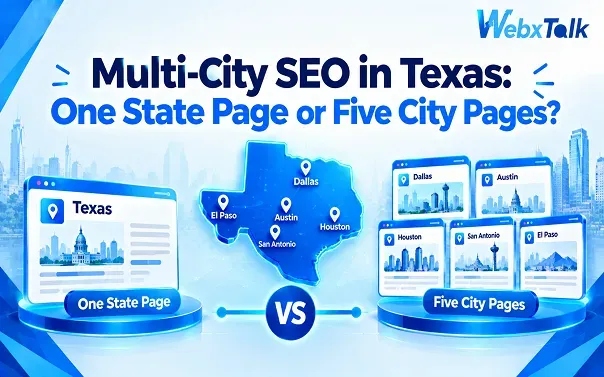
Multi-City SEO in Texas: One State Page or Five City Pages?
The state of Texas is unique in that a number of the largest cities are also markets of their own. Dallas and Austin, and even more importantly, San Antonio, have large and growing business bases, and Houston has over 2 million inhabitants. Fort Worth is also right on the heels of them. These cities form a considerable portion of the Texas Triangle that accounts for a significant portion of both the state’s population and its economic activity.
This adds a bit to the complexity of SEO. A business attempting to market to customers throughout Texas is not marketing to a market. The same person wanting to look for a family dentist in Houston may have different requirements than an individual looking for a dentist in Austin or Dallas. Therefore, the Texas SEO plan should consider each market and not the state as a whole. Having the right foundation would have a huge impact in selecting the best SEO services in Texas.
Key takeaways
- Texas holds four of the ten most populous US cities, a distinction no other state has
- The Texas Triangle contains roughly 22.5 million people, over 66% of the state’s population, and generates about 77% of its GDP
- Google returns separate local pack results for each incorporated city, so a state page cannot win local placement anywhere
- State pages serve a real but narrow purpose: capturing statewide-intent queries and acting as a hub linking down to city pages
- City pages only work when the content could not have been written about a different city
- Deleting city pages to fix cannibalisation removes you from the searches that carry the volume
- Most businesses need both, structured as a hierarchy rather than as alternatives
Does a Texas state page rank for anything useful?
Yes, but for a smaller number of queries than most businesses think. State pages are useful for searches that show genuine statewide intent, usually in areas where services are delivered remotely, regulated at the state level, or are truly location-independent. The good thing is that they cannot gain a spot in the Texas local pack because they need a verified address in a specific city.
Statewide intent is real in specific categories
Statewide searches make sense for certain types of businesses; for example, someone looking for a Texas business filing service, an insurance broker licensed across Texas, or a professional service they can use remotely may not care where the provider’s office is located. Their goal is to find a service that operates across the state, which is where a texas seo strategy can focus on reaching customers beyond a single city.
For these kinds of businesses, a dedicated state-level page can work as the right asset. But this changes when the service requires someone to physically visit the customer. In those cases, people are more likely to search for a provider nearby, so statewide searches tend to have lower volume and weaker local intent.
The local pack is closed to state pages
Google’s local results are connected to the searcher’s device location and the verified address of businesses. A page targeting Texas cannot appear in a Houston or Dallas local pack because the pack requires a physical location in that municipality.
That single mechanic explains much of the state page vs city pages debate. If your revenue depends on map placement, a state page cannot substitute for a city presence, which is why Texas location pages remain important for businesses targeting specific local markets.
State pages work best as hubs
The most valuable function of a Texas page for most businesses is not ranking; it is routing. It gives search engines a clear parent for your city pages, gives users a way to find the right location, and creates a stronger multi city seo texas structure by connecting those locations under one state-level hub.
Treated as a hub rather than as a competitor to your city pages, it earns its place regardless of how much traffic it captures directly.
When do city pages actually outperform a state page?
Local service delivery at any time when the customer is expecting local delivery of services. It’s for most services, everything retail, all trades, healthcare, hospitality, legal and any B2B where buyers would like to have a vendor in their metro. Otherwise, the city-level search volume is significantly higher than the statewide search volume since buyers are looking for products in their local city instead of their state.
Buyers search cities, not states
Someone in Plano searches Plano or Dallas. Someone in Sugar Land searches Sugar Land or Houston. Almost nobody searching for a local service adds the word Texas. That is why multi city seo texas approaches consistently outperform statewide targeting for local service categories. The volume simply sits at the city level, which makes this an important part of a broader texas seo strategy.
Intent is stronger at city level
A search with a city name gives you a better idea of both the person’s location and what they are looking for. A state-level search is broader and may come from someone who is still researching their options rather than ready to contact a business.
That difference can affect conversions. Someone searching for a service in Dallas may be closer to making a decision than someone simply searching for the same service across Texas. This is one reason the state page vs city pages question matters when planning a local SEO strategy.
Local pack placement is the whole game in many categories
For trades, healthcare, restaurants, retail, and most consumer services, the majority of clicks originate from map results rather than from organic listings. A business absent from the pack is absent from the decision regardless of its organic position.
What makes a Texas city page worth publishing?
Content that could only have been written about that specific city. Named local clients, references to actual local geography and industry, and answers to questions particular to that market. A Houston page that is your Dallas page with the city name swapped will not rank and can weaken both pages simultaneously.
The swap test decides it
A quick way to check whether a city page has enough unique value is to replace the city name with another one. If the page still reads naturally without changing anything else, it may be too generic to justify its own URL. For example, if a Dallas SEO page works just as well when you replace “Dallas” with “Austin,” there may not be enough local detail. Repeating the same template across Texas location pages can also create unnecessary keyword overlap.
Texas metros are genuinely different, so writing differently is easy
Houston runs on energy and the world’s largest medical complex. Dallas-Fort Worth runs on corporate headquarters and financial services. Austin runs on technology and a bifurcated labour market. San Antonio runs on military, healthcare, and tourism with a bilingual population.
A business that cannot find genuinely different things to say about these four markets has not looked. The differences are large, documented, and commercially relevant, giving a multi city seo texas approach plenty of room for genuinely local content.
Thin pages are a content problem, not a structural one
When several city pages target similar searches, deleting them and keeping only one Texas page may seem like an easy solution. But that can also mean losing valuable local searches. A good Texas SEO strategy should account for people searching for services in specific cities, not just across the state.
Instead of removing a thin page, improve it. Add local examples, explain the services in a way that fits the area, and include details that would not make sense on another city page. The goal is simple: each page should have a clear reason to exist and be useful to someone in that location.
How should a Texas hierarchy actually be structured?
Keep the structure simple: start with a national page if the business serves more than one state, followed by a Texas page, metro pages, and then city pages for locations where the business has a physical presence. Each page should naturally link to the next level, while city pages link back to the main Texas page. There is usually no need for city pages to link directly to one another.
Four levels, cleanly separated
The national page is designed to capture searches that happen across one or more states in the country. Texas pages target statewide searches, while metro pages target searches across Dallas-Fort Worth, Houston, Austin, San Antonio, and other major areas. City pages then focus on specific areas they serve, creating a clear structure for Texas location pages.
Each page should address a distinct kind of search, and having these separate levels makes the website easier to understand while eliminating needless duplication.
Suburbs need their own pages, not a mention
Plano, Irving, Round Rock, Georgetown, New Braunfels, and Sugar Land are separate incorporated cities returning their own Texas local pack results. Being mentioned on a Dallas or Austin page does not produce visibility in those markets.
Where you hold a verified address in a suburb, it needs a page. Where you do not, be honest that organic positions are achievable and pack placement generally is not.
Link downward in prose, not in a footer block
City links work better when they appear naturally within the page content instead of being pushed into a long footer list. For example, a Texas page can briefly mention different cities or metro areas and link to the relevant city pages as part of the sentence. Breadcrumbs can also help by showing the relationship between the state, metro, and city pages in a simple way.
Does a business need a physical location in every Texas city?
In the sense of the placement of local plants, well, yes. Service area configuration does not limit reach for certain types of queries but extends reach beyond proximity within the pack. Yes, there are organic positions that can be done from anywhere; the only question is which one of the two is your income dependent on? This distinction is an important part of the state page vs city pages question for businesses serving multiple markets.
Verified addresses are only reliable route to the pack
A real, staffed address where you meet customers is what Google’s local results require. Virtual offices, coworking mail drops, and unstaffed suites violate the guidelines and get removed, frequently after a competitor reports them. For businesses building a texas seo strategy, keeping location information accurate is therefore essential.
Service area businesses have a genuine but limited option
Defining a service radius and removing the public street address is legitimate for businesses that travel to customers. It helps for some query types and does not eliminate proximity weighting.
For businesses that travel to customers, this can support a multi city seo texas approach without requiring a physical storefront in every market. Treat it as a supplement rather than a substitute for presence in a market you intend to dominate.
Sequence rather than spreading
A fixed budget across five Texas metros produces five weak positions. The same budget on two produces two that generate leads.
Start where you already hold customers and references, add the metro with the highest concentration of your buyer type second, and leave the rest until the first two are producing enquiries. Choosing where to expand first should therefore be part of the broader texas seo strategy, rather than trying to build every market at the same time.
Conclusion
The choice between a state page and city pages does not have to be either-or for most Texas businesses. A state page can target people searching across Texas, while city pages are useful for local searches in places like Houston, Dallas, Austin, and San Antonio. City pages also work better when they connect back to the main state page, giving the website a clear structure instead of leaving each page on its own.
The content on those pages matters just as much. Each Texas market has its own audience and business environment. Houston has a strong energy and healthcare presence, Dallas-Fort Worth has many large companies, Austin has a major technology scene, and San Antonio has its own mix of military, healthcare, tourism, and bilingual communities. If the same city page could be used for every location without much changing, the content probably is not local enough. Webxtalk builds Texas SEO services around this structure first, so each page has a clear purpose and supports the others.
Frequently asked questions
Can a Texas state page rank in local pack results?
No, a state page does not have a specific business address, so it cannot appear in local map pack results for cities like Houston, Dallas, or Austin. But it can still rank in regular organic search for people looking for services across Texas.
Should I delete my city pages if they are cannibalising each other?
No, it is not required, as city pages can still be useful because people often search for services in a specific location. Instead of deleting them right away, check whether each page offers something different. Add useful local details, examples, and information that actually relate to that city.
How do I know if a Texas city page deserves to exist?
Read the page without focusing on the city name. If you can replace “Houston” with “Dallas” or “Austin” and the content still makes perfect sense, the page probably is not local enough. A good city page should have information that would not make sense on every other location page.
Do Texas suburbs need their own pages?
Where you hold a verified address, yes. Plano, Irving, Round Rock, Georgetown, and Sugar Land are separate incorporated cities returning their own local pack results, and being mentioned on a Dallas or Austin page produces no visibility there.
Which businesses genuinely need a state page as their primary asset?
Those with statewide-intent customers: business filing services, state-level licensing consultants, insurance brokers, and remote professional services where the customer does not expect anyone to arrive at their address.
How many Texas metros should a business target at once?
It is usually better to focus on a small number of metro areas instead of trying to target the entire state at once. A limited budget can be used more effectively when the focus is on one or two markets. Start with the areas where the business already has customers, then expand based on where the right audience is located.
Should city pages link to each other?
City pages do not need to link to every other city page, as too many links between them can make the site structure confusing. A simpler setup is to have each city page link back to the main Texas page, which acts as the central point connecting all locations.




 Yes, I Want Growth