
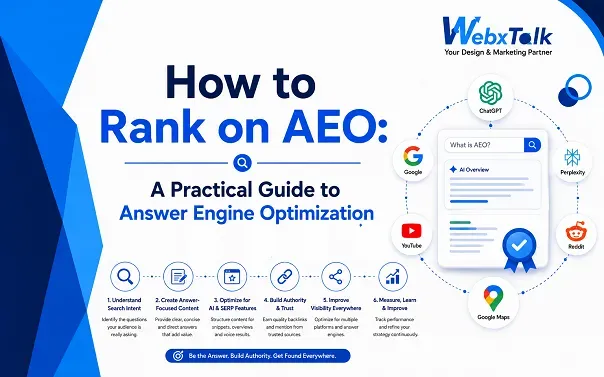
How to Rank on AEO: A Practical Guide to Answer Engine Optimization
When you type a query into Google, a summary pops up on the screen. Maybe it comes from Perplexity, or as a direct response inside ChatGPT. Either way, it saves you the hours you would have spent reading a long article, and it saves you from clicking through blue links that take you somewhere buried under a thousand words.
This is because of AEO, an extension of SEO. It is what sits behind those crisp answers you get when you type a query. But why has it become important to rank there? Is there a specific reason?
Yes, and the reason is the crowd. A growing share of people now put their questions to AI tools instead of tiring their eyes on long articles. If a large part of your audience is already there, why wouldn’t a business follow them? Of course it will. And that is why you landed on this article. So we made this guide focus purely on how to rank on AEO, unlike other articles you click on that end up explaining things far away from the topic.
What is AEO and How Does it Work?
Answer Engine Optimization (AEO) is the process of creating content that is clear, useful, and relevant to the questions users ask through search engines and AI tools. While SEO focuses mainly on improving visibility in search results, AEO focuses on making information easier to understand and use in direct answers.
For example, a search such as “How do I switch accounting software without losing old data?” requires more than a general article about accounting software. Useful AEO content would explain what data to protect, what problems may occur, and how to complete the switch safely. There is no guaranteed method for earning a citation, but clear, accurate, and relevant information can improve the chances of being considered in an answer.
How to Rank on AEO
To rank on answer engines, you need to understand the basics: what increases your AEO visibility and what does the opposite. We have put together 8 steps that help make your content visible on AI platforms.
1. Structure Content for Easy Understanding
Good structure isn’t decoration. It is what lets both readers and systems locate the specific piece of information they need without reading the whole page.
- Use headings that describe what’s actually in the section.
- Keep paragraphs short.
- Use tables for comparisons.
- Use bullets and numbered lists.
All of this makes content easier to read and easier to pull from. Well-researched content presented in a messy way will lose to clearly presented content every time.
2. Answer Questions Directly and Clearly
Suppose your answer reads like this: “Once upon a time, a scientist discovered fungi in a petri dish, and now we know it works as an antibacterial medicine.” That doesn’t help anyone. The reader wanted to know what the antibiotic is made from. Instead of saying penicillin, you told the whole story, which takes time to get through and leaves the reader frustrated.
Lead with the answer. Add the story afterwards if it is worth telling at all.
3. Build Topical Authority and Trust
Covering a topic once, well, is good. Covering it consistently, from multiple angles, over time, is what actually builds authority. If your site has one article about email marketing and nothing else related to it, that single piece is working alone. If you’ve got a dozen interconnected pieces — segmentation, deliverability, subject lines, automation, A/B testing — each one benefits from the others existing.
This isn’t about publishing more content for the sake of volume. It’s about depth. A page written by someone who’s clearly done the thing they’re describing reads differently than one assembled from other people’s summaries. Specific details, real numbers, actual outcomes — the kind of thing you only know from having done it — carry a different weight than generic advice repeated across a hundred other sites.
4. Understand What Your User is Searching For
Before you can answer questions well, you need to know what people are actually asking. Not the keyword-tool version of the question, but the real one, in the words people actually use.
Start pulling from customer support tickets, sales call notes, review sections, Reddit threads, and forums in your niche. These sources capture how people phrase problems when they’re not thinking about SEO at all, which is usually messier and more specific than what a keyword tool spits out.
For example, say you sell project management software. A broad topic like “project management” is close to useless for this purpose. Break it down into the actual questions people ask: “how do I stop projects from constantly going over budget,” “what’s the difference between Gantt charts and kanban boards for a five-person team,” “can I use [tool] if my team works across three time zones.” Each of those is something a person typed or said, not a general overview.
5. Make Your Website Easy to Crawl and Understand
This doesn’t mean you need to dig deep into technicalities, but a few factors are essential. Make sure your key pages are not hidden from crawlers. Maintain a clear, easy-to-follow site structure. Internal linking is a good way to connect related content. And use schema markup where it applies, such as FAQ, Article, or Product types. Schema tells search engines what each page is.
6. Keep Your Content Fresh and Accurate
Content loses value when the information is no longer current. An old statistic, a changed feature, or a broken source link all affect how trustworthy the page feels.
Review your important pages every so often. Check whether the facts still hold, update anything that has changed, and replace links that no longer work. The aim is to keep the page useful, not simply to stamp a new “updated” date on it.
7. Support Your Content With Reliable Sources
Claims without backing are easy to write and easy to ignore. If you are going to state something as fact, especially a number or a statistic, it needs to be checked and, where relevant, linked to something credible.
I once read an article about heart attacks that listed causes and then named specific medicines, claiming they would clear arterial blockages. Not one study was cited anywhere on the page. I didn’t believe it. So why would your readers believe you if you do the same thing?
8. Match Content With Search Intent
The words in a search query only tell you part of the story. What matters more is what the person actually wants once they type it in. Someone searching “best CRM software” might want a comparison, a recommendation, or a pricing breakdown, depending on where they are in their decision.
- Informational — the person wants to understand something.
- Comparison — they’re weighing options.
- Commercial — they’re close to buying and want detail.
- Transactional — they’re ready to act.
The same keyword can need completely different content depending on which of these applies. “CRM pricing” from someone researching options wants a breakdown of tiers and what’s included. The same phrase from someone about to buy wants a direct answer: the number, the plan, the sign-up link. Writing one generic page and hoping it serves every intent is how content ends up too vague to be useful for any of them, which also makes it too vague for an answer engine to extract cleanly.
How to Track AEO Performance
There’s no single dashboard metric that tells you “AEO is working.” Tracking it means piecing together a few different signals over time, not watching one number go up.
- Mentions and citations. Check whether your brand or content shows up in AI Overviews, chatbot answers, or voice assistant responses when you run queries related to your content.
- Visibility in answer-engine results. Look at AI search results directly and note whether the tools mention your brand at all.
- Referral traffic where measurable. People still click through for more detail after reading an AI answer. Watching which pages get those clicks tells you what readers actually wanted to know.
- Conversions. Once people land on the site, are they clicking, signing up, and buying, or just skimming and leaving?
- Changes over time. As you add more relevant, targeted, and well-structured content, does visibility improve or stay flat? That trend matters more than any single reading.
AEO vs. SEO
They both end in “EO,” so you can already tell they are related. What’s worth looking at is where they differ, even though both are forms of optimization.
| The Battleground | Traditional SEO | AEO (The New Reality) |
| The Main Goal | Rank a page in search. | Be selected as the source. |
| The User Interface | Traditional results pages. | AI answers, chats, voice bots. |
| Content Approach | Comprehensive keyword pages. | Brutal clarity plus background depth. |
| User Behavior | Scans listings, clicks links. | Reads the text. No click. |
| Visibility Metric | Position on the SERP. | Mentions and citations. |
| The Daily Focus | Keywords, backlinks, tech setup. | Schema, trust signals, direct text. |
None of this means SEO stops mattering. A page that’s poorly structured, technically broken, or invisible to crawlers isn’t going to perform well in either world. Strong SEO fundamentals are still the foundation, and AEO is what you build on top of them once that framework is in place.
Common AEO Mistakes People Often Make
- Writing for keywords instead of people. This is the most common one. We write to keep search engines happy instead of answering the question a person actually asked. Write for readers, not engines.
- Burying the answer instead of leading with it. Don’t play history teacher. Write what the question demands. Neither readers nor engines want the backstory before the answer.
- Repeating information without adding anything new. Rewriting what’s already in the top ten results, in your own words, gets you nowhere. Add something your competitors haven’t covered. That gap is your opportunity.
- Making claims you can’t back up. People trust facts and credible sources. If you present solutions with no real study behind them, it hurts both trust and rankings.
- Ignoring search intent. Someone searches “website services” and lands on a long definition of what a website is. That reader leaves frustrated.
- Overcomplicating simple answers. If a question has a one-sentence answer, give the one-sentence answer first. Add nuance only where it is needed.
- Adding FAQs purely to target more keywords. Only include questions that are genuinely useful and related to what readers want to know. A long list of unrelated or repetitive questions makes the content feel padded.
- Neglecting basic technical accessibility. If your page is blocked from crawling or buried deep in a confusing site structure, search engines will struggle to find and understand it.
- Assuming AEO guarantees citations. Doing everything right doesn’t guarantee visibility in AI search. There is no way to know for certain where an engine will pull its data from.
How to Make Your Content More Likely to Be Cited
Everything above is about building content that’s genuinely useful. This section is narrower. It’s specifically about what makes content easy to lift from and reference once it’s already solid.
Use Clear Headings, Lists, and Examples
Presentation affects whether an answer engine can isolate the exact piece of information it needs. A paragraph that buries three separate facts together is harder to extract from than three short, clearly labeled points.
Compare these two ways of presenting the same information.
Poorly presented: “When choosing a business structure, you’ll want to think about liability protection, and also tax implications matter a lot, plus there’s the question of how much paperwork is involved, which varies quite a bit depending on the state.”
Clearly presented: “Three factors matter most when choosing a business structure:
- Liability protection — does the structure shield personal assets?
- Tax treatment — how is income taxed at the business and personal level?
- Administrative burden — how much paperwork and filing does it require?”
The second version isolates each factor so it can be lifted independently. An answer engine, or a reader skimming, can grab just the piece it needs.
Add Original Insights and Useful Information
Content earns its value when you add ground reality and your own experience, the kind that is actually useful to another person. Take an article about buying a car. If you cover the warranty, the payment process, and maintenance, you have written what every competitor already wrote. But add something like this: don’t buy from a salesperson, because they are trained in persuasion and it will cost you more. Buy from a fleet manager instead, so you pay for the car rather than for the salesperson. One real insight like that sets you apart, because it lands with people in a way generic advice never does.
Use FAQs When They Actually Help
FAQs work when they answer real, distinct questions your audience actually has, the kind that come up in sales calls or support tickets. They stop working the moment they become a list of twenty loosely related questions bolted onto the bottom of a page purely to target more search terms.
A page with four genuinely useful FAQs, each answering something a reader would actually wonder, is more valuable than a page with twenty generic ones padded out for coverage. Adding more questions doesn’t automatically make a page more likely to be cited. It just makes it longer.
Final Thoughts
AEO is changing how businesses approach online visibility. It is no longer only about ranking on search engines. It is about creating content that gives clear, useful answers to the questions people are searching for.
There is no shortcut to visibility in AI-powered search. The focus has to stay on understanding your audience, creating valuable content, building trust, and making information easier to understand.
For businesses that want to improve their digital presence, Webxtalk can help create SEO and content strategies that fit the changing search landscape and connect brands with the right audience.
Frequently Asked Questions About AEO
What is AEO?
Answer Engine Optimization is the process of making content clear, well-structured, and trustworthy enough that AI tools such as AI Overviews, ChatGPT, or Perplexity can understand it and surface it to people.
Will AEO replace SEO?
No. Traditional search still exists, and AEO follows many of the same underlying rules that search engines have always used. AEO adds to SEO rather than replacing it.
Is AEO better than SEO?
Neither is better, because they serve different purposes. SEO helps your content get found and ranked, while AEO increases visibility across AI channels. The two are connected, and SEO remains the foundation of AEO.
How can I know my brand’s AI search visibility?
Monitor whether your brand appears across AI platforms such as ChatGPT, Gemini, Perplexity, and AI Overviews by running the queries your audience would ask and recording what comes back.
What is the purpose of AEO?
The purpose is to optimize your content so AI tools can easily pull information from it and reflect that content in relevant search results.
What are the top AEO platforms?
The main answer engines include Google’s AI Overviews, Perplexity, ChatGPT, and Gemini, along with voice assistants that pull from web content to answer spoken queries.
How can I find keywords and prompts for AEO?
Watch forums, Reddit, and customer platforms where real questions get asked. Use those questions in your content, which helps both readers and AI understand what your page covers.


 Yes, I Want Growth