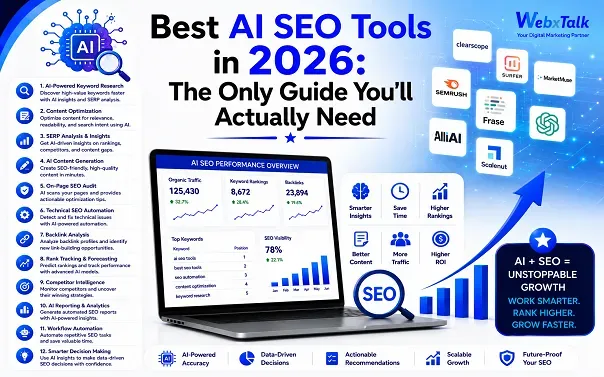
Best AI SEO Tools in 2026: The Only Guide You’ll Actually Need
You’ve been here so many times before.
You go to the Google search box and type in, the best AI SEO tools. And end up exhausting on a list that feels like it was written by someone who hasn’t used any of them. Those tools with Generic descriptions, Affiliate links are embedded in them. You lost because there are no sincere responses to the one question.
Which of these will actually help me rank?
We put all of our sweat into reading those articles and searching by ourselves with multiple tabs open. And created this guide, in which you find all the gaps they left, researching beyond what they discussed, and writing what they didn’t dare write. Plus, we even add the tools to avoid and explain why most “AI-powered” SEO tools are just fancy dashboards with a high price tag. So, you get the ground reality of what is actually going on.
If you’re a single blogger looking to drive your first 1,000 visitors, a marketing team with multiple brands, or an agency with 20 clients, there’s a section here for you.
No fluff. No padding. The truth about AI SEO tools in 2026, as a smart friend would tell it to you over a cup of coffee.
Let’s get into it.
The Truth Nobody Tells You About SEO in 2026
As the trends evolve time to time similarly, there is something that has changed in the past year that most SEO guides haven’t gotten a handle on. As you already use ChatGPT and Google AI more rather than waiting for those long articles to answer your question. You want something straight and real which share the exact thing in less time.
As I was reading a post that said, “AI Overviews are present in up to 48% of all Google searches, and when they are, the organic click-through rate (CTR) declines by 61%.”
The new platform emerges each week, claiming to “automate your entire SEO strategy. Most of them can’t. As only a few truly can impact your ranking, how you are cited, and your growth rate, leaving others is just a part of fancy marketing.
This guide cuts that external jargon and focuses on what actually works in 2026 — for Google, AI, and people searching.
What Actually Makes an AI SEO Tool Worth Your Money
Before we dive into the tools list, here’s a quick filter. A true AI SEO tool performs at least one of these things well:
- Identifies keyword opportunities that people might not see
- Takes care of your content for Google and AI.
- Monitors your brand’s presence on ChatGPT, Perplexity, and Gemini.
- Eliminates the tedious work and lets you concentrate on strategy
- Provides you with data that you can actually do something with — not pretty dashboards!
If a tool simply adds the word “AI-powered” to a simple keyword list, it’s not worth adding to your stack. You would be paying for something that Google Search Console is providing for free.
The Master Comparison Table: Best AI SEO Tools in 2026
Here’s every tool you need to know — at a glance. Sorted by use case, not just popularity.
| Tool | Best For | Starting Price | Free Option | AI SEO Feature | GEO/AI Visibility |
| Semrush One | All-in-one SEO + AI visibility | $199/month | 7-day trial | AI Overviews tracker, ContentShake AI | ✅ Yes — tracks ChatGPT, Perplexity, Gemini |
| Ahrefs | Backlinks + keyword research | $129/month | Free Webmaster Tools | Brand Radar, AI Content Helper | ✅ Yes — 243M+ monthly prompts tracked |
| Surfer SEO | Content optimization | $99/month | No | Real-time Content Score, AI Writer | ✅ Yes — AI Tracker included |
| Frase | Content briefs + research | $45/month | 5-day trial | AI Writer, SERP analysis | ✅ Beta GEO scoring |
| Clearscope | On-page content grading | $189/month | No | Real-time keyword scoring | ❌ Traditional SEO focus |
| SE Ranking | Rank tracking + audits | $65/month | 14-day trial | AI Overview Tracker, Content Editor | ✅ Yes — AI Overview monitoring |
| AlsoAsked | People Also Ask research | $15/month | 3 free/day | PAA visual maps | ✅ Great for GEO content planning |
| Writesonic | Content creation + SEO | $99/month | Free plan | AI Article Writer, GEO scoring | ✅ Yes |
| MarketMuse | Topical authority planning | $149/month | Free plan | Topic clusters, content briefs | ❌ Limited |
| Search Atlas | Ahrefs alternative | $99/month | 7-day trial | Full SEO suite | ✅ Growing |
| Rankability | Content optimization | $99/month | No | Content Monitor, NLP scoring | ❌ Traditional focus |
| Keywordly | Budget keyword research | $29/month | Free trial | Reddit keyword tool | ❌ Basic |
| Koala AI | Solo blogger content | $9/month | Free plan | One-click article writer | ❌ Content only |
| ChatGPT Plus | Research + ideation | $20/month | Free plan | Versatile SEO assistant | ✅ IS an AI platform |
| Perplexity Pro | Research + fact-checking | $20/month | Free plan | Source-cited research | ✅ IS an AI platform |
| Google Search Console | Performance tracking | Free | ✅ Always free | Core SEO data | ✅ AI Overview data |
| Ubersuggest | Small business SEO | $29/month | Free plan | AI Keyword Overview | ✅ AI Search Visibility |
Best AI SEO Tools by Use Case
Not every tool is right for every person. Here’s what to actually use based on your situation.
If You’re a Blogger or Solo Creator
| Goal | Tool to Use | Why |
| Write SEO content fast | Koala AI or Writesonic | Cheapest AI writing with SEO baked in |
| Find low-competition keywords | Ubersuggest or Keywordly | Affordable, beginner-friendly |
| Optimize before publishing | Frase | Best content briefs at the price |
| Track rankings | SE Ranking | Most affordable rank tracker with AI features |
Starter Stack: Google Search Console (free) + Ubersuggest ($29/mo) + Frase ($45/mo) = Under $75/month for a complete AI SEO setup.
If You’re a Marketing Team or In-House SEO
| Goal | Tool to Use | Why |
| Full SEO suite | Semrush One | Best all-in-one with AI visibility tracking |
| Content optimization | Surfer SEO | Most precise real-time content grading |
| Keyword + backlink research | Ahrefs | Deepest data, most accurate backlink index |
| Content briefs at scale | Frase or MarketMuse | Saves hours of SERP research per article |
Team Stack: Semrush One + Surfer SEO + Ahrefs = The stack most serious in-house teams run.
If You’re an Agency
| Goal | Tool to Use | Why |
| Client reporting | SE Ranking or Whatagraph | White-label reports, clean dashboards |
| AI visibility tracking | Semrush One or Ahrefs Brand Radar | Track client brands across ChatGPT, Perplexity |
| Content at scale | AirOps or Writesonic | Automated workflows for high-volume production |
| Link building outreach | Pitchbox or BuzzStream | Industry-standard outreach CRM |
Agency Stack: SE Ranking + Semrush One + Pitchbox = Full client management capability.
Free AI SEO Tools That Actually Work in 2026
Nobody talks about this enough. You don’t need to spend $200/month to get started with AI-powered SEO. These free tools are genuinely useful:
| Free Tool | What It Does | Why It’s Underrated |
| Google Search Console | Rank tracking, impressions, AI Overview data | Most accurate data you’ll ever get — and it’s free |
| AlsoAsked (3 free/day) | People Also Ask maps | Shows exactly how AI “fan-out” queries expand |
| ChatGPT (free plan) | Research, outlines, meta descriptions | Still the most versatile SEO assistant at $0 |
| Ahrefs Free Webmaster Tools | Site audit + backlink data for your own site | A $129/month tool — free for your own domain |
| Google Keyword Planner | Search volume data | Straight from the source — zero cost |
| Koala AI (free plan) | Short-form AI content | Good enough for testing before committing |
| Ubersuggest (free plan) | Basic keyword research | Neil Patel’s free tier is surprisingly capable |
The truth: You can run a basic but effective AI SEO strategy with $0 using Google Search Console + ChatGPT + AlsoAsked. Only scale up to paid tools when you’re ready to go deeper.
What is GEO — And Why It Matters More Than Regular SEO Right Now
This is something no one told you clearly.
Traditional SEO = Getting your page to rank on Google’s blue links.
GEO (Generative Engine Optimization) = Citation of your content in the answers generated by AI such as ChatGPT, Perplexity, Google AI Overviews, and Gemini.
Why does it matter? At the moment, brands mentioned in Google AI Overviews receive 35% more organic clicks. AI referral traffic is increasing by 527% Year-over-Year. And 3 out of 4 Americans are already using AI search weekly.
The kicker? Just 14% of marketers are currently monitoring the performance of AI citations. That means 86% of your competitors are blind in the fastest-growing traffic source right now.
How to Show Up in AI Search Results — In Plain English
Here are the essential components of your AI SEO strategy for 2026:
- Write direct answers first. AI systems are fond of content that provides instant answers to questions. Avoid putting the answer in a long paragraph.
- Use Q&A format. Questions are listed as headings, and answers are right below. This is the most frequently used structure by ChatGPT and Perplexity.
- Build real credibility. AI platforms check if third-party sites mention you. Be featured on authoritative sources. Build backlinks. Develop content that other sites want to link to.
- Utilize structured data and schema markup. This makes your content machine-readable — exactly what AI systems need to confidently cite you.
- Go deep on topics. Research indicates that the depth of content (word count, sentence count, topical completeness) is directly related to AI citation rates.
Stay fresh. Update your content regularly. Certain AI models are very biased towards freshness.
AI SEO Marketing and Strategy: The 2026 Playbook
Here are some of the ways that smart SEO teams are integrating traditional SEO with AI SEO services and tools in 2026:
Phase 1 — Research: Research keywords using Ahrefs or Semrush. Map the actual questions asked by people and AI systems by using AlsoAsked.
Phase 2 — Create: Write content that addresses the main keyword AND all the questions. Make sure nothing is missing by using Surfer SEO or Frase.
Phase 3 — Optimize: Check your content score. Add structured data. Ensure that your page loads quickly — AI systems favor faster-loading pages.
Phase 4 — Track: Use SE Ranking or Semrush to track Google rankings. Monitor AI visibility using the AI Visibility Toolkit in Semrush One or Ahrefs Brand Radar.
Phase 5 — Repeat: Update top-performing articles every 3-6 months. The brands that are winning in AI search are not publishing more; they’re maintaining better.
Following these steps can keep you ahead of your competitors, as these are the fundamentals that work as a pillar for any SEO content.
AI SEO Tools to AVOID in 2026
This is the section nobody writes. But it’s the one that saves you the most money.
| Tool Type | The Problem | What to Do Instead |
| Generic content spinners | Google’s 2026 updates actively penalize low-effort AI content | Use AI to assist writing, not replace it |
| Cheap keyword stuffing tools | Intent-based search makes keyword density irrelevant | Use Clearscope or Frase for intent-first optimization |
| Tools with stale data | If keyword volumes are off by 20%+, decisions become guesswork | Cross-check everything against Google Search Console |
| Any tool that “guarantees rankings” | No tool can guarantee Google rankings — it’s against Google’s own guidelines | Walk away immediately |
| SEO content optimizers alone | Studies show they give high scores to content that later drops | They measure competitors, not what Google actually wants |
| Overpriced “AI wrappers” | Many tools just send your content to ChatGPT and charge $200/month for it | Use ChatGPT directly for $20/month |
The truth: after Google’s January 2026 core update, tools that purely optimize for keyword density — without addressing genuine helpfulness — stopped working. The tools worth paying for in 2026 are the ones focused on search intent, AI visibility, and topical authority. Everything else is noise.
Frequently Asked Questions About AI SEO Tools
- What are the best AI SEO tools in 2026?
Semrush is the complete solution, as it integrates traditional SEO with AI visibility monitoring in ChatGPT, Perplexity, and Google AI Overviews, making it the best choice for most users.
- Can AI do SEO automatically?
Partially. AI can help with keyword research, content briefs, technical audits, and reporting. The human is still needed for strategy, brand voice and true expertise, though.
- Is SEO still relevant in the age of AI?
Yes. SEO is still relevant but now the role of SEO is also different; it is not so much about search engine results page (SERP) anymore, but it is more about Generative Engine optimization (GEO).
- What is the difference between traditional SEO and AI SEO?
Old school SEO is about these three things: keywords, backlinks, technical optimisations to be ranked in blue link results. AI SEO (also referred to as AI GEO) is about getting your content cited in AI-generated responses.
- Are there free AI SEO tools worth using?
Yes. Google Search Console, Ahrefs Free Webmaster Tools, ChatGPT’s free plan, and AlsoAsked’s free daily credits are all great free tools to get started.
- How do I rank on ChatGPT and Perplexity?
Create genuine authority by getting third-party mentions and backlinks. Present information as questions and answers. Answer questions directly. Use schema markup and maintain up-to-date and accurate information.
- What AI SEO tools work best for small businesses?
Ubersuggest ($29/month) and SE Ranking ($65/month) are the most affordable options for small businesses. Both have AI features, rank tracking, and adequate amounts of keyword data to build a solid SEO campaign that doesn’t require enterprise pricing.
- What is GEO in SEO?
GEO stands for Generative Engine Optimization, which refers to optimizing your content so that it is part of the AI-generated responses from platforms like ChatGPT, Google AI Overviews, Perplexity, and Gemini. It is the latest and fastest-growing field in digital marketing.
- What are top 3 AI tools?
Claude, ChatGPT and Perplexity are the 3 most well-known AI tools considered essential.
- What is the best AI SEO agent?
The “best” AI SEO agent depends on the individual needs; options include all-purpose AI-driven agents to specialized content optimization tools.
The Bottom Line
The best AI SEO tools in 2026 aren’t about automating everything and hoping for the best. They’re about working smarter, not harder, and using AI to do the research, structure, and tracking, while you do the insight, experience, and real value that no tool can replicate.
At WebXTalk, we believe the brands that are winning right now are doing two things: ranking on Google and appearing in AI answers. That means a strategy that addresses both, and the appropriate tools to implement it.
Begin with what you can afford. Build from there. At WebXTalk, we always recommend focusing on content that genuinely benefits the reader—that’s what Google rewards and that’s what AI platforms reference. That hasn’t changed. It’s more important than ever.



 Yes, I Want Growth