

How to Choose the Right SEO Agency in Texas in 2026
Hiring the wrong SEO agency in Texas will cost you more than money. It will cost you months or, in some cases, years of lost ground as your competitors leap above your search results. When you are considering SEO services in Texas, there are a few things you need to know before choosing the right agency to hire.
Texas has more than 3.5 million registered businesses that are competing for digital visibility across dozens of unique local markets. It is extremely competitive to secure a spot on Google’s first page in cities like Houston, Dallas-Fort Worth, Austin, and San Antonio. In a 2025 survey by BrightLocal, 62% of businesses that switched their SEO agencies confirmed that they wasted a significant budget – sometimes between 6 and 12 months – on the initial provider before it became clear that no results would ever come.
This Guide will provide you with all that you need to make the correct call. You will get a 10-point vetting checklist, a honest overview of what modern SEO really includes in 2026, the exact questions that need to be asked before signing a contract, red flags that every business owner in Texas needs to be familiar with, a clear picture of what realistic pricing, and a frequently asked questions section that will be built around the questions that real business owners are currently asking.
Why Choosing the Right SEO Agency in Texas Is More Critical Than Ever
Since 2023, the Texas digital market has transformed drastically. Google’s AI Overviews now appear at the top of millions of search results – placing the traditional organic links much lower on the page. The voice search is gaining a larger proportion of local searches. And Google’s algorithm updates in 2025 were specifically designed to filter out the thin, low-quality content and manipulative link-building that have been steadily increasing since 2025.
In this environment, not every SEO agency is equally equipped. There are still those who are using 2020-era playbooks. Others are actually adapting – creating content for AI-driven search engines, acquiring high-quality links through digital PR, and designing websites for both users and AI engines.
The gap between a good and a mediocre Texas SEO agency has been broader. Here’s what’s actually at stake when you choose wrong:
- Budget loss: On average, small business in Texas spends an average of $1,500 – $5,000/month on SEO. A year with the wrong agency, you could lose up to $60,000 in a year—and see zero results.
- Google penalties: Agencies that employ spammy links, overuse of keywords, or use of PBN networks can trigger manual actions that destroy your rankings, sometimes permanently.
- Lost competitive ground: Each month, your competitors are ranked higher than you; they are getting leads that should be yours. In Texas’s biggest metros, that’s not a small number.
- Contract traps: Certain agencies still have the right to content and data. When you go, you begin all over again.
What Modern SEO in Texas Actually Looks Like in 2026
Before you assess an agency, you have to determine what professional SEO services in Texas should include in 2026. This is not something you can afford to know, but rather, it is your safety net against agencies that offer you outdated work at high prices.
Traditional SEO Fundamentals (Still Essential)
They haven’t disappeared: they’ve simply become the baseline.
- Technical SEO: Site speed, Core Web Vitals, mobile-first indexing, crawlability, structured data/schema markup, and site structure. Slow, poorly structured websites simply will not rank in competitive markets in Texas, no matter how good the content is.
- On-Page SEO: Title tags, meta descriptions, heading structure, and positioning keywords, internal linking, and URL structure – all aimed at real search intent, and not just key density.
- Link Building: Obtaining high authority backlinks through digital PR, writing guest posts on related publications, and being listed on a local Texas directory. In 2026, the quality, not quantity, will be considered.
- Local SEO: Google Business Profile optimization, NAP (Name, Address, Phone) consistency, geo-targeted landing pages, reviews generation, and building of local citations – this is critical to any Texas-based business serving a geographic area.
2026 SEO Requirements That Many Agencies Are Missing
This is where most mid-tier agencies fall short:
- AI Overview Optimization (AEO): The way content is structured so that the Google AI engine includes your site in its AI solutions (answers). This necessitates plain, straightforward content formats, FAQ schema, and verifiable E-E-A-T indicators.
- Generative Engine Optimization (GEO): Making your brand discoverable on ChatGPT Search, Perplexity, and other AI-based search engines that are eating into Google’s market share.
- E-E-A-T Content: Google now rewards content that displays a display of true Experience, Expertise, Authoritativeness, and Trustworthiness. In the case of Texas businesses, this translates into actual writers who have actual knowledge of the industry, not generic AI-generated filler.
- Hyperlocal Content Strategy: Content at the city level (and even at the neighborhood level) that directly addresses local searchers. The plumber in Frisco is better off when their website is talking to the Frisco customers and not just to the Dallas plumbers.
- Voice Search Readiness: With more than half of all searches today now voice or AI-assisted, content must now be able to respond to questions in a conversational manner – the way people actually speak, not the way people used to type.
10-Point Checklist: How to Choose the Right SEO Agency in Texas
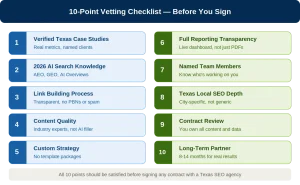
1. Demand Verifiable Texas Case Studies — Not Just Testimonials
A five-star review can be gathered by any agency. The first thing that you should have is documentation: the precise results of specific clients of Texas markets, with real metrics: the increase in organic traffic over a period of time, and preferably, the lead or revenue impact.
What good looks like: Named clients (or detailed anonymous case studies), specific keyword improvements, percentage increase in traffic by time periods, and results in Texas industries and cities you can relate to.
Red flag: We have helped hundreds of businesses, but with no specifics at all, an impressionist portfolio or testimonials that merely state the agency was great to work with but no results data.
Ask them: Can you tell me a Texas client case study within the past 12 months including keywords they targeted, where they started and where they are now.
2. Expert Their 2026 SEO Knowledge -AI Search in particular.
And this one question will instantly separate current agencies from outdated ones: “How are you maximizing content to appear in Google AI Overviews?”
An effective Texas SEO company in 2026 would be diligent in the inclusion of an AI Overview as opposed to just traditional blue-link rankings. They must be in a position to discuss their approach to structured data, development of E-E-A-T, optimizing FAQs, and depth of content without hesitation.
What good should look like: Be clear, confident answers regarding AEO strategies, schema markup implementation, answer-oriented content formats, and experience monitoring AI Overview appearances on behalf of clients.
Red flag: Confusion, dismissal (“AI search isn’t that important yet”), or a generic answer about how to keep up with the changes to the algorithms.
3. Confirm their link-building procedure step-by-step
The worst practice in SEO is link building, and where the worst agencies get caught. PBNs, paid link farms, and mass directory submissions continue to be rampant. They have the ability to create Google manual punishment that destroys local Texas companies in competitive industries.
What good looks like: Digital PR outreach to Texas-relevant publications, guest posting on topically relevant sites with real traffic, local citations of the business in legitimate business directories, resource page link building, and reclaiming unlinked brand mentions.
Red flag: Promises of “50–100 links in 30 days,” inability or unwillingness to name their link sources, or unusually low pricing that can only be explained by cutting corners on quality
Ask them: (a) Can you tell me the names of websites you have recently placed links on behalf of Texas clients? (b) How did you get them?
4. Evaluate Their Content Quality and Production Process
Google’s Helpful Content system, one of the key elements of the ranking algorithm since 2023, in particular, eliminates thin, generic content, which does not add real value. In 2026, the content on the website that transfers no expertise to the reader is AI-generated content, which is a liability, rather than an asset, of the rankings.
What good looks like: Writers who have industry-specific knowledge (not just SEO knowledge), an editorial process that involves research and expert review, content that builds around the actual search intent, and examples of their content that are currently ranking.
Red flag: Agencies who promise 10 or more blog posts per month at very low prices, sample content that reads as an apparent AI-generated text, or writers who seem to have no clue about your particular industry.
Ask them: Who is the content author, in-house specialist, or freelancer? Can I see examples of your content that you have created in my industry that have been ranked currently?
5. Demand a Custom Strategy – Do Not Accept Template Pitches
One of the biggest red flags in Texas SEO sales is an agency that offers a standard package in the first 15 minutes of a call – before asking a single meaningful question about your business.
Any legitimate SEO plan begins with an actual audit: what you have now, what your competitive landscape in Texas is like, what your keyword gap analysis will look like, what your geographic targeting needs will look like, and what your specific revenue goals will look like. If an agency gives you a price before they’ve done any of this work, they’re selling you a template.
What good looks like: A discovery process whereby the agency inquires about your goals, current traffic, top Texas competitors, target audience, and geographic scope before they ever mention pricing.
Red flag: Instant package deals, prices that are offered without any reference to your business or market.
6. Demand Full Reporting Transparency – With Live Dashboard Access
In 2026, acceptable SEO reporting will not be a once-a-month PDF with a keyword ranking table. Full transparency entails a live dashboard that can be accessed without the need to ask an employee, clear explanations of what work was done and why, and honest conversations when something is not working.
What good will look like: GA4 and Google Search Console integration in a reporting dashboard available to clients, monthly strategy meetings where results will be explained in plain English, and proactive communication: not radio silence when your campaign is impacted by algorithm updates.
Red flag: Reporting systems that are proprietary and are not accessible to you in standalone mode, agencies that only report on positive metrics and hide problems, or month-end reports that do not simply and clearly relate activity to outcome.
7. Clarify Who Is Working on Your Account
The individual who sells you the SEO contract is often not the same individual who does the work. Whoever signs should ask the name and position of all the members of the team who will touch your campaign, and ask how many clients each has at the same time.
The account manager with 30+ clients is unable to devote your Texas business the needed attention. It can be done by a senior strategist overseeing 812 targeted accounts.
What good should be like: Named team members, assigned roles (technical SEO, content, link building, account management), low client-to-manager ratios, and explicit escalation paths in case of problems.
Red flag: Imprecise promises that a team will do everything, inability to name a senior person who will work on your account, heavy dependence on offshore execution teams with no senior supervision.
8. Assess Local SEO Depth Specific to Texas Geography
The geographic size of Texas presents local search engine optimization issues exaggerated to a staggering degree by most out-of-state agencies. A business ranking in Austin is not a ranking in Houston. The multi-city campaigns in Texas should be carefully designed of which are separate geo-targeted landing pages, localized citation profiles, and city-specific content.
What good looks like: Proven experience working on multi-city Texas campaigns, clear vision on how to optimize Google Business Profile, experience with local directories and citation sources specific to the city of Texas, and an understanding of the proximity signals and Local Pack ranking factors.
Red flag: Agencies who treat Texas SEO as one campaign, or those who are out-of-state agencies with no documented results of using Texas SEO in the past, who treat your market as something they specialize in.
9. Review every line of the contract
Texas SEO contracts have pitfalls that even a business owner who has been in business long enough does not see. When you are about to sign anything, check out the following:
| Contract Element | What to Require | What to Reject |
| Contract Length | 6-month initial term | 12+ months with no performance benchmarks |
| Content Ownership | You own 100% of all content | Any agency’s retention of content rights |
| Data Access | Full, independent dashboard access | Proprietary systems, you can’t log into |
| Exit Terms | 30-day written notice | Penalty-based exit clauses |
| Deliverables | Specific, itemized monthly work | Vague “ongoing optimization” language |
| Ranking Guarantees | Honest projections with clear caveats | Any guarantee of specific ranking positions |
One important thing: ensure that you have all the content, backlinks, and on-site work in case you cancel. There are agencies that are using client domains in their own link schemes, that is to say that your rankings are constructed on their infrastructure, rather than on yours.
10. Select a Long-term partner, not a vendor
The competitive markets in SEO in Texas require 8-14 months of consistent and quality work to achieve meaningful results. That schedule implies that you are getting into a legitimate partnership. Such aspects as cultural fit, style of communication, and shared values are more important than most business owners would think at the stage of proposal.
What good looks like: An agency that calculates success in business performance (leads, calls, revenue) – not just in keyword positioning, which proactively communicates, and which is proactive when you seek tactics that would amount to damaging your long-term rankings.
Red flag: Agencies that never discuss revenue impact, talk about rankings regularly, or run silent between monthly report submissions.
SEO Pricing in Texas: Expectations in 2026
The SEO industry does not have transparency in pricing. Herein lies the candid dissection of what businesses in Texas are to invest in, as understanding SEO pricing in Texas can help companies know what they will receive on each tier:
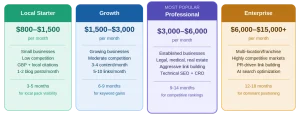
Noticeable point: Anything less than $800/month in a competitive Texas market should be an issue of serious concern as to what corners are being cut. Real SEO costs money since real time is required to build real expertise, real content, and real link building.
Red Flags: Red Flags to Be Wary of in all Texas SEOs Pitches
- Guaranteed #1 rankings – Nobody can control the algorithm of Google. Any promise of a certain job is a deceit.
- Results within 30-60 days – Organic SEO can take months to be legitimate. Anyone who promises otherwise is either promising useless keywords or he is employing dangerous tactics.
- Refusing to explain their process – A legitimate agency is able to explain how they build links, create content, and optimize your site. Bad practice is safeguarded by secrecy.
- Suspiciously low pricing – $200–$400/month “full SEO service” packages almost universally involve automated link spam, AI-generated thin content, or no real work at all.
- No Texas-specific experience – Generic national agencies with no documented market results in Texas can not compete with agencies that know that Houston is not Dallas, which is not Austin.
- High client churn – Inquire about average client retention. Agencies that have clients who drop out within 3-4 months are saying something significant: results are not forthcoming.
- Owning your assets – Any provision that implies that the agency will retain rights to the content, data, or link profile of your site after cancellation is unacceptable.
Special Considerations for Texas Businesses in 2026
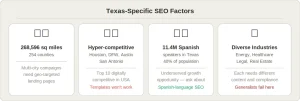
Geographic size and fragmentation: Texas covers 268,596 square miles, which consists of 254 counties. Multi-city SEO campaigns are much more complicated in this state than in most states. Your agency should have experience in handling geo-targeted strategies within Houston, DFW, Austin, San Antonio, etc., all at the same time, not just a single city at a time.
Hyper-competitive metros: Houston and Dallas-Fort Worth have always been ranked among the 10 most digitally competitive markets in the United States. There is also an unprecedented level of competition in the keywords in these cities in industries such as personal injury law, real estate, healthcare, HVAC, and financial services. Premade SEO bundles will not fare well in this.
Spanish-language opportunity: Since about 11.4 million Spanish-speaking residents of the state, which is almost 40% of the total Texas population, the opportunity is a significant, yet often underserved, growth channel. When your business caters to Hispanic communities, inquire of all the agencies you consider whether it has Spanish-language SEO capabilities.
Diversity within the industry: The economy of Texas is diversified with energy, healthcare, technology, agriculture, real estate, legal, and manufacturing. Every industry has varied SEO needs, content quality, compliance factors, and competition. The generalist agencies frequently prove to be an inappropriate choice when it comes to specialized Texas industries.
Conclusion: The Right Partner Makes All the Difference
The Texas online market rewards companies that invest in SEO the right way with the right strategy, the right team, and enough time to allow it to compound. Not all the winning businesses have the largest budgets. They’re the ones who chose their SEO partner carefully.
The following is your last checklist before you place the call:
- Verified Texas case studies with real metrics
- Confident, specific answers about 2026 AI search and E-E-A-T
- Transparent link-building process that you can verify
- Custom strategy — never a template
- Live reporting dashboard you can access independently
- Named team members with defined roles
- Contract terms that protect your assets
- Pricing aligned with your market’s actual competition level
At Webxtalk, we’ve built our entire approach around these standards. We serve Texas businesses, from first-time buyers of SEO services to companies that have already been harmed by agencies that have failed to deliver what they promise.
Ready to see what a real Texas SEO partnership looks like? Connect with Webxtalk and let’s start with a free strategy audit of your current online presence.
For a deeper foundation, read our complete Texas SEO guide before making your final decision.
Frequently Asked Questions
Q: How long does SEO take in Texas?
Most businesses see SEO growth in 3–6 months, while competitive Texas industries can take 10–14 months for strong results.
Q: How much should a Texas business spend on SEO?
A realistic SEO budget in Texas starts around $1,200–$2,500/month, depending on competition and goals.
Q: Should I hire a local Texas SEO company?
A local Texas SEO agency understands regional markets and search behavior, but proven results matter most.
Q: What’s the difference between local SEO and organic SEO?
Local SEO improves Google Maps visibility, while organic SEO helps rank in normal search results.
Q: How do I know if my SEO agency is performing well?
A good SEO agency increases leads, traffic, and rankings while providing clear monthly reporting.
Q: What makes webxtalk different from other Texas SEO agencies?
Webxtalk focuses on revenue-driven SEO with transparent reporting and Texas-focused strategies.




 Yes, I Want Growth