
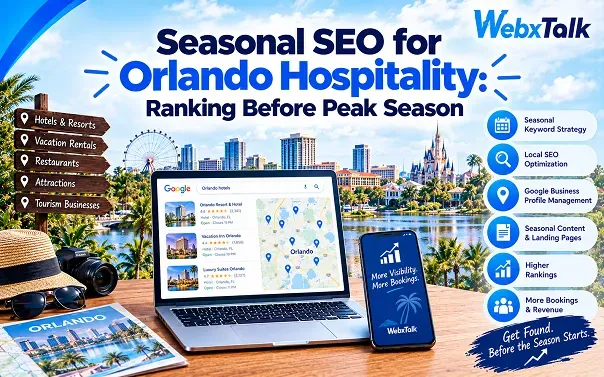
Seasonal SEO for Orlando Hospitality: Ranking Before Peak Season
Orlando welcomed 76.7 million visitors in 2025, up 1.8% from 2024, making it the biggest tourism year in the destination’s history. It also remains the most visited destination in the U.S. Of those visitors, 70.3 million were domestic travelers, with 49.2 million staying overnight. Orlando International Airport saw 57.7 million passengers during the year, showing just how strong the demand for the city continues to be.
But for businesses in Orlando, the bigger question is when that demand arrives. Tourism peaks usually follow the U.S. school calendar, not the weather, so summer, spring break, and the winter holidays bring some of the busiest periods. The quieter shoulder months are often when businesses start creating content, but that can mean they are already preparing too late. Getting hospitality SEO Orlando timing right can help businesses prepare before demand rises rather than trying to catch up once the season is already underway. It is an important factor to consider before choosing the best SEO services in Orlando.
Key takeaways
- Orlando recorded 76.7 million visitors in 2025, a record and the highest of any US destination
- Domestic visitation reached 70.3 million, up 2.2%, while international fell 2.4% to 6.3 million
- Canada remained the top international market but declined 13.3% to roughly 1.1 million visitors
- The visitor mix is approximately 81% domestic leisure, 10% domestic business, and 8% international
- Orlando’s demand follows the US school calendar, not the weather, which inverts the curve against coastal Florida markets
- New content needs three to four months to rank, so summer content is written in February
- Orlando has more than 130,000 hotel rooms and 480 hotels, the largest inventory in Florida
Why does Orlando’s season run opposite to coastal Florida?
As families plan their trips during spring, summer, and winter so the Orlando’s business travel periods are tied to school breaks rather than weather. That’s why the Orlando season content is planned around these busy times, which gives businesses a chance to reach visitors.
The school calendar sets the curve
Around 81% of Orlando’s visitors are domestic leisure travellers, with families and multi-generational groups making up a large share. Most of these travellers plan their trips around school holidays and breaks.
That means the busiest periods usually fall between June and August, during spring break in March and April, and around the late December holidays. School calendar demand is one of the most useful planning signals for businesses, especially because these dates are known well in advance.
Weather is a secondary factor, not a driver
Orlando summers are hot, humid, and storm-prone, which would suppress demand in a weather-driven market. It does not, because the constraint is school schedules rather than comfort. School calendar demand also helps explain why these seasonal patterns remain relatively predictable even when weather conditions vary. Businesses applying coastal Florida seasonal logic to Orlando get the calendar inverted, which is a full six months of misplaced effort.
Convention demand fills different gaps
Domestic business travel makes up roughly 10% of visitors, while the Orange County Convention Center hosted 187 events with more than 2 million attendees in 2025. These events can bring a steady flow of visitors during periods that may not match the usual leisure travel peaks.
For hotels and restaurants near the convention area, this creates another pattern to plan around. School calendar demand and convention schedules can bring customers at different times, giving businesses two separate demand cycles to consider.
When exactly should Orlando hospitality content be published?
Work backwards three to four months from each peak. Summer content is written in February. Spring break content is written in November or December. Holiday content is written in August or September. Orlando seasonal content published during a peak ranks for the following year, not the current one.
The three-to-four-month rule
New content needs that long to accumulate the engagement signals and authority that determine ranking. There is no way to compress it when competing against established pages.
Orlando seasonal content published in June for the summer peak arrives too late to influence that summer. It becomes next year’s asset, which is fine if intended and wasteful if not.
Booking windows sit further ahead than visit
Families planning an Orlando trip research months before arrival, comparing parks, hotels, ticket options, and dates. Research for a summer trip often begins in January or February.
That means Orlando seasonal content should be ranking not just before the visit but before the research phase, which pulls the deadline earlier still.
Update one URL rather than republishing annually
Creating new pages and new URLs every year can be a frustrating task; instead of doing this, just update the page content like prices, timings, dates, venues, and events that will make your content easier to find. Plus, a constant hospitality seo orlando approach can keep that seasonal page useful and competitive year after year.
What Do Orlando Visitors Actually Search For?
People do not wait until they arrive in Orlando to start figuring things out. Most have already begun planning their trip and are looking for practical answers along the way. They want to know how long to stay, which attractions to visit, what the crowds are like, and what is nearby. That is where hospitality SEO Orlando can be useful. The content should answer real trip-planning questions instead of filling pages with general travel information.
Planning and Itinerary Questions
Trip planning brings up very specific questions. Visitors want to know how many days they need for Magic Kingdom, whether Universal is worth adding, and how a three-day trip compares with a week-long stay. Families may also want help planning around young children or a busy convention week. Attractions rarely give completely neutral advice, so useful Orlando hotel marketing content can fill that gap and become something travelers come back to.
Cost and Value Questions
Travelers want to know what the trip will really cost. That can include tickets, hotels, meals, parking, transportation, and those smaller expenses that are easy to overlook. Orlando hotel marketing can help by giving clear price information instead of only promoting packages or special offers. Honest answers are easier to trust, especially when most search results feel like advertisements.
Logistics and Location Questions
Once the attractions are chosen, the practical details become important. How far is the hotel from a specific park? Is a rental car necessary? Does the shuttle actually help? How different are International Drive, Lake Buena Vista, and Kissimmee? These are the questions visitors use to make their final plans. For Vacation rental SEO in Orlando, this is especially useful because rental guests often need more help with transportation, parking, and getting around.
Rain Day and Rest Day Content
Orlando weather can change quickly, especially during the summer. A sunny morning can turn into a heavy afternoon storm, leaving visitors looking for something else to do. Helpful content covering indoor attractions, nearby activities, or easy rest-day plans can meet that need at exactly the right time.
Which Orlando hospitality queries are winnable?
Practical, specific, and locally framed queries. Attraction brand terms belong to the parks, and generic accommodation terms belong to the booking platforms. What remains open is planning content, neighbourhood comparison, property-specific detail, and anything a visitor asks after arriving. This is where hospitality seo orlando can focus on useful, locally relevant searches instead of competing for broad accommodation terms.
Concede the brand & booking queries
Theme park names are navigational searches by people who already chose the destination. Generic hotel searches are held by online travel agencies with inventory scale; no individual property matches.
Neighbourhood & corridor comparison
International Drive, Lake Buena Vista, Kissimmee, Celebration, and the convention corridor are all very different experiences that are very affordable. Visitors look to explore the difference, and only discover listings. These comparisons can be made more useful with Orlando hotel marketing to help explain what each of these areas is like to different kinds of visitors.
No platform can create a clear comparison written by one who is familiar with the corridors.
Property-specific substance
Guests want to know what a location is like before they book their stay. Introduce rooms, describe how long it takes to reach nearby parks and mention what makes the property different from a big chain of hotels. Vacation rental SEO Orlando can also be concerned with these practical details and respond to the questions guests may have prior to they make their selection.
This type of information can be particularly beneficial to those who are already in the process of comparing properties or those who want a specific kind of accommodation. If they discover clear and candid information about the experience, they are more inclined to be sure about the direct booking.
Does the international decline change the strategy?
It shifts emphasis rather than reversing it. International visitation fell 2.4% to 6.3 million in 2025, with Canada, the top international market, down 13.3% to roughly 1.1 million. Domestic visitation grew 2.2% to a record 70.3 million, and Florida resident visits rose 3.4%.
Domestic and in-state demand is growing
With international softness concentrated in Canada, the growth is coming from US domestic travellers and from Floridians. Visits by Florida residents increased 3.4%.
That argues for more content aimed at regional and in-state visitors, including day trips, weekend breaks and locals’ passes, which most Orlando businesses overlook. A more focused hospitality seo orlando strategy can address these searches without relying only on destination visitors.
Canadian recovery is expected but not immediate
Tourism leaders have indicated they expect momentum in 2026, with fuller recovery anticipated in 2027. Businesses serving Canadian visitors should maintain rather than abandon that content, since the audience is returning rather than gone.
International content still earns its place
At roughly 8% of arrivals, international visitors remain a meaningful segment with higher spend per trip and longer stays. Content addressing visa questions, travel distances, currency, and what to expect from a US theme park visit serves an audience that publishes almost nowhere else. For businesses targeting these visitors, hospitality seo orlando can help make that information easier to find before the trip.
Conclusion
Orlando’s tourism changes with the school calendar, with summer, spring break, and winter holidays bringing in the most visitors. People also start planning these trips months ahead, so businesses need to prepare their content early. Summer topics should be ready by February, spring break content by November, and holiday content by August. This gives the content time to reach travelers while they are making their plans.
There is also plenty of room to attract visitors without competing directly with major theme parks or large booking sites. Helpful topics such as trip costs, area comparisons, hotel details, and rainy-day activities can bring in people who are still deciding what to do. With more US visitors expected to matter in 2026, businesses can focus on reaching domestic and nearby travelers. Webxtalk’s Orlando SEO services help hospitality businesses plan their content around these travel periods and connect with visitors at the right time.
Frequently asked questions
When is Orlando’s actual peak season?
The peak season is in summer, from June to August, and spring break, which starts in March and ends in April, and also the late December holiday period. Orlando’s demand follows the American school calendar rather than the weather, which inverts its curve compared with coastal Florida markets that peak in winter.
When should Orlando hospitality content be published?
The best time to publish the content is 3 to 4 months before the peak season. Like writing the content for summer in February, December for the spring, and for the winter holiday in August. As it takes time for the message to reach the audience.
How many visitors does Orlando actually get?
Orlando welcomed a record 76.7 million visitors in 2025, up 1.8% over 2024, making it the most visited destination in the United States. Domestic visitation reached a record 70.3 million while international fell 2.4% to 6.3 million.
Can a small Orlando hotel outrank the booking platforms?
Not for generic accommodation queries, where platforms hold inventory scale and domain authority. Independent properties win on property-specific content, corridor comparisons and planning material that platforms do not publish, which also converts to higher-margin direct bookings.
What do Orlando visitors search for most?
Practical planning questions: how many days to allow, which weeks are least crowded, what a trip realistically costs, where to stay for a specific park, whether a car is needed, and what to do on a rain day. Attractions have little incentive to answer these honestly.
Has the Canadian visitor decline changed Orlando’s market?
It shifted emphasis. Canada remained the top international market but fell 13.3% to roughly 1.1 million in 2025, while domestic visitation grew 2.2% to a record and Florida resident visits rose 3.4%. Tourism leaders expect fuller recovery by 2027.
Should I publish a new seasonal guide every year?
No. Publishing annually splits demand across multiple weak URLs. Keep one guide on a stable URL, refresh it before each season with current pricing, hours, and event dates, and update the visible publication date.



 Yes, I Want Growth