
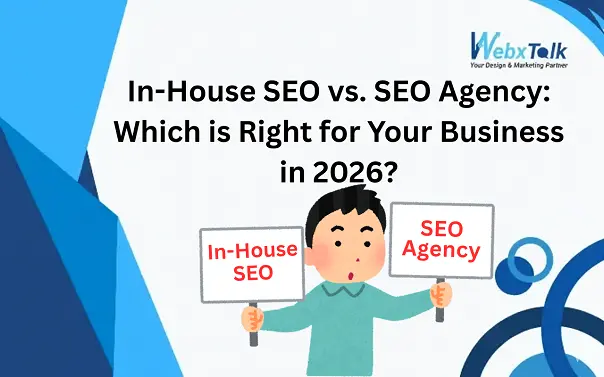
In-House SEO vs. SEO Agency: Which is Right for Your Business in 2026?
In today’s digital-first world, having an online presence is essential. Search Engine Optimisation (SEO) plays an important role in ensuring your website is visible to your targeted customers, brings traffic, and converts your visitors into regular customers.
However, a key issue that businesses may face is whether to handle in-house SEO or hire a professional SEO agency. Each of the two options has its advantages and disadvantages, and choosing the right approach can have a significant impact on your marketing performance.
In this blog, we will address the issue of in-house SEO and SEO agencies, their pros and cons, and the most important aspects that must be taken into consideration so that you can make the correct decision regarding your business.
Understanding In-House SEO
In-house SEO or internal SEO means handling all the SEO-related assignments in your firm, where an internal team is involved to do the job. Such a team can consist of SEO experts, content creators, web developers, and digital marketing professionals who are dedicated to the company’s site and the online strategy.
Critical Tasks of the In-House SEO Team
On-Page SEO
On-page SEO includes content optimisation, meta tags, internal linking, and keyword research, all of which are handled by the internal SEO team to ensure that all pages of your website are search engine-friendly.
Technical SEO
Technical SEO involves optimising site speed, mobile responsiveness, structured data, crawlability, and fixing issues that may affect the search performance of your website.
Off-Page SEO
Off-page SEO involves link-building tactics and outreach initiatives, which are carried out by the internal team to establish authority within your industry.
Monitoring and Reporting
Regular monitoring of site performance, keyword rankings, traffic, and user behaviour will help the team correct their strategies.
Advantages
Full Control
You have complete authority over your SEO plan and implementation, so it fits your business objectives.
Better Communication
A company team can make decisions quickly, implement changes immediately, and more effectively organise activities among departments.
Deep Knowledge of Your Brand
Internal staff understand your organisational culture, products, services, and target market and can therefore execute more customised SEO tactics.
Challenges
Higher Costs
Recruiting seasoned SEO experts requires investment in salaries, training, and tools, which is unaffordable for small businesses.
Skill Limitations
The internal teams may not be well-versed in every aspect of SEO, including technical optimisation, link building, or sophisticated analytics.
Resource-Intensive
SEO is a time-consuming strategy, and an internal SEO team might not be able to balance daily maintenance operations and long-term strategic planning.
Understanding SEO Agencies
SEO agencies are third-party experts that provide businesses with SEO services. Such agencies usually possess a team of specialists who are both professionals in various industries and have access to sophisticated tools and technologies.

SEO Agencies provide many services
SEO Audits
Agencies provide in-depth SEO audits of your website, such as technical, on-page, and off-page analysis.
Technical, On-Page, and Off-Page SEO
The agencies take care of content optimisation, the creation of backlinks, and improvements to the site structure to increase overall performance.
Creation and Strategy of Content
Many agencies offer content marketing opportunities like writing blog posts, copywriting, and video content to gain better rankings on search pages.
Analytics and Reporting
The agencies track performance indicators, give insights, and take corrective actions based on data-driven recommendations.
Benefits of Outsourcing an SEO Company
Access to Expertise
SEO agencies have experts in various fields of SEO, enabling them to provide a holistic approach.
Cost-Effective
Outsourcing SEO for small and medium-sized businesses may be cheaper compared to constructing and sustaining a full Internal SEO team.
Staying Updated with Trends
SEO companies are in touch with changes in Google’s algorithms, the industry, and best practices.
Difficulties Include:
Less Control
Day-to-day SEO actions and strategy implementation may be less under the control of businesses.
Potential Misalignment
Agencies might not completely understand your brand, vision, and internal processes, which might interfere with campaign results.
Dependence on External Schedules
Agencies can have many clients, so communication and implementation schedules may differ.
Key Differences Between In-House SEO and SEO Agencies
| Factor | In-House SEO | SEO Agency |
| Cost | Higher upfront cost (salaries, tools, training) | Monthly retainers or project-based pricing are often cheaper for small businesses |
| Expertise | Limited to the internal team’s skills | Access to diverse experts across multiple SEO domains |
| Control | Full control over strategy and execution | Moderate control; strategy is collaborative |
| Scalability | Requires hiring additional staff | Can scale services based on business needs |
| Speed | Immediate implementation possible | Dependent on agency schedules |
| Tools & Technology | May need separate investment | Agencies often include advanced SEO tools in service |
Issues to Consider When Deciding Between In-House SEO and an SEO Agency
The in-house vs. SEO agency dilemma is not about which one is superior in all cases, but about what is more appropriate for your business.
Company Size and Budget
A dedicated internal SEO team can work to the advantage of larger organisations with larger budgets, whereas an agency can be more viable for a smaller business.
SEO Goals
Identify whether your objectives are short-term (e.g., getting more traffic in a short time) or long-term (e.g., maintaining organic visibility).
Available Expertise
Determine the level of knowledge and experience of your internal team to carry out effective SEO strategies.
Level of Control Desired
Determine the level of control and the mode of operation for SEO activities: whether you want to collaborate or outsource.
Competitiveness
The competitive nature of highly competitive industries sometimes requires specialised skills of an SEO company, whereas niche markets could be easily handled internally.
When In-House SEO Is Ideal
This is ideal when a business believes that the investment it will make in SEO is long-term and it is capable of affording it. It is most effective with firms that have larger budgets, well-established marketing units, and those that are not afraid to take total control of strategy and execution. An internal team collaborates closely with other departments and ensures faster implementation and greater alignment with brand objectives.
This model suits the business especially well when it requires continuous optimisation, content that is regularly updated, and deep knowledge of its products and audience. Long-term internal SEO teams can deliver steady performance and maintain complete ownership of data, processes, and decision-making.
When an SEO Agency Is Ideal
Businesses that seek to hire the services of professionals without creating a team of experts internally should use an SEO agency. Agencies are frequently employed by small- and medium-sized enterprises due to lower initial costs and availability of specialised expertise.
Agencies are well-placed for companies, whether it is to ensure rapid improvements, conduct technical audits, or engage in highly competitive industries. They also assist companies in focusing on core operations while leaving SEO activities to experts. This strategy is flexible, scalable, and meets industry requirements without permanent, full-time employment.
The Hybrid Approach: The Best of Both Approaches
In other firms, a hybrid approach is applied in which management is done internally while the services of agencies are also employed. This allows companies to:
- Balance strategy, control, and agency expertise in technical or specialised work.
- Increase resources and expand freely without hiring additional personnel.
- Ensure round-the-clock supervision and reporting by the internal team while leveraging agency experience.
Content creation and daily monitoring of SEO can be done by an in-house team, with an agency performing technical audits and backlink campaigns.
Conclusion
Choosing in-house SEO vs. an SEO agency depends on the goals of the business, budget, and experience. Internal SEO will be more appropriate in cases where a company requires long-term control and a strong brand fit, whereas the latter is more flexible, specialised, and faster. Many businesses may consider a hybrid solution to be the best option. The correct choice helps achieve sustainable development, greater visibility, and expansion of the digital plan in 2026.
Choosing the right SEO strategy can shape your business success in 2026. Connect with WebxTalk to get expert guidance and a tailored strategy that drives visibility, growth, and ROI in 2026.
 FAQs
FAQs
Would it be more expensive to outsource to an SEO company than to develop an in-house team?
For most businesses, yes. An agency is typically less expensive than the employment, development, and maintenance of a full in-house team.
What role can an SEO agency play in business development and profit?
A search engine optimisation company can help more people discover your business online and convert this visibility into long-term, consistent income.
How different is the cost of in-house SEO versus outsourcing to an agency?
In-house SEO is associated with salaries, benefits, and the cost of tools, whereas an agency usually charges a simple fixed monthly fee.
What is the difference between in-house SEO expertise and agency SEO expertise?
In-house SEO is often handled by a single individual wearing many hats, whereas agencies provide a team of specialists.
What are the associated background costs of in-house SEO?
Software, training, hiring mistakes, and employee turnover can accumulate over the years.
What SEO tools and resources do agencies have that in-house teams usually do not?
Agencies tend to have access to sophisticated tools, industry data, and proven systems that are costly for individual companies to maintain.
What are the key drawbacks of in-house SEO management?
It is slower to scale, more difficult to maintain, and expensive to sustain.




 Yes, I Want Growth