
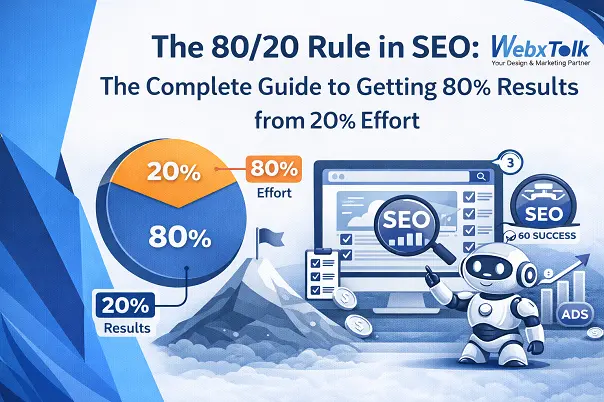
80/20 Rule in SEO: Get Maximum Results with Minimum Effort
The 80/20 rule in SEO (Pareto Principle) explains why a small portion of your efforts—like optimizing a few high-intent keywords, improving top-performing pages, and earning relevant backlinks—can drive the majority of your organic traffic and conversions. In this guide, we break down a practical, data-backed framework to identify your highest-impact SEO actions, optimize existing content using real Search Console insights, and build a focused strategy that delivers measurable results without wasting time on low-value tasks.
When working in the competitive environment of SEO, it’s easy to feel overwhelmed by the multitude of tasks that need to be done. However, it is knowing that not every effort delivers the same results. The 80/20 Rule (Pareto Principle) is the compelling principle, which can guide you to concentrate on the essential few SEO activities, which will give the best out of the least amount of effort.
You can optimize your SEO success by determining which actions out of 100 you do that result in 80% of the success, and, thus, make the whole process of your SEO more effective. Now, let us explore the way in which you can use this rule in different aspects of SEO and increase the performance of your website.
Key Takeaways
- 20% of your SEO efforts generate 80% of your results — focus on high-impact activities instead of doing everything.
- A small number of power pages drive most organic traffic and conversions.
- High-intent “money keywords” produce the majority of revenue — prioritize intent over volume.
- A few authoritative backlinks carry more ranking power than dozens of low-quality links.
- Major technical fixes (site speed, crawlability, Core Web Vitals) impact rankings more than minor tweaks.
- Updating and optimizing existing high-performing content often delivers better ROI than publishing new content.
- SEO success comes from working strategically, not just working harder.
Why Most SEO Efforts Don’t Deliver Results?
Many SEO practitioners tend to think that they are doing things all in the right way, optimizing on-page items, enhancing the speed of the website, and establishing back-links. Not everything you do in SEO will help you, however. It is important to know why some of these efforts do not bear the anticipated returns on investment (ROI).
The Problem with “More Is Better” SEO
SEO can also be viewed as the game about numbers: the more content you have, the more backlinks you can get, or the more technical problems you solve, the better your results will be. But this isn’t always the case. SEO is not about doing everything, it’s about doing the right things. The tendency to work on quantity over quality can result in diminishing returns.
For example, creating hundreds of blog posts that you have optimized poorly or which do not relate to your target audience, could contribute to your number of content but will not make any significant difference in your rankings. It is better to optimize your current high-value pages or concentrate on high-quality content, which would most likely yield better results.
Why Hard Work Does Not Equal Rankings
A lot of individuals assume that they can just make extra efforts on their SEO and they will rank higher. In reality, search engines prioritize quality over effort. It is not only the extent of the number of hours you are working but it’s about whether you are working on the correct keywords, optimizing the correct pages and enhancing the user experience.
For example, solving a minor technical glitch such as an image alt tag might not make a huge difference to your rankings as compared to improving your site load speed or optimizing high traffic pages. The trick is to concentrate on high-impact strategies to achieve better SEO performance.
The Hidden Pattern Behind High-Performing Websites
When analyzing successful websites, you will always see a common trend that a very small percentage of pages, keywords, and backlinks will provide the majority of the traffic as well as conversions on the site. By discovering these high value parts you can also focus on them later during optimizations instead of spending precious time on areas that do not have significant impacts.
As an example, a few posts or product pages can push majority of the traffic and conversions of your site. By optimizing these core pages and repurposing the information within them, you can achieve significant results with minimal effort.
What Is the 80/20 Rule? (Pareto Principle Explained)
The 80/20 Rule or Pareto Principle is a principle which explains that 20% of the causes give 80% of the results. This concept was introduced by Italian economist Vilfredo Pareto in the 19th century, which has been used in many aspects, including SEO. It assists companies and marketers to establish the most effective strategies in order to maximize their returns.
By Applying the 80/20 Rule in SEO, you can concentrate on the few high-value activities, which will contribute the most to the performance of your website.
The Origin of the 80/20 Principle
The 80/20 Rule was initially uncovered by an Italian economist, Vilfredo Pareto who noticed that 80 percent of the land in Italy was controlled by 20 percent of the population. This principle has over time been applied to numerous business and economic cases showing that a little fraction of inputs tends to result in the majority of outputs.
Implementing this concept in SEO allows discovering the 20 percent of pages, keywords, or back links that will give the greatest contribution to the performance of your site.
Why the 80/20 Ratio Is Not Always Exact?
Though the 80/20 ratio is quoted frequently, it’s not a fixed rule. The ratio could be different based on the business or website. You can also see that 70 percent of your traffic has been generated by 30 percent of your pages, or 90 percent of your conversions generated by 10 percent of your keywords. What should be remembered here is the fact that few efforts usually bring most of the outcome, identifying and focusing on those high-impact SEO activities should be your main priority.
Real-World Examples of the 80/20 Rule
The 80/20 Rule can be traced in digital marketing and SEO in various aspects:
- 20% of products generate 80% of sales in e-commerce.
- 20% of your content generates 80% of the traffic.
- 20% of keywords bring in 80% of the organic traffic.
This is because once you understand how the 80/20 Rule would be applied to your website, you would be in a position to focus on the activities that would give you the highest benefits in terms of a return on investment.
What Does the 80/20 Rule Mean in SEO?
When applied to SEO, the 80/20 Rule suggests that 20% of your SEO efforts will yeld 80% of your results. It implies that the effective use of high-value activities, such as optimization of the best-performing pages, high-conversion keywords, and authoritative backlinks, can lead to significant improvements in SEO performance.
The 20 % of Pages has 80 %of Organic Traffic
The organic traffic in most websites is accounted by a few pages. Such pages usually appear on high-volume keywords or high-conversion keywords which bring in high traffic to the site. With this approach you can maximize your traffic to the site by optimizing these high performing pages and not all the pages.
Example of Top-Performing Pages:
| Page Title | Organic Traffic | Conversion Rate |
| Homepage | 50,000 visits | 2% |
| Product Page A | 20,000 visits | 5% |
| Blog Post on Industry Tips | 10,000 visits | 1.5% |
20% of Keywords Drive 80% of Revenue
In SEO, not all keywords carry equal potential. A small percentage of high-intent keywords, also known as “money keywords”, typically drive the most revenue. These are the keywords that reflect strong purchase intent and are more likely to convert visitors into customers. By focusing on these high-conversion keywords, you can increase ROI without having to target every keyword under the sun.
Prioritizing High-Intent Keywords:
| Keyword | Search Volume | Conversion Rate | Estimated Revenue Impact |
| “buy running shoes” | 15,000/month | 5% | High |
| “types of running shoes” | 8,000/month | 2% | Medium |
20% of Backlinks Drive 80% of Authority
Backlinks are a crucial element of SEO, but not all backlinks are equal. A small number of authoritative backlinks from high-ranking domains can significantly boost your domain authority and rankings. It’s not about quantity, but about quality. Focus on acquiring backlinks from authoritative sites within your industry.
Example of High-Authority Backlinks:
| Source Domain | Link Type | Domain Authority |
| nytimes.com | DoFollow | 95 |
| harvard.edu | DoFollow | 91 |
20% of Technical Issues Cause 80% of Ranking Problems
In technical SEO, some issues, such as site speed or crawlability, can have a much bigger impact on rankings than others. By identifying and fixing the major technical bottlenecks first, you can improve rankings without getting bogged down by minor issues.
For example, improving Core Web Vitals and fixing crawl errors will likely have a more significant impact on SEO than fixing minor issues like image alt tags.
Why Traditional SEO Strategies Fail?
Many traditional SEO strategies fail to deliver results because they focus on quantity and minor tasks instead of high-impact efforts that move the needle. Let’s explore why certain strategies fall short.
Busy Work vs High-Impact Work
Any SEO may seem a never-ending list of things to do, including correcting some minor aspects of the technicalities or providing new content. But doing things that are unimportant such as minor adjustments on tags or visiting non-relevant backlinks is time wastage. The actual work should be high-value SEO work, such as improving the first pages or high conversion keywords.
When it comes to SEO, you have to prioritize doing a few things that can actually bring about the desired outcomes instead of being surrounded by the busy work. It is at this point when the 80/20 Rule really comes out because one should focus on the work that produces the greatest return on investment (ROI).
Publishing More Instead of Improving What Works
In many cases, publishing more content is the go-to strategy for improving SEO. However, the real value comes from optimization and enhancement of the existing content rather than endlessly writing and publishing new blog posts. Content updates on high-traffic pages are much more efficient than posting many low value posts which do not correspond to users intentions or business interests.
A more effective plan is to review what you have now, revise information that is old, and create value to the high-performing pages.
Chasing Traffic Instead of Conversions
Traffic is significant, yet the most important one is conversions. The desire to get traffic is one of the pitfalls. Traffic is not equally created. Inferential traffic (e.g. blog posts about general subjects) does not usually convert well as compared to transactional traffic (e.g. visitors to the site searching: buy [product] or hire [service]) as an example.
Targeting the high intent keywords, as well as optimizing pages that match the intent of the buyer is a better tactic than chasing the general traffic.
Fixating on Minor Technical Fixes
It is easy to lose track in fixing the smallest technical problem like changing small meta descriptions or inserting alt text to images. Nevertheless, minor adjustments regularly do not cause any significant difference in rankings as compared to more significant technical challenges, such as site speed optimization or crawlability problems. Rather than doing little, low-impact fixes, first fix the high-impact technical problems to enhance the general performance.
Applying the 80/20 Rule to Keyword Research
SEO is all about the keyword research, but success depends on targeting the right keywords—not just more keywords. The 80/20 Rule is applicable in this case because it allows you to concentrate on the keywords that give the most results.
Understanding Search Intent
Search intent can be defined as what users are trying to accomplish when they search something online. Transactional keywords (e.g., buyer running shoes online) have high chances of conversion as opposed to information keywords (e.g., types of running shoes).
By focusing on high-conversion, high-intent keywords, you can attract visitors who are actively looking to make a purchase or engage with your services.
Finding High-Intent “Money” Keywords
“Money keywords” are those keywords that indicate a high level of user intent to buy or commit another revenue-generation action. These keywords are normally the ones that have high conversion rates and your keyword strategy should be targeted to these keywords.
With the help of such tools like Google Keyword Planner, Ahrefs, or SEMrush, it is possible to define high-value keywords that will most probably attract paying customers.
Example of High-Intent Keywords:
| Keyword | Search Volume | Conversion Rate | Estimated Revenue Impact |
| “buy running shoes” | 12,000/month | 5% | High |
| “purchase running shoes” | 8,000/month | 3% | Medium |
Keyword Prioritization Framework
The key to successful keyword research is prioritizing keywords that will bring the most value. Use a framework to assess keywords based on search volume, conversion potential, and ranking difficulty.
| Metric | Why It Matters |
| Search Volume | More volume means more potential traffic |
| Search Intent | Transactional intent leads to higher conversions |
| Ranking Difficulty | Harder keywords take longer to rank but are more competitive |
| Revenue Impact | Focus on keywords that align with your revenue goals |
Applying the 80/20 Rule to Content Strategy
A good content strategy is more than just writing blogs. It is all about building high value contents that will generate traffic and conversions. The 80/20 Rule is also applicable to content as it allows focusing on the most effective pages.
What Are Power Pages?
Power pages are high performing, high-quality content that generates high-traffic and conversions is called power pages. These may be product pages, cornerstone blog pages or landing pages. Optimization of such pages will enable you to increase your rankings and attract more targeted visitors.
For example, one of your high performing pages may be your product page that is focused on the purchase of running shoes. Make it as relevant to the relevant keywords, enhance user experience, and include trust indicators to maximize the rate of conversion.
How to Identify Top-Performing Content?
You can also use the Google analytics and SEMrush statistics of your site to determine the pages that drive most traffic and conversions. Once identified, focus your SEO efforts towards these pages by further refining them, adding, improving internal links and ensuring that they align with user intent.
Revising vs Creating New Content
It is usually more efficient to revise old content instead of making new content. It can be quite easy to rank higher by refreshing and improving high-traffic pages than creating new ones. Look for pages that are already performing well but may be outdated, and give them a refresh with updated information, new images, or enhanced keyword targeting.
Content Consolidation Strategy
When you have a few or several similar blog posts or pages, it is usually good to combine them into a single information source. Not only does this minimize the cases of duplication of the content but also assists in increasing the ranking possibilities of your consolidated page.
Applying the 80/20 Rule to Link Building
Link Building is an important part of the SEO process and not every backlinks are equal. The 80/20 Rule is applicable here by recommending that you should concentrate your efforts on the process of getting high quality backlinks that will mostly affect your rankings.
Quality Over Quantity
Good reputation links that are of high quality (e.g. industry leaders, universities or other high quality publications) can give more SEO value compared to dozens of low quality links on irrelevant sites. It does not matter how many links you have but where you get them.
Identifying High-Authority Backlinks
Use tools like Ahrefs, SEMrush, and Moz to identify websites in your industry that have high domain authority. These sites are likely to provide the best link-building opportunities.
Building Links to Revenue Pages
Instead of creating backlinks on all the pages, create links to income generating pages like product or service pages. It is more probable that these pages turn visitors into customers.
Applying the 80/20 Rule to Conversion Optimization
Most of the SEO strategies tend to ignore conversion optimization yet it is very critical in increasing ROI. Using the 80/20 Rule in conversion rate optimization (CRO), you can be able to make sure that the pages with the highest amount of traffic are also highly converting.
Giving a Clear Goal to Each Page
Each page in your site must have a purpose, be it to make purchases, get email sign-ups or to motivate the user to do something specific. You can determine which specific pages to optimize in terms of conversion by setting specific objectives of each page (particularly pages with heavy traffic). You will be maximizing traffic without considering user journey without having clear goals.
We will use the product pages as an example; product pages should have a goal of driving sales, whereas blog posts may be geared towards gaining email sign-ups to read new content.
Optimizing High-Traffic Pages First
Conversion optimization should first focus on the pages that already have high traffic. These pages have already demonstrated user interest, and by enhancing them to improve conversion rates, you can maximize their potential. If your product page receives 10,000 visits per month, even a small increase in conversion rate (e.g., from 2% to 3%) will have a huge impact on revenue.
Example of Conversion Rate Increase:
| Page Title | Current Traffic | Current Conversion Rate | New Conversion Rate | Projected Revenue Increase |
| Product Page A | 10,000 visits | 2% | 3% | $5,000 |
Improving CTAs on Revenue Pages
One of the most significant aspects on any page that should result in conversions is the call to action (CTA). When you do not have clear and compelling CTAs, visitors can leave without performing the required action. On the revenue-generating pages with high traffic (e.g., product pages, service landing pages) you should test various CTA strategies and determine which ones result in the highest conversion rates. Make sure that your CTAs are conspicuous and
Aligning Content with the Buyer Journey
Buyer intent varies at different stages of the customer journey. It’s important to align your content with where the user is in their journey.
For Example, an individual in the awareness stage might not be in a position to make a purchase and hence the informational contents such as blogs as well as guides need to be focused to them. With users at the consideration phase or decision phase, you ought to concentrate on the content which emphasizes on the features, benefits, and testimonials of your services or goods.
How to Find Your Vital 20% (Step-by-Step SEO Audit)

The most important step of 80/20 Rule to your SEO strategy is to perform an SEO audit. The goal is to identify which pages, keywords and technical problems are adding the greatest value to your site’s performance and then focus your efforts on optimizing these key areas.
Step 1: Identify High Traffic Pages
In the beginning, determine the pages that attract the most organic traffic. It can be done by reviewing your site’s Google Analytics or SEMrush data. Once you know the pages that are driving traffic, then you can begin to optimize them to perform better.
Tool for Traffic Analysis:
- Google Analytics
- SEMrush
Step 2: Determine Keywords that Drive Revenue
With the help of such tools as Ahrefs or Google Search Console, identify which keywords are driving the revenue-generating traffic. These keywords are your “money keywords”. After you have identified them, make sure that they have been optimized adequately on your website to achieve maximum in terms of revenue generation.
Tool for Keyword Analysis:
- Ahrefs
- Google Search Console
Step 3: Analyze Conversion Data
Identify the pages that have the best conversion rate and optimize them even more. Determine the pages that have high traffic but low conversion rates and optimize those to improve performance.
Step 4: Fix Significant Technical Bottlenecks
Fix significant technical SEO problems that might be causing your site not to rank highly, like indexing and crawlability problems. You can locate such technical issues with the assistance of such tools as Screaming Frog or Google Search Console.
Technical SEO Audit Tools:
- Screaming Frog
- Google Search Console
Step 5: Improve Internal Linking
Internal linking will distribute authority throughout your site and it also improves crawlability. Ensure that other related pages contain links to your high performing pages. A solid internal linking structure will assist Google to comprehend the content hierarchy of your site.
Step 6: Cutting-off Low-Impact SEO Activities
Lastly, detect and remove useless SEO activities. These may be the minor technical problems that do not make the ranking any different, or working on low-traffic keywords that do not generate revenue.
Using 80/20 Thinking to Build Topical Authority
Topical authority is the process of becoming a guru in your business. The 80/20 Rule will assist you to pay attention to the most significant points of your content strategy so that you could become an authority in your niche.
Developing Core Topic Clusters
The initial move towards establishing topical authority is creating core topic clusters around your prime products or services. Delve on high quality issues that are appealing to your audience and address their needs. Each cluster should have a pillar page that serves as the main content resource, linking to multiple related subtopics.
Supportive Content Around Power Pages
After your core pillar pages have been created, you can create support materials (blog posts, case studies, videos,guides) that go further to offer more depth and context. This reinforces your authority on those subject areas in the eyes of Google and improves the rankings.
Internal Linking Architecture Strategy
Your topic clusters should be reflected in your internal linking strategy. Link supporting content to the pillar page and vice versa. Internal linking structure will boost the search engine performance of your site and will also allow search engines to crawl all your valuable content.
Depth vs Breadth in Content Strategy
Although it might be tempting to discuss as many things as you can, it will be more productive to be deep on several major points instead of making your content too thin. This strategy enables you to be a real expert in those fields which consequently leads to more specific traffic.
How Different Businesses Can Apply the 80/20 Rule?
The 80/20 Rule can be applied to achieve maximum SEO results in the different types of businesses, despite the fact that their strategies may vary.
Local Businesses
In the case of local businesses, the 80/20 Rule would assist in targeting the local keywords and local pages that generate the greatest foot traffic or conversions.
For example, Google My Business optimization can make a big difference in attracting local customers.
Service-Based Businesses
For service-based business, 80/20 Rule can be used on the most profitable services as well as the targeted service pages. Make the pages be optimized for high-converting keywords and make sure your descriptions of the services are clear and persuasive.
E-commerce Stores
In e-commerce, emphasize on the products that make the highest sale. Increase awareness of these products using product page optimization and specific paid campaigns. Also, it is a good idea to enhance the layout of your e-commerce websites.
SaaS & B2B Websites
In the case of SaaS and B2B websites, the 80/20 Rule can be used to target high-value leads and solutions that generate the most business. Demo requests, testimonials and use case studies to foster leads in the funnel.
Common Mistakes When Applying the 80/20 Rule in SEO
The 80/20 Rule is a strong tool, but there are several pitfalls that may destroy your strategy.
Completely Ignoring the Remaining 80%
The fact that 20% of your efforts bring 80% of the results, does not imply that the rest 80 percent does not matter. Even minor tweaking can result in compounding improvements, sometimes.
Assuming the Ratio Is Always Exact
The 80/20 split is an approximation, not a fixed rule. The exact ratio can vary, but the principle remains the same: focus on the most impactful elements of your SEO strategy.
Treating It as a One-Time Strategy
The 80/20 Rule is not a one-time fix. SEO is a continuous process and your 20% of high impact pages or keywords may vary over time as your site expands, search engines change their search algorithms and users change their behaviors.
Focusing Only on Traffic Metrics
Traffic alone will not be a sufficient measure of success in SEO. An evaluation of the success of your SEO efforts should also consider conversion, revenue, and user engagement.
Conclusions: Work Smarter, Not Harder in SEO
The 80/20 Rule reminds us of the need to invest in the few high-impact activities in SEO that will yield the most results, and not divide ourselves thin between the low-payoff tasks. With a basic understanding of what makes your 20 percent, and what areas should be maximized, you can drive significant improvements in your SEO performance with less effort.
Frequently Asked Questions
What is the 80/20 rule in SEO?
The 80/20 Rule of SEO suggests that 20% of your SEO efforts, such as some of your pages, keywords, or backlinks will bring in 80% of your results in the form of traffic and conversions, as well as rankings.
Does the 80/20 rule really work in SEO?
Yes, the 80/20 Rule has always been witnessed in SEO. Concentrating on high-impact pages, keywords, and backlinks will make the SEO strategy more effective and give better returns.
How do I find the 20% of pages that drive results?
Google Analytics and SEMrush can be used to find out the pages on your site that are performing well in terms of traffic and conversions. Enhance these pages to achieve improved performance.
How does the 80/20 rule apply to keyword research?
According to the 80/20 Rule, it is better to concentrate on the high-conversion keywords which generate the greatest traffic and revenue instead of hundreds of less relevant keys.
Can small businesses use the 80/20 rule in SEO?
Absolutely! The 80/20 Rule is an applicable rule in any business. The use of high-value local keywords, optimization of the top-performing pages, and authoritative site backlinks can help small enterprises.




 Yes, I Want Growth